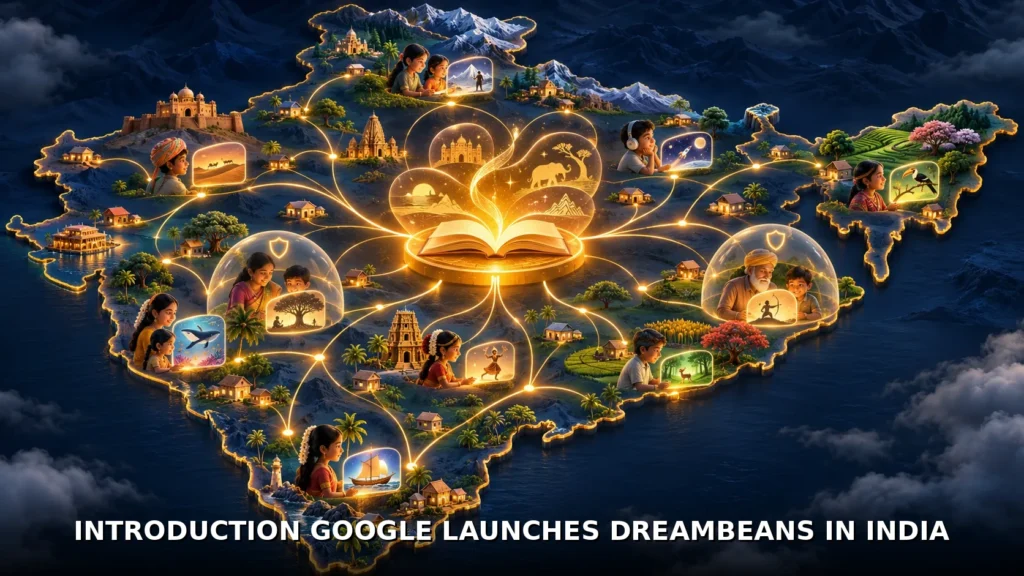


Introduction: Google launches Dreambeans in India
Google has launched its experimental Dreambeans app in India, its first market outside the United States. Available on Android and iOS, the app turns information from connected Google services into personalized illustrated stories, generating them proactively without requiring users to write a prompt. The expansion brings support for 13 local languages alongside English, according to TechCrunch’s reporting.
The central proposition is personal storytelling built around information Google users already accumulate. Dreambeans draws on connected services including Calendar, Gemini, Gmail, Photos, Search, and YouTube to produce stories about users’ interests and everyday lives. That makes its usefulness dependent on both the personal context available to it and users’ willingness to let an experimental app draw on that context.
India gives Google a larger setting in which to test that proposition. But the rollout also exposes two important constraints: supporting several languages does not yet mean generating multilingual stories, and drawing proactively on personal information can surface subjects users would prefer to avoid. Those limits matter as much as the app’s new availability when assessing what this expansion delivers.
Market significance: India’s AI and internet landscape

India is the world’s second-largest internet market, according to the TechCrunch report. Google said it chose the country because Indian users had expressed strong interest in accessing Dreambeans and because its services are widely used there. Product manager Gozde Oznur specifically pointed to the high overlap of users across Gemini, Gmail, and Google Photos during a press briefing.
That overlap is relevant to how Dreambeans works. An app that generates stories from connected services has a different starting point from one that waits for a user to describe a task. Google’s explanation suggests that India offers an audience already using several of the services that can supply personal context. It does not establish how many people will connect those services to Dreambeans or continue reading its stories.
The U.S. download figures provide some context for that uncertainty. Sensor Tower estimates shared with TechCrunch put Dreambeans at nearly 55,000 U.S. downloads since its June debut. About 63% came in September, when Google opened the app to all eligible U.S. users aged 18 and older. Downloads then fell 84% month over month to about 5,500 in October. These are third-party estimates reported by TechCrunch, rather than usage figures published by Google.
Sensor Tower also estimated 29,000 Dreambeans downloads in the first 30 days after that broader U.S. opening. The report compared that figure with 7.4 million for Meta’s Muse, 2.8 million for ChatGPT, 362,000 for Grok Bot, and 155,000 for Claude during their respective first 30 days after launch. The comparison has substantial limits: the Dreambeans window follows an earlier debut, and its storytelling focus differs from the general-purpose AI apps in that group. The figures describe downloads, not sustained use or satisfaction.
The Indian launch therefore expands access to a product whose ability to maintain an audience remains unresolved in the supplied reporting. Market size and existing Google service use explain the opportunity; they do not demonstrate demand for this particular form of personalized content.
Feature rollout: multilingual support and video animation

Dreambeans’ India release supports 13 local languages, including Hindi, Punjabi, Tamil, Telugu, and Bengali, alongside English. Users select a language for their generated stories. The breadth of that support gives the app a way to present personalized content in several widely spoken Indian languages, although it comes with a restriction discussed below: each story experience is limited to one selected language at a time.
The underlying experience combines personal context with generated visuals. Rather than asking users to formulate a request, Dreambeans proactively produces illustrated stories from connected Google services. Its initial format used static AI-generated illustrations. Google has since added a feature using its Veo video-generation model to animate images in select stories, TechCrunch reported.
That qualification matters. The reported feature is animation in some stories; the evidence does not establish that every story becomes a video or that users have a general-purpose video creation interface inside Dreambeans. The supported change is an expansion of the app’s storytelling presentation from exclusively static illustrations to animation in selected cases.
Language support and animation address different parts of the experience. Language determines how a story is communicated, while animation changes its visual presentation. Neither feature, by itself, establishes whether the app has selected a relevant subject or interpreted personal context appropriately. For a proactive storytelling product, the choice of what to surface remains central to the experience, however polished the resulting illustration or animation may be.
Privacy and data controls for users
Dreambeans uses Google’s Personal Intelligence technology to draw on connected services and personalize its stories. Because those services can contain sensitive personal information, the scope of access is a substantive part of the product. Users are being asked to connect personal context to an app whose purpose is to create content about their own lives.
Oznur said users can choose which Google services to connect and disconnect them at any time. They can also delete their Dreambeans data from within the app. She further asserted that information deleted from an underlying connected service is removed from Dreambeans’ personalization system. These are Google’s descriptions of its controls as reported by TechCrunch; the supplied evidence does not independently verify deletion behavior.
The controls operate at different levels. Choosing services determines which sources of information the app can draw on. Disconnecting a service changes that connection. Deleting Dreambeans data addresses data within the app, while the statement about underlying-service deletion describes how a change elsewhere is meant to affect personalization. Keeping these distinctions clear helps users understand the choices Google says it provides without assuming technical guarantees absent from the reporting.
There are also controls over subject matter. Users can tell Dreambeans to avoid certain topics, including business-related information, and Oznur said the app will try to adjust its stories accordingly. That wording leaves a meaningful limitation: the reported behavior is an attempt to adapt, rather than an assurance that an excluded subject can never appear.
Dreambeans is available only to personal Gmail account holders, not enterprise users, according to Oznur. She also said generated stories are visible only to the account holder. Restricted story visibility addresses who sees the output; users still need to decide which personal information they want involved in generating it.
Strategic implications for Google’s AI‑agent ecosystem
Dreambeans illustrates a proactive use of personal AI: selecting material from a user’s connected services and turning it into content without an initial prompt. Its initiative lies in generating personalized stories. The reported functionality should be distinguished from taking actions on the user’s behalf, which Google described as an area it is exploring.
For Google, the India rollout connects several parts of its existing ecosystem. Personal context comes from services such as Gmail and Photos; Google’s Personal Intelligence technology supports personalization; Veo supplies animation for select stories. The strategic significance is the combination of those components in an experience that asks users to consume automatically generated personal content.
Google’s stated reason for choosing India reinforces this interpretation. The overlap among Gemini, Gmail, and Photos users is directly relevant to a product that draws on connected services. Existing use of those services gives Google a potential foundation for personalization, although it leaves user consent, story quality, and continued interest as separate questions.
Oznur told reporters that Google is exploring ways to make Dreambeans more actionable, moving beyond personalized stories and recommendations to help users act on suggestions. The reporting supplies no implementation details or release commitment for that direction. It is a stated area of exploration, not evidence that Dreambeans currently performs those additional actions.
That distinction sets the boundary for evaluating the app as part of an AI-agent ecosystem. Today’s documented proposition is proactive storytelling from personal context. Any assessment of a broader action-taking role must wait for evidence of what Google actually introduces and what controls accompany it.
Challenges: language mixing and user privacy concerns
Dreambeans can draw on information across Google services in multiple languages, but it cannot currently generate stories that mix languages, Oznur said. Users can select only one language at a time for their stories. Input flexibility and output flexibility are therefore different: access to multilingual information does not translate into multilingual storytelling within a single generated experience.
That limitation has particular relevance in India, where people regularly switch between languages, including Hindi and English, and may mix them as Hinglish. TechCrunch identified the restriction as a potential limit on Dreambeans’ appeal. Supporting 13 local languages is a substantial part of the rollout, but the number alone does not capture how closely the output can follow the language patterns of an individual user.
The personal nature of the content creates a second challenge. Oznur acknowledged that Dreambeans could generate stories involving people who have died. A system that initiates stories about a user’s life can therefore bring up memories the person did not choose to revisit. The issue is not simply whether the story is relevant to available account information, but whether it is welcome at that moment.
Oznur said users can tell the app to stop showing particular subjects, comparing the feature with Google Photos controls that let people limit which memories appear. Such controls offer a way to respond to unwanted material. They do not establish that a difficult memory will be avoided before it appears, and the supplied reporting provides no measured assessment of how reliably subject preferences are followed.
Privacy and emotional relevance consequently intersect. A user may be comfortable connecting a service yet uncomfortable with a particular story drawn from it. Service-level choices and subject-level preferences address different decisions. Their practical value will depend on behavior the available evidence does not measure, including how consistently Dreambeans respects requests to avoid a topic.
Conclusion: Future of AI‑driven personal storytelling
Dreambeans’ India launch tests whether proactive personal storytelling can find a broader audience through local-language support and access to an existing network of Google services. Animation through Veo adds another presentation option, while the app’s core proposition remains illustrated stories generated from personal context without a prompt.
The unresolved questions are concrete: whether those stories sustain interest, whether single-language output fits users’ everyday language habits, and whether the reported data and subject controls provide the experience users expect. Google’s exploration of more actionable suggestions could extend the product’s scope, but the current rollout is best assessed on the relevance, discretion, and usefulness of the stories it already generates.