

Introduction to Huang’s views on succession planning
Jensen Huang reportedly told Nvidia employees that the company does not need succession planning because of its distinctive business model, arguing that a plan would introduce unnecessary hierarchy. His position makes the company’s organizational design central to a question it does not, by itself, answer: how would leadership continue through another change at the top?
According to TechCrunch’s November 24 report, the comments came at an all-hands meeting following Huang’s return as chief executive. TechCrunch attributed the account of his succession remarks to CNBC, which cited an unnamed person present at the meeting. That reporting chain matters: this is a reported account of comments to employees, rather than a published succession policy or a direct statement from Nvidia’s board.
The immediate context gives the argument practical weight. TechCrunch reported that Huang had resigned earlier in the month and that chief financial officer Colette Kress served as interim CEO for 12 days. Nvidia had therefore recently experienced a temporary leadership transition. Huang’s return restored him to the top role, but it did not establish how a future transition would work.
His objection is organizational: succession planning, in his account, would impose a hierarchy that does not fit the way Nvidia operates. That is a different proposition from demonstrating that the company can transfer executive authority reliably. The distinction is the central issue in assessing his comments.
The available reporting supports an examination of that tension, rather than a verdict on Nvidia’s readiness. It describes Huang’s reasoning and parts of the company’s management structure, but does not provide a board-approved transition procedure, identify a designated long-term successor, or explain what arrangements might exist privately. Saying that Huang considers a plan unnecessary should not be confused with establishing the full contents of Nvidia’s internal preparations.
Analysis of Nvidia‘s organizational structure
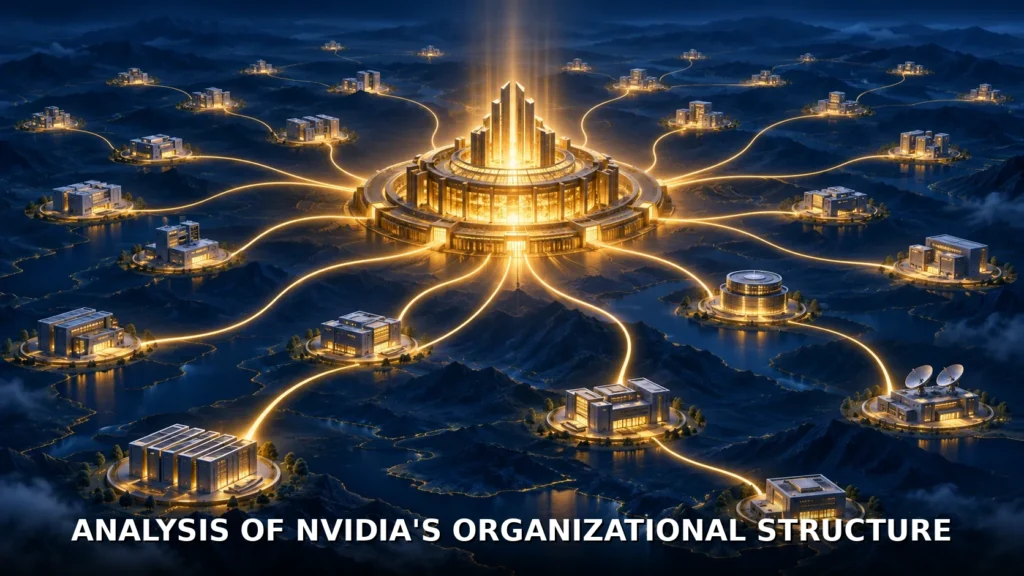
TechCrunch describes Nvidia as a flat organization, with fewer management layers than the large corporations it uses as a comparison. Huang says he has about 60 direct reports. The report also identifies five executive officers, including Huang, citing the company’s regulatory filings.
Alongside Huang and Kress, those officers are Ajay Puri, who leads worldwide field operations; Debora Shoquist, executive vice president of operations; and Timothy Teter, executive vice president and general counsel. This is a description of the executive officer group, not a complete inventory of Nvidia’s managers or a list of succession candidates. None of those titles, on its own, establishes who would become the next permanent CEO.
The direct-report figure and executive officer count describe different aspects of the organization. The former concerns Huang’s stated span of management; the latter concerns the officers identified in the report. Treating the five-person group as the entirety of the leadership available to Nvidia would go beyond the evidence. Equally, treating approximately 60 direct reports as proof that executive authority is broadly transferable would assume something the reporting does not demonstrate.
Huang’s defense of the structure predates the reported staff meeting. TechCrunch points to a March interview with podcaster Lex Fridman in which he argued that a company’s organization should follow the product it is intended to produce. His criticism of similar-looking organizational charts across different industries was part of that argument: the structure should serve the work, rather than follow a standard corporate pattern.
That reasoning helps explain his opposition to adding hierarchy for succession purposes. If management design is supposed to reflect how Nvidia produces its output, a separate layer created around a future CEO could appear inconsistent with that principle. This is an interpretation of his stated position, however, not evidence that any particular succession arrangement would require such a layer.
The organizational facts leave two questions distinct. How does Nvidia want to manage its ongoing work? How would it select and support someone to lead that work after Huang? A flat structure describes the first more clearly than the second. The reporting does not establish that answering the succession question would require abandoning the existing structure.
Implications for leadership continuity

The recent interim appointment is the most concrete continuity example in the report. Kress’s 12 days as interim CEO show that someone other than Huang held the chief executive role during the episode. They do not establish a permanent succession decision, nor do they reveal how an extended transition would be managed.
An interim appointment and a long-term succession arrangement answer related but different questions. Naming an interim chief identifies who holds the role for a period. A lasting transition also raises questions about who receives the permanent appointment and how responsibility moves to that person. The available account establishes the temporary appointment but provides little detail on those further questions.
Huang’s approximately 60 direct reports make this distinction especially relevant to the organizational argument. A broad set of reporting relationships can coexist with a single chief executive at their center. The number therefore does not settle whether leadership is distributed in a way that would make a CEO transition straightforward. The report provides no account of how those relationships would be reassigned or maintained under a successor.
Nor does the evidence establish the opposite conclusion: that Nvidia’s structure would fail without Huang. Such a claim would require information about decision-making, delegation and transition procedures that is absent here. The defensible observation is narrower. Huang’s description of the current organization does not supply a complete explanation of its continuity arrangements.
For a reader assessing the implications, the useful distinction is between preserving a management philosophy and preserving the ability to lead. A successor might be expected to work within the existing structure, or a transition might prompt changes. Neither possibility is documented as Nvidia’s chosen approach. They remain questions raised by the gap between Huang’s public reasoning and the limited operational detail in the account.
The recent transition makes that gap consequential without resolving it. Nvidia had an interim leader and Huang returned. Those reported events show what happened in one episode. They cannot, by themselves, establish the company’s preparedness for a different or longer absence, or demonstrate that formal planning would add the hierarchy Huang opposes.
Reactions from investors and analysts
TechCrunch reports that investors and analysts viewed the succession issue differently when Huang resigned earlier in the month. It also suggests that his comments and previous defenses of the structure might not reassure the board or shareholders over the longer term. Those are the report’s characterizations, and they should be read with their evidentiary limits intact.
The supplied account does not identify individual investors or analysts expressing those concerns. It includes no attributed analyst quotation, shareholder statement or board response on the succession question. It also provides no measure of how widely the concern was shared. A detailed account of investor sentiment would therefore go beyond what this evidence can support.
In particular, the possibility that shareholders may remain unconvinced is not the same as a documented campaign for a succession plan. The suggestion that the board might need more reassurance is likewise not evidence that directors have rejected Huang’s position. The report raises a governance question without establishing an institutional response to it.
Still, the difference in emphasis is clear enough to analyze. Huang’s reported objection concerns the effect of planning on the organization. The concern described by TechCrunch concerns continuity when the chief executive role changes hands. A defense of the current management structure may explain why Huang prefers it while leaving the transition question open. The two positions address different parts of the problem.
A more complete assessment would require evidence that connects those parts: an explanation of how Nvidia would maintain leadership while retaining the structure Huang defends. The report does not supply that explanation. It also does not establish whether investors have received information privately that is absent from the public account.
For now, the reaction supported by the reporting is a disagreement over the importance of succession planning, not a quantified judgment on Nvidia’s management. There is no basis here to attach a share-price effect, forecast a board intervention or claim a consensus among analysts. The evidence supports scrutiny of Huang’s answer; it does not support inventing the market’s next move.
Conclusion on the future of Nvidia’s leadership
Huang’s stance puts a specific question before Nvidia: can the company explain how leadership would continue without introducing the organizational hierarchy he considers unnecessary? His reported comments offer a rationale for resisting a succession plan, grounded in the way he believes the business should operate. They offer less detail about what would take the place of such a plan.
The available evidence establishes a flat management structure, Huang’s stated broad span of direct reports, a small executive officer group and a recent temporary CEO appointment. It also records his longstanding argument that company design should follow the product. Together, those details explain the logic of his position more clearly than they establish the adequacy of Nvidia’s continuity preparations.
Kress’s interim service is relevant evidence of a transition that occurred. It should neither be ignored nor expanded into an announcement about who would ultimately succeed Huang. The report identifies no designated permanent successor and does not describe the board’s internal arrangements. The future leadership question therefore remains open within the available account.
The unresolved issue is how Nvidia’s preferred structure and its transition arrangements fit together. A flat organization does not, on the evidence presented, prove that succession planning is unnecessary. Nor does Huang’s opposition to hierarchy prove that Nvidia lacks every form of preparation. Assessing either proposition would require details the report does not provide.
Huang has explained why he objects to the conventional idea of a succession plan. What remains unanswered is how Nvidia would preserve the management system he defends through a lasting change in the person leading it.