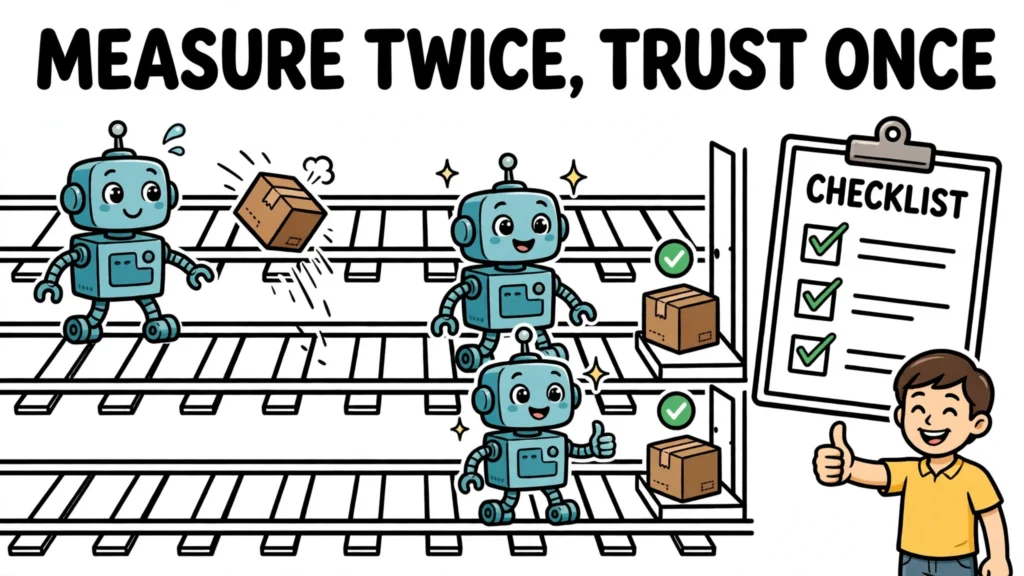



This article sets out ai agent evaluation as a repeatable method: define what success means, test the agent against realistic tasks, grade the results with checks you can trust, and keep measuring after deployment. An agent is harder to evaluate than a single-turn chatbot because it works over many turns, calls tools, changes state, and adapts as results come back. A single impressive demonstration proves very little; a small, well-designed evaluation suite proves much more.
What AI agent evaluation actually measures
Evaluation is a comparison against a defined expectation. Anthropic defines an evaluation, or eval, as giving an AI system an input and applying grading logic to its output to measure success. For agents, that simple definition needs four separate judgements, because each one can pass while the others fail.
First is correctness: did the agent achieve the goal it was given? Second is safety and side effects: did it avoid actions it should not have taken, and did it leave the environment in an acceptable state? Anthropic makes the point with the outcome: the final state in the environment at the end of a trial is what counts, not only what the agent claims in its final message. Third is reliability: does it succeed again when the same task is repeated? Fourth is efficiency: how much time, how many steps, and how many tokens did success cost?
A single pass rate hides all four distinctions. An agent can complete a task unsafely, succeed once and fail on the next run, or succeed only by burning far more time and money than the result is worth. Keeping the four dimensions separate is what makes results actionable: a correctness failure, a safety failure, a repeatability failure, and a cost problem each demand a different fix. It also matters what is being evaluated: Anthropic evaluates the harness and the model working together, so a result always belongs to a specific combination of the two.
Define success before you measure anything
The first step in the method is to write down what success means before the agent runs. OpenAI’s guidance for agent skills makes the same point: define success before you build, split into outcome, process, style, and efficiency goals. Outcome goals ask whether the task completed; process goals whether the agent used the intended tools and steps; style goals whether the output follows the conventions you care about; efficiency goals whether it got there without thrashing.
For each task, write a task specification: the goal, the tools the agent may use, the constraints it must respect, and what counts as done, including forbidden side effects. Define the pass criteria per task, and decide the rubric or grader in advance, before seeing the agent’s outputs.
Task quality comes from unambiguous specifications and reference solutions. Ambiguity in a task specification becomes noise in the metrics, so everything a grader checks should be clear from the task description. A reference solution for each task, a known working output that passes all graders, proves the task is solvable. When a task scores zero across many trials, inspect the task specification, the reference solution, the graders, and the agent’s failures together, without presuming in advance which cause is most likely.
Build an evaluation task set
With success defined, collect the tasks the agent will be tested on. Anthropic’s roadmap starts early and starts small: 20 to 50 simple tasks drawn from real failures is a great start. The tasks should come from real usage: the manual checks you already run, failures from your bug tracker and support queue, and the common tasks end users actually try.
Include the hard cases deliberately. Add edge cases, ambiguous instructions, and tasks where the correct behaviour is to refuse or escalate rather than act. Build balanced problem sets: test both the cases where a behaviour should occur and where it should not. A suite that only tests one direction can optimise the agent in that direction alone: for example, testing only whether an agent searches when it should, and never whether it should answer from existing knowledge, can produce an agent that searches for almost everything.
Finally, hold out part of the set. Keep some tasks aside so the agent is never tuned against its own test; a held-out set, used only for scoring, is what keeps the measurement honest.
Run offline evaluations

Offline evaluation runs the agent against the curated task set before deployment, in a controlled environment. LangSmith draws the key distinction: offline evaluations use datasets with reference outputs, so they can check correctness, while online evaluations in production have no reference outputs and must judge quality patterns and safety instead. The offline loop has three parts: run the task, grade the result, and record the transcript.
Start with deterministic graders wherever possible. Anthropic recommends choosing deterministic graders where possible, LLM graders where necessary, and human graders judiciously for validation. Deterministic checks cover what can be verified exactly: the final state in the environment, whether the expected tool was called with valid arguments, and whether a file was created in the right place. SWE-bench Verified follows this pattern, grading solutions by running the test suite.
Where the answer needs judgement, use model-based graders or human review, and calibrate them. A model-based grader scores an output against a written rubric. Anthropic advises calibrating LLM-as-judge graders closely against human experts, using clear structured rubrics for each dimension of a task.
Record every run’s transcript, the complete record of a trial including outputs, tool calls, reasoning, and intermediate results. Anthropic’s Step 6 is to check the transcripts: reading them is how you tell whether a failure was a genuine agent mistake or a grader rejecting a valid solution. Grade the outcome first, and avoid prescribing an exact sequence of tool calls when alternative approaches satisfy the task, while retaining checks for required tools, handoffs, and safety policies. Agents regularly find valid approaches the eval designer did not anticipate, so a rigid step-by-step check can reject a solution that genuinely satisfies the task.
Measure reliability separately from correctness
Reliability needs its own measurement, because a single successful run feels like proof. It is not. Model outputs vary between runs, so Anthropic runs multiple trials per task to produce more consistent results. Repeat each task under identical conditions, restoring the initial state and isolating each trial in a stable environment, so shared state from an earlier trial cannot help or hinder the next. Each task has its own success rate, and a task that passed on one run might fail on the next.
Two metrics capture this. Pass at k measures the likelihood that the agent gets at least one correct solution in k attempts; pass to the power k measures the probability that all k trials succeed. Anthropic’s illustration makes the difference concrete: with a 75 percent per-trial success rate over three trials, the probability of passing all three is about 42 percent. Pass at k fits tools where one success matters, while pass to the power k fits customer-facing agents where users expect reliable behaviour every time.
Report reliability as a rate over many runs, and classify the failures: the wrong tool, the wrong arguments, loops, stopping too early, or unsafe actions. Failure classification turns a single percentage into a repair list. A single demonstration, however impressive, cannot support any reliability claim at all.
Benchmarks illustrate why repeatability belongs in the method. Tau-bench simulates multi-turn customer-service interactions with a user persona, policy constraints, and tool use, judging the final database state against a goal state. GAIA tests multi-step assistant work against short reference answers, and OSWorld checks final desktop state with per-task scripts. These benchmarks score task completion against a fixed check. A task-completion score alone does not establish repeatability: whether the same agent would pass the same task again is a separate question, answered by the repeated-trial measurement above. This article does not claim which named benchmarks report repeated-trial results.
Measure performance: latency, cost, and steps

Performance in agent evaluation means efficiency, not only speed. Track four numbers for every run: latency per step and per run, token usage, cost per run, and the number of steps taken. Anthropic notes that once evals exist, these can be tracked on a static bank of tasks, giving baselines and regression tests for free. A slower, more expensive run must earn its extra spend with measurably better results.
Watch for loops and retries. An agent that eventually succeeds after twenty steps and repeated tool calls has succeeded expensively, and the step count and token totals are what reveal it. Anthropic adds the trade-off explicitly: agentic systems often trade latency and cost for better task performance, and teams should consider when that trade-off makes sense.
Standardised telemetry helps here. The OpenTelemetry GenAI semantic conventions define attributes for token counts on model-call spans, including gen_ai.usage.input_tokens and gen_ai.usage.output_tokens, and two client metrics, gen_ai.client.token.usage and gen_ai.client.operation.duration. One caution belongs with the recommendation: the conventions were still marked Development in the releases current in November 2026, and attribute names have already changed, so dashboards built on them should be pinned to a specific instrumentation version.
Keep evaluating in production
Offline evaluation is not the end of the method. Production is where the agent meets inputs no task set predicted, so evaluation must continue there. LangSmith’s online evaluations run against real production traces, assessing quality patterns and safety without reference outputs. Sample live traces for human review on a schedule, weighted toward risky actions: irreversible operations, money movement, and external messages deserve more review than read-only lookups.
Before shipping a new version, compare it against the previous version on the same task set. Regression evals ask whether the agent still handles the tasks it used to handle; a decline is a signal to investigate, using repeated-trial results to distinguish a real regression from run-to-run variation. Capability evals measure what the agent can newly do. As capability evals approach saturation, when the agent passes all solvable tasks, they graduate into regression suites and harder tasks take their place.
Alert on trends, not only on crashes. A rising failure rate, a cost spike, a new failure pattern, or a drift in live inputs all deserve attention before users report that the agent feels worse. Anthropic’s complete picture combines automated evals for fast iteration, production monitoring for ground truth, and periodic human review for calibration, with systematic human studies reserved for calibrating LLM graders or evaluating subjective outputs.
Common mistakes and a starter evaluation checklist
The most damaging mistakes are the ones that make evaluation results misleading or unreliable. Testing on the tasks the agent was tuned on, grading with an uncalibrated judge, and reporting a single run as a result can each distort the result in either direction: an uncalibrated grader can reject valid results just as readily as it can pass poor ones, and one stochastic run can overstate or understate performance. Prescribing an exact sequence of steps instead of grading the outcome can punish valid solutions the designer did not foresee, while checks for required tools, handoffs, and safety policies should still be retained. A broken grader can hide a capable agent, so check the eval before blaming the agent.
A starter checklist, in the order this article presents it, looks like this:
- Success is written down per task, including forbidden side effects, before the agent runs.
- The task set holds 20 to 50 realistic tasks, including edge cases and refusal cases, with part held out from tuning.
- Deterministic checks grade outcomes first; model-based graders use written rubrics calibrated against human judgement.
- Each task runs multiple trials under identical conditions, with initial state restored and trials isolated, and reliability is reported as a rate, with failures classified by type.
- Latency, token usage, cost, and steps are recorded per run and compared against a baseline.
- Every trial’s transcript is recorded and failures are read, not only counted.
- New versions are compared with the previous version on the same task set before shipping.
- Production traces are sampled for human review, and trends in failure rate and cost trigger alerts.
Evaluation is not a gate at the end of a project. It is the instrument that tells a team whether a change helped and whether users can trust the agent with real work. Start with a small suite, define success honestly, measure the four dimensions separately, and let the failures become the next test cases.