


Gemini 4 Argon brings physical reasoning, simulation generation and robot-control demonstrations into the same model offering. Google DeepMind describes it as applicable across the robotics lifecycle: building simulated environments, interpreting manipulation tasks, controlling robots and improving actions through simulation and hardware feedback. For engineers, the central proposition is a workflow linking visual observations to simulation and then to physical action. The demonstrations support that proposition, while leaving important questions about repeatability and deployment performance unanswered. Google DeepMind’s robotics announcement supplies the technical examples.
Google’s October 13, 2026 rollout announcement says Argon is globally available to developers and enterprises through the API in AI Studio and the Gemini platform. Access through consumer and development products depends on subscription tier. The evidence also contains a disagreement about AI Studio eligibility, making the access route a practical consideration alongside the model’s capabilities.
From visual observations to robot actions
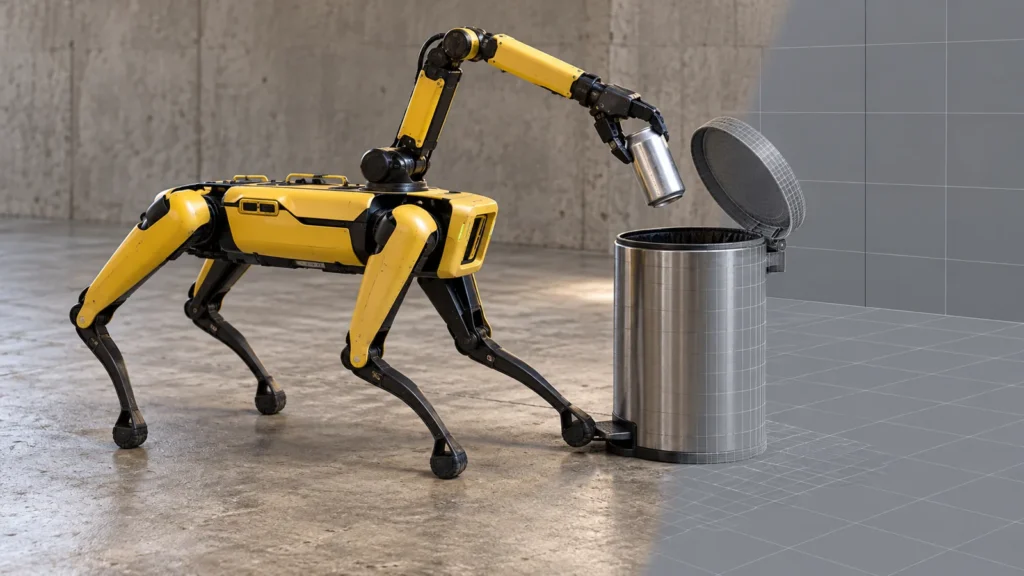
Google’s Spot demonstration provides the clearest example of how the pieces connect. Argon controls a Boston Dynamics Spot quadruped with 12-DoF legs and a 6-DoF arm to dispose of soda cans in a foot-pedal trash bin. Before acting on the physical bin, it creates an articulated MuJoCo digital twin and practices the movement in simulation.
The supplied description includes picking up a can, checking the wrist camera, practicing three-leg tripod balance, stepping on the pedal and verifying the hand’s position before releasing the can. The accompanying prompt requests two verification agents, named foot-verifier and hand-verifier, to check pedal placement and hand alignment. That is a concrete example of explicit verification within a manipulation workflow; the announcement does not establish how much those checks improve reliability across repeated trials.
A separate demonstration, presented as zero-shot control, uses a simpler robotic arm to turn a fallen mug upright and place a crumpled napkin inside it. Google describes the model reasoning over several turns with a visual coordinate harness and action primitives. The wrist-camera view includes a calibrated grid and a jaw-closing reticle.
Those details matter when interpreting “zero-shot.” The demonstrated task still uses structured observations, coordinates and available actions. An engineering reading of the example is that the surrounding interface helps connect visual reasoning to movement; the label alone does not establish compatibility with arbitrary robot hardware. Both demonstrations are documented in Google DeepMind’s post.
Building simulation environments from video and sketches
Google groups another set of capabilities under Real2Sim: reconstructing physically calibrated simulation twins from robot-camera feeds, first-person human video or hand-drawn sketches. In the documented examples, Argon watches a real robot teleoperation episode and develops a digital twin, and identifies task-relevant objects from a human manipulation video.
The sketch example extends that input range. Google says a developer can photograph a rough pen-and-paper sketch and have Argon construct a GPU-accelerated mujoco_warp scene. Together, these examples position simulation construction as part of the model’s robotics role, rather than treating the simulation environment as an entirely separate prerequisite.
The evidence also includes control inside the Gemini Omni World Model: robots rearrange five scattered Scrabble tiles, G, R, A, N, O, into a row spelling A - R - G - O - N. This is a simulated-world demonstration, distinct from the physical Spot and robotic-arm examples. Google DeepMind describes both categories.
A further example links human video to humanoid motion. VentureBeat reports Google’s demonstration in which Argon studies a person playing cornhole, constructs simulation code and generates a motion sequence transferred to Apptronik’s Apollo humanoid. Google says Apollo landed seven consecutive throws. That is a reported demonstration outcome, without enough supplied testing detail to infer a general success rate.
What the reasoning benchmark establishes
Google DeepMind reports an 87% score using pure reasoning on the Embodied Reasoning (ERQA) benchmark, which tests understanding and solution of physical, spatial problems in 3D environments. VentureBeat describes the benchmark as Embodied Reasoning Question Answering and reports that Google’s release comparison places Argon ahead of Claude Opus 5.5 and GPT-6 Astra. These are attributed results from Google’s comparison, rather than independent evaluations supplied with the research.
For developers, the distinction between question answering and physical execution is consequential. The 87% figure measures the reported benchmark performance; it does not supply a robot-task completion rate. Likewise, successful demonstrations do not establish control latency, robustness across changing scenes or sustained operation. The supplied evidence does not provide those measurements.
Google also lists multimodal hindsight labeling, dexterity understanding, dense value functions and progress estimation under physical understanding, alongside action improvement through simulation and iterative improvement on hardware. These broaden the announced scope, but the available material offers less detail about their implementation than about the control demonstrations. Google DeepMind’s announcement is the source for those capabilities and the ERQA result.
Access depends on the product—and one account conflicts
Google’s rollout announcement distinguishes three routes: developer and enterprise API access through AI Studio and the Gemini platform; Google Antigravity access for Google AI Ultra subscribers; and Gemini app and AI Mode in Search access for Google AI Ultra and Pro subscribers. The robotics post says developers can select Gemini 4 Argon (gemini-4-argon) in Antigravity for complex planning, /goal runs and multi-agent orchestration.
There is a material discrepancy over AI Studio. The robotics announcement describes availability through the paid tier of the Gemini API in AI Studio, while Ars Technica’s rollout report says Argon in both Antigravity and AI Studio is restricted to AI Ultra plans. The supplied evidence does not resolve whether that difference reflects distinct API and interface entitlements or an inconsistency in reporting. A paid API account should therefore not be assumed, from these accounts alone, to establish every AI Studio entitlement.
Introductory API prices have an end date
VentureBeat’s pricing report specifies the following public API rates:
| Pricing period | Input per million tokens | Output per million tokens |
|---|---|---|
| Introductory rates through November 30, 2026 | $2 | $10 |
| Standard rates beginning December 1, 2026 | $4 | $20 |
Google’s rollout announcement also states a 95% discount for cached input tokens. The change doubles the listed input and output rates. For a team assessing multi-turn reasoning or agent orchestration, the relevant commercial question is how its measured token use translates into cost after the introductory period. The supplied evidence gives prices, but no per-task robotics token consumption or deployment cost benchmark.
Software safeguards leave physical performance to be evaluated
VentureBeat reports Google’s claimed 0.7% attack success rate on the Gray Swan Indirect Prompt Injection benchmark across 15 adaptive attempts, and unauthorized shortcut attempts falling to 2% on coding evaluations. It also reports that Argon was trained to respect system boundaries and pause before irreversible actions.
Those findings concern the specified software evaluations. They do not establish physical robot safety or manipulation reliability. For robotics engineers, the strongest supported reading of Argon’s launch is that Google has demonstrated a connected path from observation to simulation to action. Evaluating that path on a particular robot still requires evidence about its performance under the conditions in which the team intends to use it.