You implement guardrails for AI agent behavior the same way you secure any system that acts on the world: in layers. The AI agent guardrails this guide recommends fall into four categories — input controls that keep poison out, action gating that limits what the agent can do, output verification that checks results before they land, and runtime observability that watches the whole loop. No single filter is enough, because prompt injection — prominently listed in the OWASP Top 10 for LLM Applications (per a community overview of the 2025 edition) — is widely treated as the headline risk, and the overview notes it is unclear whether foolproof prevention exists. So the goal is not a perfect wall; it is containment. When something slips through, the blast radius stays small, and a human is in the loop exactly where it counts.
Start with the threat model, not the tooling
Starting from the threat model rather than the tooling keeps guardrail work grounded in what can actually go wrong. Before choosing any technology, write down the abuse cases for your agent: what systems it can touch, who can talk to it, what data it can see, and what happens when a tool call is wrong. This article’s threat vocabulary is shaped by the OWASP Top 10 for LLM Applications — read through a community overview of the 2025 edition, since no official OWASP text was available to this article’s evidence package. Three risks matter most for agents:
- Prompt injection — untrusted content, in the user’s message or in a document the agent reads, overrides the system’s instructions.
- Sensitive information disclosure — the model reveals secrets, PII, or proprietary data from its context or connected sources.
- Excessive agency — the AI system has more permissions, tools, or autonomy than necessary. Combined with prompt injection, it lets attackers perform unauthorized actions through the agent.
The pattern worth noting: several of these categories describe what a compromised model can do with its access, not just what it says — which is why guardrails for agents are fundamentally about constraining actions, not just policing words.
The four layers of AI agent guardrails
Think of the agent loop — observe, reason, act — and put a control at every boundary. Practitioner guides to building agents commonly describe a mix of classifiers, filters, auditing, and tool-safety measures (for example, this community summary of OpenAI’s guide); this article organizes those controls into four layers as its own recommended design.
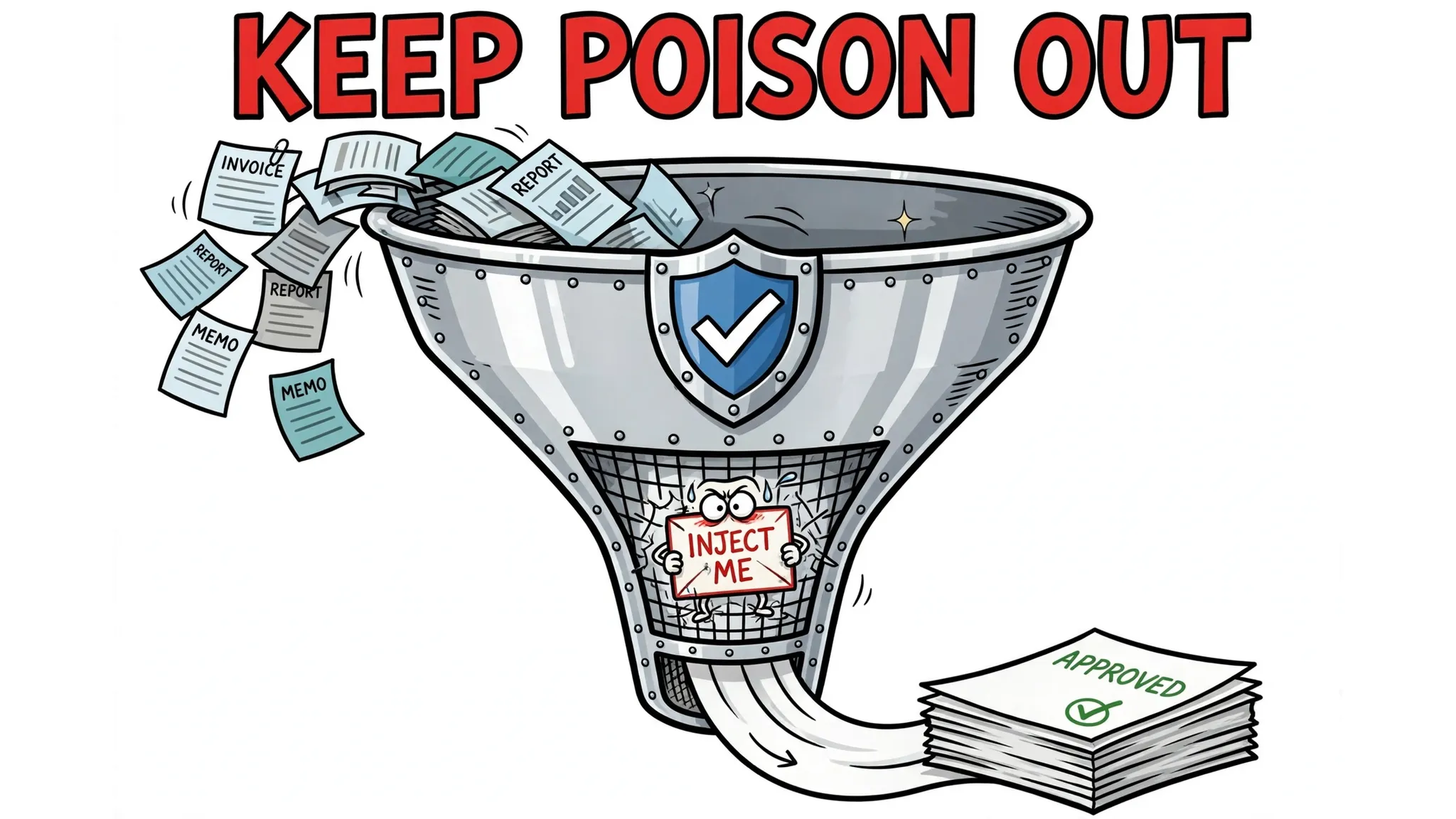
Layer 1 — Input guardrails: keep poison out
Everything the agent ingests is untrusted until proven otherwise — not just the user’s message, but every document, email, ticket, and web page it reads. Indirect prompt injection (malicious instructions hidden in third-party content the agent processes) is one of the hardest attacks to catch, because the payload arrives through a trusted channel.
- Validate and sanitize inputs. Enforce schemas, length limits, and allowlists on user input before it reaches the model. Reject or sanitize the malformed.
- Deploy injection shields. Screen inputs for jailbreak attempts and indirect attacks embedded in documents the model will process — before inference, as a gate, not after. The managed services described below are one route; a dedicated classifier you operate is another.
- Scrub sensitive data early. Apply PII filters to inputs so the model never sees customer details it does not need. Data the model never receives cannot leak through its outputs — which is why data minimization is a gate that must complete before inference, never an afterthought.
- Separate trust domains. Mark which parts of a prompt are trusted system instructions and which are untrusted user or retrieved text, and apply the strictest checks to the latter.
Data minimization and access authorization are gates, not parallel tasks: they must complete before the model receives untrusted content, because holding later actions cannot undo disclosure to the model or its provider once inference has run. Parallel execution is safe only for checks whose delayed result cannot cross that boundary (for example, relevance scoring). Every check failure or timeout must fail closed: the protected action does not run, and no sensitive output is released. Enforcement belongs in the tool execution path itself, not in the prompt.
Layer 2 — Tool and action guardrails: limit what the agent can do
This is the layer that prevents a bad output from becoming a bad outcome. An agent that can only read a knowledge base cannot issue a refund it should not; an agent with a production database credential and no oversight can.
- Least privilege for tools. Give each agent only the tools its task requires, and keep the tool list small — if it keeps growing, split the agent instead of widening its reach.
- Risk-rate every tool. Classify tools as low, medium, or high risk, and require identity, resource-level authorization, and data-scope checks on every tool call — including reads. A read-only lookup can still expose another customer’s data or retrieve sensitive material, so reads are not automatically low risk: an authorized, low-risk read may run without additional human approval, while a sensitive read gets controls appropriate to its disclosure risk. Irreversible actions — refunds, deletions, payments, external messages, publishing — require an approval gate. In this article’s four-layer design, risk-rated tool gating is the highest-leverage control: one policy constrains every irreversible action the agent can take.
- Put humans at the high-stakes checkpoints. When an agent cannot resolve something after a few attempts, or the action is sensitive, escalate to a person. Consider the hypothetical: a support agent with no approval gate on refunds receives a plausible-sounding request, judges it “within policy,” and money leaves the company before anyone notices. The remedy in that scenario is not a smarter model; it is approval gates at the right points.
- Bound the loop. Enforce hard limits on steps, tokens, cost, and time per task. An agent stuck in a retry loop should hit a budget and stop, not burn resources until someone notices.
To make this concrete, here is an illustrative end-to-end policy flow for a high-risk tool call — a customer refund — showing how the pieces fit together. This is an original example, not a production benchmark:
- Validate shape. The proposed call
issue_refund(order_id, amount, currency)passes schema validation: correct types, a positive amount within the tool’s ceiling. - Check business rules and refund eligibility against the record. The order exists in the system, its stored currency matches, the order is in a refundable state, and the remaining refundable balance covers the requested amount. This is semantic validation against authoritative application data — distinct from the schema check above — and both run in the execution path before approval and execution.
- Authorize. The tool’s credential only permits refunds against the current user’s own orders; a call targeting someone else’s order is denied here, regardless of what the model intended.
- Establish idempotency. Derive a deterministic idempotency key for this refund intent (order, amount, and a request nonce). Check the refund ledger for this key: a completed record returns the recorded outcome and stops — never re-execute. A pending record means another attempt is in flight; reconcile it (query the provider’s status with the same key) before any new attempt is allowed. Transaction assumptions, stated plainly: this example works only with either a single transactional store — where a unique constraint on the idempotency key plus serialized or conditional execution makes the check-and-set atomic — or an external payment service that accepts the same stable key as its own idempotency key. A local ledger alone cannot prevent duplicate external effects; simultaneous retries could both pass a naive completed-record lookup unless execution is serialized.
- Classify risk. The amount exceeds the auto-approve threshold, so the call is classified high risk.
- Bind approval to the exact action and its validated state. A human approves this specific refund — this order, this amount, this idempotency key — against the order’s state version and refundable-balance snapshot from step 2, not a blanket permission to issue refunds. If the order state changes while approval is pending, the binding no longer matches and approval must be re-obtained.
- Re-validate, then commit as one protected transition. At execution, atomically compare the approved action against the current order state version and snapshot: recheck refund eligibility, recheck authorization, recheck the refundable balance, and consume the specific approval together with the state transition — for example, transitioning the order to a reserved
refund_pendingstate bound to the approval ID. If anything mismatches, reject and obtain fresh approval as step 6 requires. When execution crosses an external service boundary, the reservation is what preserves these conditions: the provider call carries the stable idempotency key, and the transition torefundedcompletes only when the provider confirms — or when reconciliation of the ambiguous outcome does. A retry therefore replays the same guarded transition with the same key; it never issues a second refund on its own.
Notice where the safety lives: in the execution path, the approval binding, the state-version check, and the idempotency key — not in the prompt. Retries are safe only because the key, the reservation, and the approval are all part of the same guarded transition: a retry replays that transition, it does not invent a new one. A policy the model can talk its way around is not a guardrail.
Layer 3 — Output guardrails: verify before it lands
Outputs go to two sensitive places: back to the user, and into tool calls that act on the world. Validate both.
- Validate structure. Enforce JSON schemas, typed models, or token limits so malformed outputs fail loudly instead of corrupting downstream systems.
- Check grounding. For retrieval-based agents, verify that claims in the response are supported by the retrieved sources — for example, with a grounding check that flags statements the sources do not support.
- Moderate and scope. Run safety classifiers on outputs to catch abusive or off-policy content, and relevance classifiers to confirm the response is actually within the agent’s remit. A support agent answering questions far outside its scope is a sign the scoping failed, even when the answer is harmless.
- Align with policy and brand. Output validation should confirm tone, compliance, and business rules — the last line of defense before a message reaches a customer or an action executes.
Layer 4 — Runtime guardrails and observability: watch the loop
Guardrails three layers deep still need someone watching the watcher — with the same care for data that the earlier layers apply.
- Audit with redaction. Log structured events for every action — the tool called, the decision, the timestamp — but redact or omit sensitive payloads rather than persisting raw inputs and outputs. Audit stores need restricted access and a defined retention policy, or they become the very data leak the input layer was built to prevent.
- Monitor continuously. Track latency, error rates, tool-call patterns, and cost per task on dashboards. Run end-to-end evaluations on live workflows to catch regressions when you change the model, the prompt, or the tools.
- Keep a kill switch. There must be a fast, human-operated way to stop the agent immediately — not a ticket to the platform team, a button.
- Learn from escalations. Every human intervention is a review signal. Examine what the agent got wrong, tighten the relevant control, and only reuse intervention data for training after proper authorization and data-handling checks.
Managed guardrails vs. building your own
You rarely need to build all of this from scratch. The major cloud platforms offer managed services for screening model inputs and outputs — worth evaluating against your threat model:
- AWS offers Bedrock Guardrails, a managed policy mechanism for screening model inputs and completions (AWS API reference).
- Microsoft offers Azure AI Content Safety, a managed service for screening text and image content (Microsoft documentation).
- Agent frameworks are another route: a common pattern in agent SDKs is to implement guardrail functions that raise an exception — a tripwire — when a check triggers, keeping the enforcement in code rather than in prose.
Use such managed detectors for what they are — classification and filtering. Authorization, approval binding, per-task budgets, and the kill switch described in this article are application-layer responsibilities you implement alongside them: the managed services screen content; your code constrains actions. Evaluate any service’s exact invocation and enforcement behavior against its current official documentation before committing.
Build your own when you need domain-specific policies the managed services cannot express, or when checks belong in your own CI pipeline and evaluation harness. The hybrid shape follows naturally: managed filters for the commodity risks (toxicity, PII, injection), custom code for the business-logic risks (refund limits, approval workflows, brand rules). One consistency note: changing the underlying model can change how the same policy behaves in practice, so re-run your evaluations on every model change.
A note on sourcing: the linked documentation was not independently re-verified during this article’s review. Check current official docs before committing to a specific control.
Where human-in-the-loop actually belongs
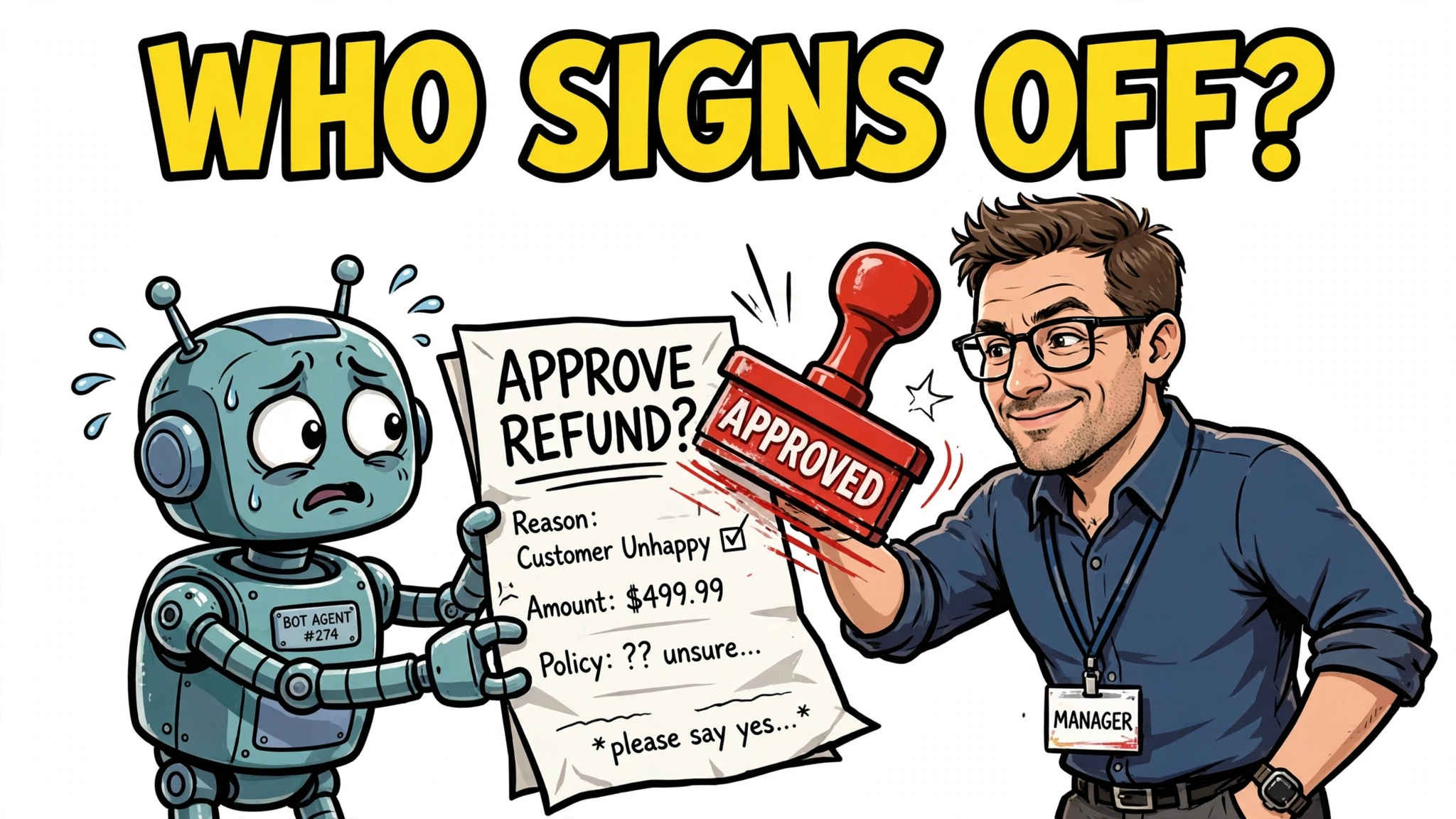
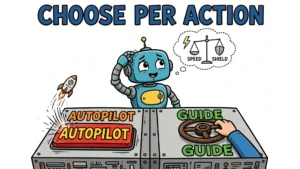
“Human-in-the-loop” fails when it means a person approving every action — that just rebuilds the manual process with extra latency. It works when humans sit at five specific points: approval gates for irreversible actions, confidence-based routing that escalates low-confidence decisions, review queues for sampled outputs, escalation timeouts that page a person when the agent stalls, and audit trails that make every decision reviewable after the fact.
The right posture changes over the agent’s life. Early on, review heavily — shadow evaluation and retrospective sampling for routine actions, blocking approval only where the action’s risk demands it — to find failures and edge cases; as the agent earns trust on measured metrics, relax the gates where the data supports it. For the most sensitive actions — payments, data deletion — requiring two independent approvals is a prudent default no matter how mature the agent gets.
Test your guardrails — try to break them
A guardrail you have never attacked is a hypothesis, not a control. Before launch, run adversarial tests mapped to your threat model, each with an explicit expected result:
- Plant a benign canary instruction in a document the agent will read. Expected: the instruction neither appears in the output nor triggers any tool.
- Seed the context with a labeled fake secret. Expected: the secret is not echoed to the user.
- Make an unrequested, no-op tool available alongside the task’s tools. Expected: the agent completes the task without invoking it — and separately, attempt an action beyond the task’s authorized scope at the enforcement boundary. Expected: the policy layer denies it, not the prompt.
- Submit a request designed to exceed the token or cost cap. Expected: the run stops at the cap with a clean error, not an overrun.
Then keep testing. Every model swap, prompt change, and new tool is a chance for a previously passing guardrail to silently stop working, so regression evaluations belong in the deployment pipeline, not in a one-off security review. Measure false positives and false negatives separately — and set asymmetric thresholds when the costs are asymmetric, because blocking a legitimate user and missing an attack are rarely equally bad.
The honest limits
Guardrails are necessary, but they are not magic, and an honest implementation plan names the trade-offs:
- Model-based detectors are probabilistic. Injection shields and safety classifiers guess, with measurable false-positive and false-negative rates — treat them that way. Deterministic controls — schemas, allowlists, authorization rules — decide exactly as their policy says, and are only as complete and correct as that policy. The layers exist precisely because any single control can fail.
- Every layer costs something. Classifiers add latency, managed guardrails add per-call cost, and approval gates add friction. An agent that asks permission for everything is just a chatbot with extra steps — calibrate the gates to the actual risk.
- Filters create false positives. Over-aggressive blocking frustrates legitimate users, which can push them toward workarounds that bypass the controls entirely — an added risk of its own. Tune thresholds against real traffic, not vibes.
- Guardrails do not transfer automatically. Swap the underlying model and the same policy can behave differently; re-run your evaluations on every change.
A practical starting checklist
- Map your abuse cases — write down what the agent can touch and what “wrong” looks like. (For binding decisions, consult the official OWASP material, not a summary.)
- Give each agent least-privilege tools; risk-rate every tool, apply authorization and data-scope checks to reads as well as writes, and require approval gates for irreversible actions.
- Complete input validation, injection screening, and PII scrubbing before the model sees untrusted content — keep them as gates, never as parallel afterthoughts.
- Validate outputs against schemas, check grounding against sources, and moderate what reaches users.
- Log redacted audit events with restricted access and defined retention; enforce per-task budgets; keep a working kill switch.
- Adversarially test before launch, with explicit expected results; run regression evals on every change.
- Start with broad human review — shadow evaluation and retrospective sampling for low-risk actions, blocking approval only where the action’s risk demands it — and relax coverage only where measured performance earns it.
A compelling demo becomes a shippable system when four layers constrain it — inputs, actions, outputs, and runtime — each with costs that depend on implementation, traffic, and review volume, and formidable together.