
Deciding between autonomous vs guided agent behavior starts with what each mode actually means. Autonomous agents decide their own next steps, choose their own tools, and act without waiting for a human. Guided agents follow a path defined in advance by code, rather than choosing their own steps at runtime. Oversight — policies, verification, human approval — is a separate dimension: an autonomous agent can operate inside guardrails, with approval required for selected actions, and still direct its own process. The tradeoff is not speed versus safety in the abstract. Autonomy buys throughput, scale, and the ability to handle open-ended work whose steps cannot be predicted in advance. Predefined guidance buys predictability and easier review. Oversight buys judgment, error interception, and accountability. The practical answer is to decide per action: grant autonomy where outcomes are readily reversible with no residual side effects, verifiable, and low-stakes, and keep guidance or blocking oversight where actions are hard to reverse, ambiguous, or consequential.
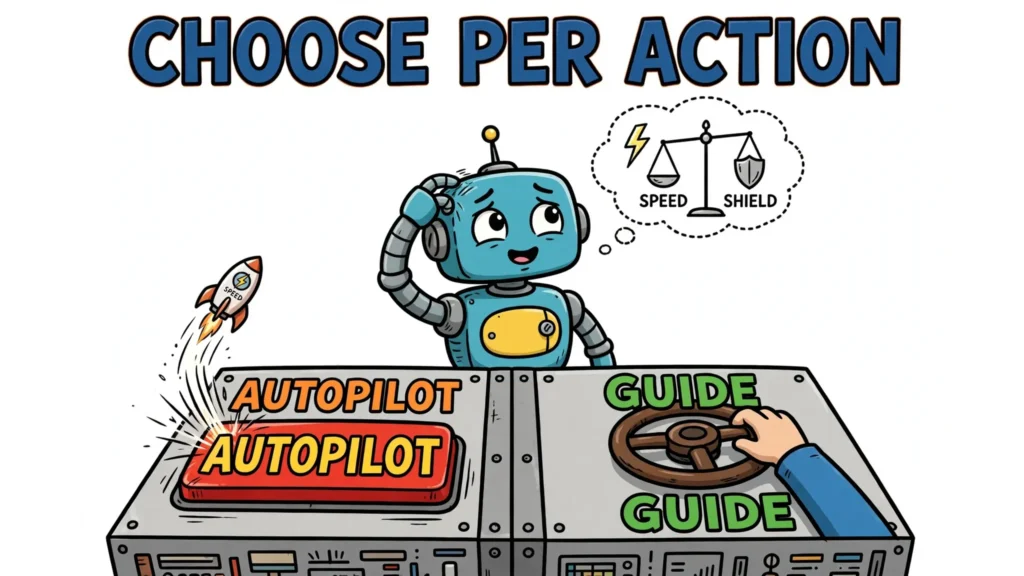
Decide per action, not per system
Most teams frame this as a single choice: should our agent be autonomous or guided? That framing leads to bad defaults. The same system can — and usually should — be autonomous in one function and tightly overseen in another. A support agent might freely search documentation, draft replies, and summarize tickets, yet require human approval before issuing a refund or deleting an account. A coding agent might run tests and explore a codebase on its own, yet need review before merging to a protected branch.
The rule that survives production is simple: the more hard-to-reverse, high-blast-radius, hard-to-verify, or ambiguous an action is, the more guidance or oversight it needs. The more readily reversible, narrow, checkable, and routine it is, the more autonomy it can earn.
What the two modes actually mean
Autonomous behavior
In autonomous behavior, the model directs its own process. Given a goal, it plans, selects tools, observes results, adjusts, and continues until it reaches a stopping condition. Anthropic draws this distinction explicitly: workflows orchestrate language models and tools through predefined code paths, while agents are systems where the model dynamically directs its own processes and tool usage. Autonomy is therefore a property of control flow — who decides what happens next, the code you wrote or the model at runtime? It does not mean absence of guardrails: OpenAI defines agents as systems that independently accomplish tasks on the user’s behalf within clearly defined guardrails, so a model-directed agent can remain autonomous while policies, verification, and human approval bound selected actions. Longer horizons multiply both value and risk, because each additional unsupervised step is another chance for an early mistake to compound.
Guided behavior
Guided behavior means the path is directed by code written in advance, not by the model at runtime: a predefined sequence of steps or a checklist the agent must follow. Policies, verifiers, approval gates, and tool allowlists are a different thing — oversight and permission boundaries. They constrain what an agent may do, but they do not by themselves make a model-directed agent guided: a bounded autonomous agent can use all of them and still direct its own process. Guided behavior does not mean the human does the work. It means the code decides which steps happen, in what order, and what counts as done. Guidance is strongest when enforced by code rather than by prompt instructions alone: for example, a code-defined sequence that runs validation, then a dry run, then — only if the checks pass — the write step, with branching decided by check results rather than by the model. A tool allowlist with no delete operation and a policy gate that blocks the call are enforceable oversight and permission boundaries, not guided control flow: they constrain what an agent may do without determining which step comes next, while a prompt saying “do not delete anything” is only a suggestion.
The oversight models alongside
Alongside the control-flow distinction sit three oversight models that teams mix and match:
- Human-in-the-loop: a person approves before the action executes. The gate is blocking. Use it for high-impact, hard-to-reverse actions such as sending money, publishing externally, or changing access.
- Human-on-the-loop: the agent acts, a person supervises, and intervention happens when something looks wrong. Review is asynchronous and exception-based. Use it for moderate-risk, readily reversible work where blocking every action would destroy throughput.
- Human-in-command: a person sets the boundaries and holds accountability for the whole system — goals, tool permissions, escalation rules, budget — without approving each action.
A mature deployment uses all three at once. The failure mode is applying one model everywhere: approval gates on every read, or no gates on any write.
A spectrum, not a switch
The idea that automation is a continuum, not a binary choice, predates modern AI agents by decades. In their 2000 model, Parasuraman, Sheridan, and Wickens argued — as recorded in a ResearchGate-hosted record of the IEEE paper, an indirect citation — that automation can be applied to four broad classes of function — information acquisition, information analysis, decision and action selection, and action implementation — and within each type, across a continuum of levels from fully manual to fully automatic.
That framing is directly useful for agents. An agent can be highly autonomous at information acquisition (searching many sources), moderately autonomous at analysis (summarizing what it found), subject to human decision at decision selection (proposing three options with tradeoffs), and blocked from action implementation (never sending the message itself). The same paper carries a warning that still applies: automation does not merely replace human activity; it changes it and imposes new coordination demands on the human operator. Supervising an autonomous agent is a new job — monitoring, interpreting execution records, judging exceptions, intervening — that requires different tooling and training.
What autonomy buys you — and what it costs
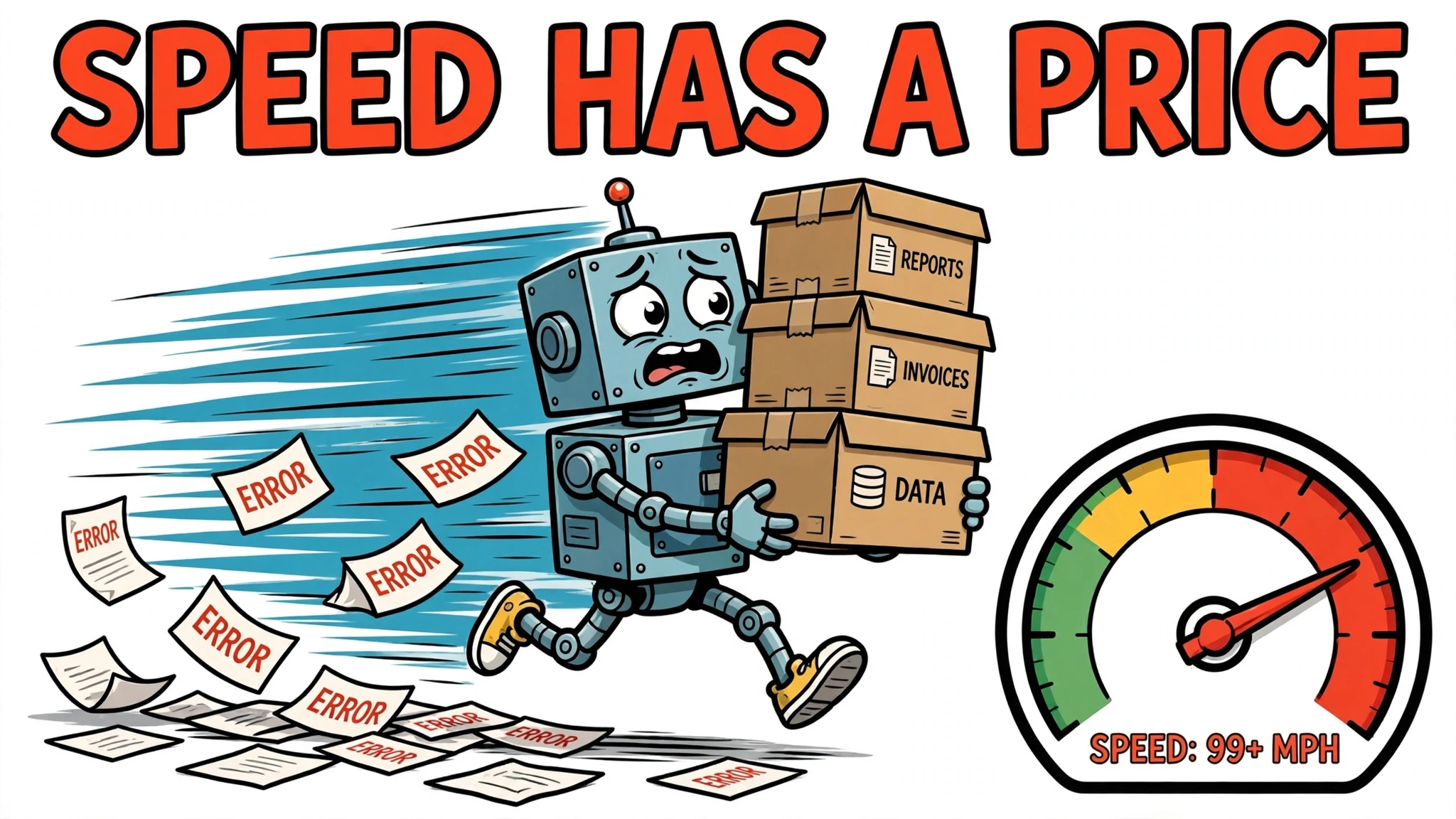
The case for autonomy starts with work that cannot be scripted in advance: when the steps, tools, or answer shape are unknown, a predefined workflow cannot cover the path. Anthropic makes this the central criterion: agents fit open-ended problems where it is difficult or impossible to predict the required number of steps and where a fixed path cannot be hardcoded. Autonomy also buys speed and scale, and it lets the agent use environmental feedback — running a test, reading the error, adjusting, retrying — which separates an agent that completes work from one that merely sounds confident.
Autonomy is not free. The first cost is compounding error: unchecked errors can propagate in either architecture — a fixed workflow can pass an incorrect output to subsequent steps and compound errors too. In an autonomous loop the risk grows further, because the agent can additionally choose later actions based on mistaken intermediate results. Error containment therefore depends on validation and checkpoints, not on fixed control flow alone. The second cost is latency and token spend — Anthropic notes that agentic systems often trade latency and cost for better task performance, and without budgets for turns, tokens, time, and spend, an agent caught in a loop can run far longer than intended. The third cost is loss of auditability: reconstructing why an agent did what it did requires observable execution records — tool calls, relevant inputs and outputs, verification results, approvals, overrides, and concise decision rationales where available — not access to the model’s internal reasoning. Those records support investigation and accountability, but logs alone do not establish compliance. The fourth is the supervision gap: an agent operating at speed can produce more output than humans can meaningfully review.
What guidance and oversight buy you — and what they cost
Predefined guidance buys predictability: it constrains the possible execution paths to a tested, reviewable set, which makes behavior easier to test and review. It does not guarantee repeatability: model outputs can still vary, and output-dependent branches can take different paths even when execution follows a fixed sequence. Oversight buys judgment where judgment is scarce: decisions with hard tradeoffs, competing values, ambiguous instructions, or hard-to-reverse consequences. In Anthropic’s account of human-agent teams, humans taught agents to surface decisions with hard tradeoffs directly to people, ensuring those decisions always had a human in the loop — an oversight choice, not a property of the code-directed path. Oversight also buys early error interception: a checkpoint before a hard-to-reverse action catches mistakes when still cheap, and a verifier checking work against a rubric catches defects before they reach a customer. Anthropic describes a “doer-verifier” pattern — one agent does the task, another checks it. Verification need not come from a human, but for consequential actions this article recommends verification separated from the agent that did the work — for example mechanical checks, environmental feedback, or a separate reviewer checking against a rubric. Those provide different kinds of assurance, and a second agent alone does not guarantee independent judgment, since it can share the same model, assumptions, or failure modes. Finally, oversight produces a learning signal: every correction is a labelled example of what the agent got wrong, which feeds evaluation sets and decisions about where blocking oversight can safely be reduced. NIST’s AI Risk Management Framework 1.0, released in January 2023, is a voluntary framework intended to improve incorporation of trustworthiness considerations into the design, development, use, and evaluation of AI systems. This article’s recommendation: treat oversight and accountability as part of that same lifecycle, not as an afterthought.
Predefined guidance costs flexibility first: a fixed path cannot adapt when the situation falls outside what the code anticipated. Oversight costs latency: every blocking approval adds waiting time, and in a multi-step workflow those waits add up. Blocking human review can become a throughput bottleneck, while automated checks also have workload-dependent latency, capacity, and cost: a verifier agent, policy check, or model-based check can block execution, queue behind other work, and consume shared capacity, so automated checks too can affect latency and throughput. Performance therefore depends on check duration, review frequency, concurrency, and the limiting resource, rather than on whether the reviewer is human — and agentic systems themselves can increase latency and cost, as Anthropic notes. The subtler cost is approval fatigue: when every action requires approval, approvals risk becoming cursory, reviewers may click through prompts they have not read, and the gate can exist on paper while no longer functioning as a control. Oversight-heavy operation can also carry a risk of skill erosion: if people stop exercising judgment on the cases the agent handles, they may lose fluency to judge hard cases when those arrive.
How to choose autonomous vs guided agent behavior: five questions per action
Stop asking whether the system should be autonomous or guided, and ask it about each action the system can take:
- How reversible is it, in practice? Reading, searching, drafting, and summarizing are typically reversible under the right conditions, while sending, publishing, paying, deleting, and changing permissions are typically hard to reverse — but reversibility depends on implementation and consequences, not on the verb alone. A draft can persist sensitive content, a search can disclose its inputs, and some deletions or permission changes can be undone. For each action, assess side effects, data exposure, rollback capability, ambiguity, and residual consequences. Actions readily reversible with no residual side effects tolerate autonomy; actions with hard-to-reverse consequences earn guidance or blocking oversight at the point of action.
- What is the blast radius? One wrong draft affects one reader; one wrong bulk operation affects thousands of records. High blast radius means narrow permissions, small batches, dry runs, and approval before execution.
- Can the outcome be verified? Mechanically checkable results — tests pass, the record matches — can run with more autonomy, because verification catches errors afterward. Results that depend on judgment only a human holds need guidance before or during execution.
- How ambiguous is the input? Clear, complete requests tolerate autonomy. Vague or contradictory requests do not, because the agent will fill gaps with guesses. When ambiguity is high, ask a clarifying question or present options rather than committing to one.
- How often does this action occur? High-frequency, low-variance actions are the worst candidates for per-action approval, because volume increases the risk of fatigue and cursory review. They are the best candidates for policy: define the rule once, enforce it in code, audit samples, escalate only exceptions.
Consider a hypothetical support agent, assuming drafts stay internal without sensitive data, search queries disclose no confidential inputs, and refunds keep a separate gate. It reads tickets, searches the knowledge base, and drafts replies, scoring well on all five: readily reversible under those assumptions, narrow blast radius, verifiable, low ambiguity, high frequency. A support agent that issues refunds scores badly: hard to reverse, direct financial impact, hard to verify without context, often ambiguous, and consequential enough to deserve a gate. The same agent should be autonomous at drafting and subject to a blocking approval gate at refunding — and the boundary should be visible in the code, not just in the documentation.
Design patterns for bounded autonomy
Bounded autonomy is the middle path: the agent directs its own process inside a defined envelope and hits a hard boundary at its edge.
Least-privilege tools
Give the agent only the tools and permissions the task requires, scoped as narrowly as possible. A research agent needs read access, not write access; a drafting agent needs to create drafts, not publish them. Separate planning and acting roles, use short-lived, task-scoped credentials, and deny destructive actions by default.
Checkpoints and stopping conditions
Anthropic advises that agents pause for human feedback at checkpoints or blockers, with stopping conditions such as a maximum number of iterations. Define checkpoints before the agent runs — after planning, before any external action, before any hard-to-reverse action — and escalation conditions: repeated failures, low confidence, unexpected tool output, or budget exceeded. Enforce both in the harness.
Layered guardrails
OpenAI’s guide treats guardrails as a layered defense: no single guardrail is likely to provide sufficient protection. Layers typically include input filtering, tool-level validation (schemas, allowlists, argument checks), policy gates that block or escalate specific actions, and output checks before anything leaves the system.
Audit trails, budgets, and circuit breakers
Log observable execution records — tool calls, relevant inputs and outputs, verification results, approvals, overrides, and concise decision rationales where available — with enough context to reconstruct what happened afterward. Those records help debug failures, support accountability reviews, and inform whether a task type has earned more freedom, but logs alone do not establish compliance: compliance also needs checks of the records against the applicable requirements. Cap turns, tokens, tool calls, time, and spend per run, and add circuit breakers that halt the agent when error rates spike or behavior diverges from its plan.
Earning more autonomy
Autonomy should be earned per task type, not granted globally. Anthropic’s human-agent team guidance supports granting autonomy in proportion to demonstrated reliability and expanding scope per task type after repeated successes, with verification such as a verifier agent checking the work. This article’s recommended implementation: start with a code-directed path and blocking oversight; review work manually at first to vet quality and design verification checklists; measure completion, accuracy, error rate, cost, and escalation rate on representative cases including edge cases; automate verification before reducing blocking oversight; reduce blocking oversight in stages — approval-before-action, then approval-after-action on samples, then exception-based review, then async audit; and keep every reduction reversible. This progression reduces blocking oversight, and it can apply to either a code-directed or a model-directed agent, since removing an approval gate does not itself change who directs the process. When asked why an agent may act autonomously on a task, the answer should be measurement, not capability: the error rate is within tolerance, verification catches the known failure modes, and here are the logs.
Failure modes to plan for
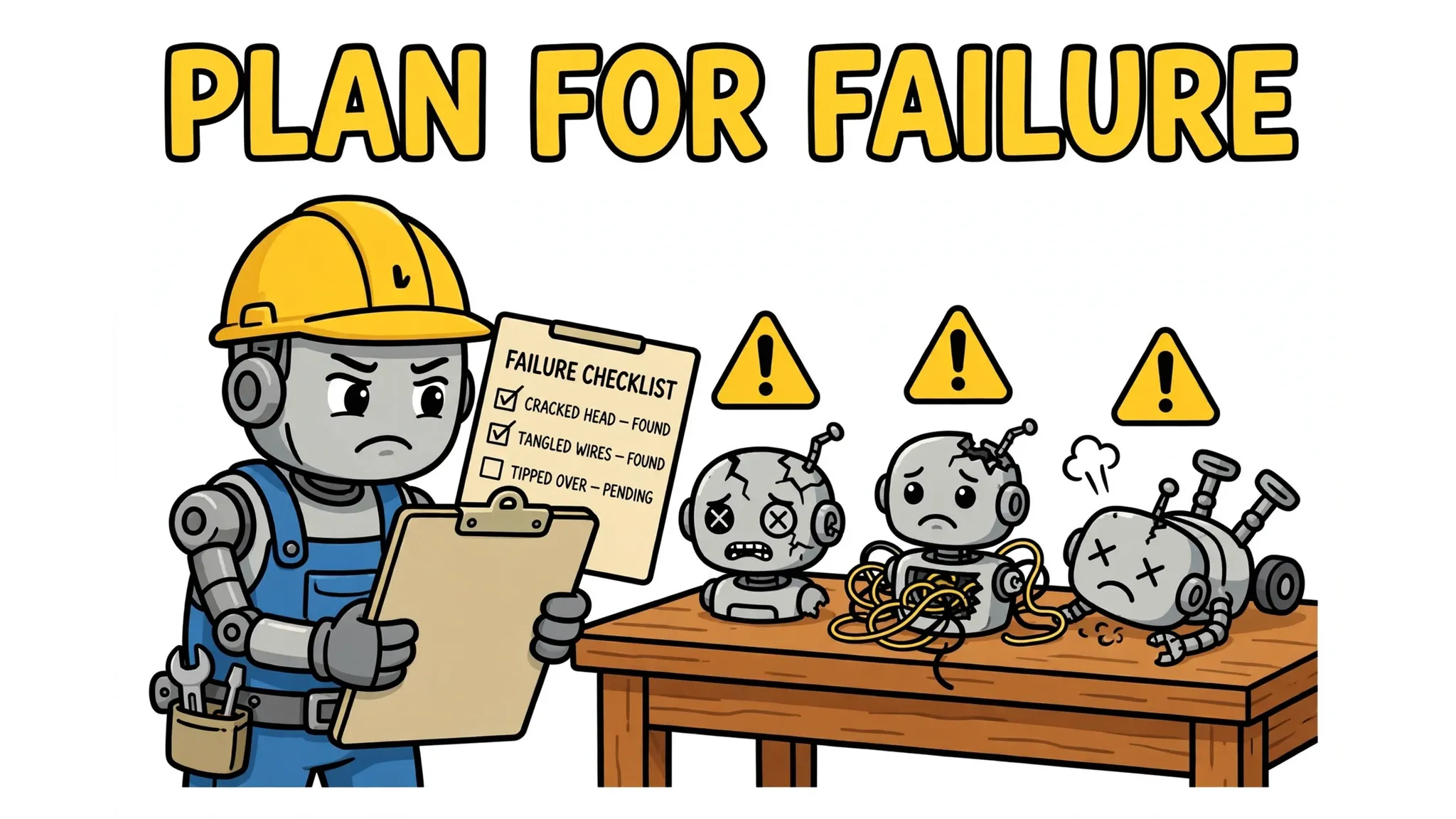
- Rubber-stamping: approval gates reviewers approve without reading. Mitigation: fewer gates, decision-grade context at approval time, sampled audits. Treat an unexpectedly high approval rate as a reason to investigate, judging review quality by sampled audits, detected defects, reviewer explanations, and the risk and size of the reviewed sample.
- Compounding errors: an early mistake becomes the foundation for later steps. Mitigation: verify intermediate outputs, checkpoint before hard-to-reverse actions, keep horizons short until reliability is proven.
- Silent drift: behavior changes gradually as models, prompts, tools, or data change. Mitigation: re-run evaluations when any of those change; monitor the same metrics in production.
- Skill atrophy: humans may lose fluency in judging the work they supervise. Mitigation: keep humans practicing on sampled and edge cases; involve them in defining quality.
- Accountability gaps: nobody can say who decided what. Mitigation: assign ownership per task type; log approvals and overrides with identity and reasoning; keep a named human in command of boundaries.
Choosing well in practice
Shneiderman’s human-centered AI framework offers a useful corrective: rather than treating automation and human control as opposite ends of one continuum, it argues designers can pursue high automation and high human control at the same time. A well-designed agent system does exactly that: the agent does the bulk of the work, the human retains meaningful control over goals, boundaries, and consequential decisions, and the division of labor is explicit, enforced in code, and revisable on evidence.
Before shipping any agent, answer in writing, per task type: What can it do without a human? What requires approval, and who approves it? What is verified, by what kind of check, and how separated is that check from the agent that did the work? What are the budgets and stopping conditions? What happens when it fails? If you cannot answer those questions, the system is not ready for the autonomy you have given it.
Checklist: before you grant autonomy
- List every action the agent can take, and score each on reversibility, blast radius, verifiability, ambiguity, and frequency.
- Put hard-to-reverse and high-blast-radius actions behind a human or policy gate enforced in code, not only in the prompt.
- Give the agent least-privilege tools and short-lived, task-scoped credentials.
- Define checkpoints, stopping conditions, budgets, and escalation rules before the agent runs.
- Verify intermediate outputs, not just final results, with a check separated from the agent that did the work where the consequences warrant it.
- Log observable execution records: tool calls, relevant inputs and outputs, verification results, approvals, overrides, and concise decision rationales where available.
- Evaluate on representative cases including edge cases, and re-evaluate when the model, prompt, tools, or data change.
- Expand autonomy per task type, in stages, on measured reliability — and keep every expansion reversible.
- Design the supervisory job: batch approvals, show decision-grade context, and limit review load to reduce fatigue risk.
- Name a human in command of the system’s goals, boundaries, and accountability.