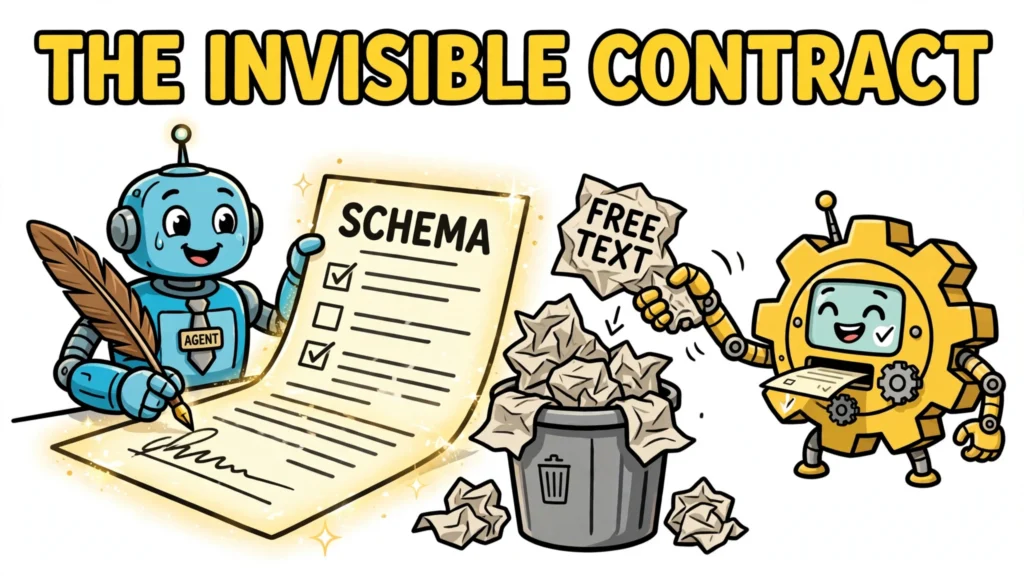



Large language models are fluent talkers but sloppy record-keepers. Ask one for an answer and you get prose — and prose fails the moment a consumer expects structured fields. That is why the structured output AI agents produce is one of the most load-bearing ideas in modern agent design: output constrained to a declared schema — named fields, enforced types, required values — so that every consumer downstream, whether it is code, a tool, or another agent, can rely on the shape and types of what arrives.
This guide explains what structured output means in practice, the mechanisms that produce it, the five roles it plays inside an agent system, where it still fails, and how to choose the right approach for your own work.
What Structured Output Actually Means in an AI Agent System
Structured output is output the model is required to shape according to a contract. The contract is usually a JSON schema: a list of fields, each with a type (string, number, boolean, object, array), a list of required fields, and sometimes enumerated values or string formats. A schema is what turns “the model’s best guess at some data” into something a program can parse with predictable structure and types — though the values inside still need validation.
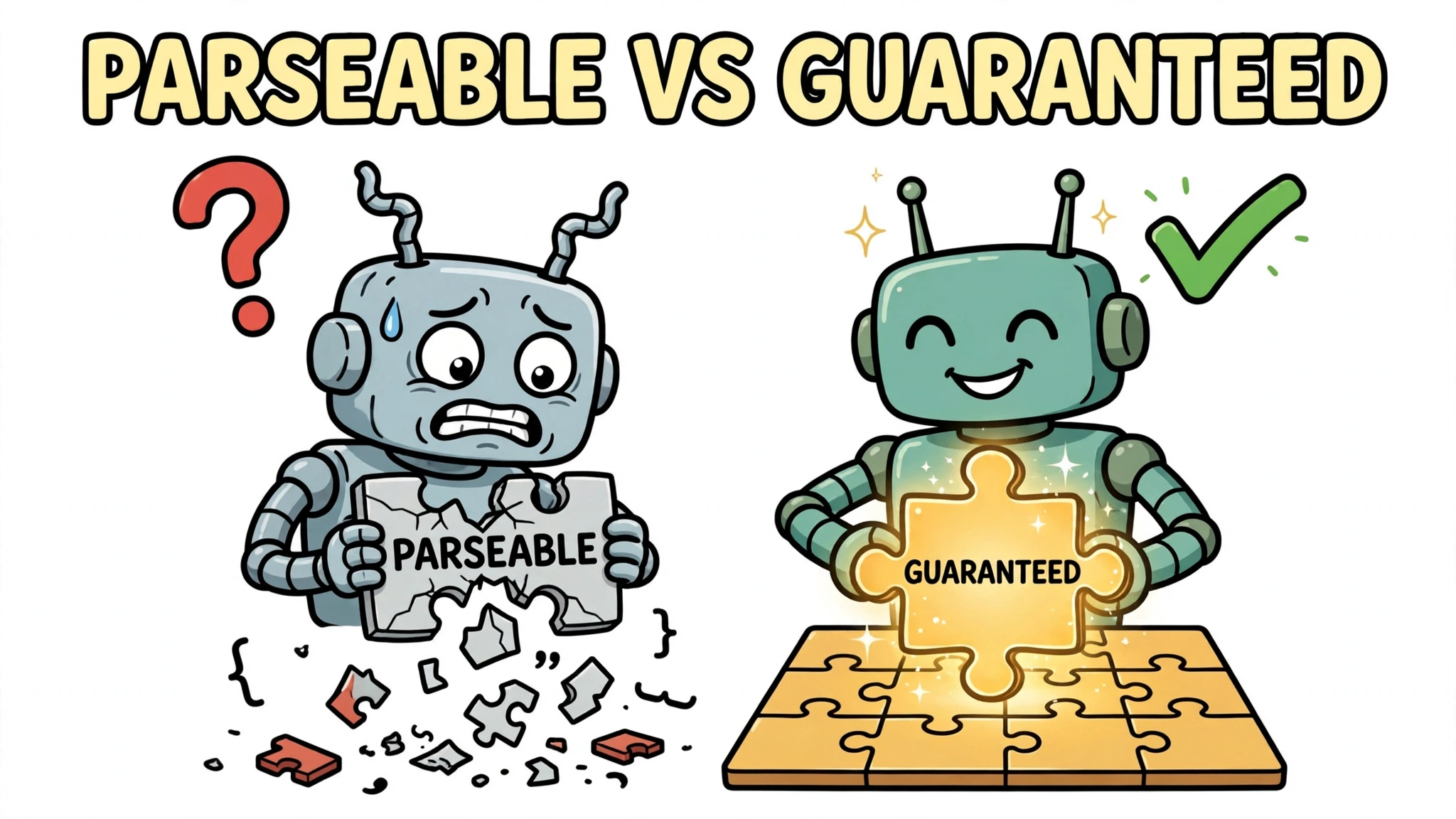
The crucial distinction is between output that merely looks like JSON and output that is guaranteed to match your schema. The first generation of solutions — prompting the model with “respond ONLY with valid JSON” and then parsing with a regex or json.loads — produced the former. Without an output contract, the model returns the right information in the wrong format — a missing field, a string where the number should be, a helpful preamble before the JSON — and any of them breaks the pipeline. Schema-constrained generation exists to move the guarantee from your code to the API itself.
How Agents Produce Structured Output Today
There are four mechanisms in common use, and they offer very different guarantees.
JSON mode guarantees parseable JSON — and nothing else. The lesson it demonstrates is that “valid JSON” is not enough: what programs need is schema-valid JSON. JSON mode cannot stop the model from returning unexpected fields, omitting required ones, or inventing its own types.
Schema-constrained generation is the answer the major providers converged on. Your JSON schema is compiled into a grammar that constrains generation token by token, so the model cannot emit output that violates the schema — the guarantee moves from your parsing code to the API itself. Strict variants tighten the contract further — required fields, no invented extras. When you choose one, prefer an implementation that fails loudly on schemas it cannot enforce rather than silently degrading.
Function and tool calling is the dominant structured interface in agent systems, and it is structured output by another name: tool definitions are JSON schemas, and the model’s tool calls are arguments shaped by those schemas. One condition matters: the schema guarantee holds when the provider supports strict, schema-constrained tool use. Ordinary tool calling without that enforcement is an interface choice, not a guarantee — its arguments still need validation and may need retries, exactly like unconstrained text.
Framework output parsers cover the cases providers do not. When the model cannot be constrained at the API level, the framework coerces: instruct the model with the schema, validate what comes back, and retry with the error fed back into a new attempt. Configure the loop to raise an explicit error when retries exhaust instead of writing a silent bad record.
A worked comparison: the same task three ways
The following is a hypothetical illustration, not measured output. The task: classify an incoming support ticket against a shared contract — category (one of billing, technical, account), priority (one of low, medium, high), and a one-sentence summary. All three fields are required, and no additional properties are allowed. The ticket reads: “My invoice shows a charge twice and I can’t log in.”
JSON mode might return:
{
  "category": "Billing",
  "priority": "urgent",
  "summary": "Customer reports a double charge and a login failure.",
  "confidence": 0.91
}
That is valid JSON, but "Billing" breaks the lowercase enum, "urgent" is not in the priority enum at all, and confidence is an invented extra field. Your code must catch this and retry.
Schema-enforced output compiles the contract into a grammar: "Billing" cannot be emitted where the enum says "billing", and the invented confidence field is rejected outright. The response arrives schema-valid, or the API returns an error. The remaining caveat is an unfinished response — a truncated output can still break the contract, which is why validation stays in the loop.
Strict tool calling frames the same contract as a tool, e.g. classify_ticket: the model emits a tool call whose arguments are constrained to the schema at generation time. The routing code still validates the values — is this really a billing issue? — before acting on them. Note the condition from the previous section: this guarantee belongs to strict tool use. Ordinary tool calls need the same validation and retry handling as any other model output. Same fields, three different guarantees: JSON mode promises parseability, schema-constrained generation promises shape, strict tool calling promises shape at the point of action. In all three, validating meaning stays your job.
Structured Output AI Agents Produce: Five Roles It Plays in Reliable Systems
With the mechanisms in place, the interesting question is what structured output actually does inside an agent loop. It plays five distinct roles.
1. Trustworthy tool input. An agent that calls tools lives or dies on its arguments. Schema-constrained tool arguments give the next tool call predictable structure and types instead of prose that has to be scraped — which is why strict schema enforcement on tool definitions matters. But structure is not permission: values and action requirements must still be validated before anything executes.
2. Structured state and memory updates. Agents that run for many steps accumulate state: what was tried, what worked, what the user asked. When the model writes its state updates as validated objects, the loop can merge them deterministically instead of re-reading prose and guessing.
3. Control flow. Classification, routing, and branching decisions are outputs the loop acts on. A router that returns {"route": "billing", "confidence": 0.92} is a decision; the same information in a paragraph is a hope.
4. Evaluation and observability. Graders, monitors, and dashboards need fields, not essays. Structured outputs make it possible to log, aggregate, and alert on agent behavior — which fields were populated, which enums were chosen, how often validation failed.
5. Consistent user-facing delivery. Tables, summaries, reports, and forms all render better from structured data than from prose the frontend has to interpret.
Where Structured Output Goes Wrong: The Common Failure Modes
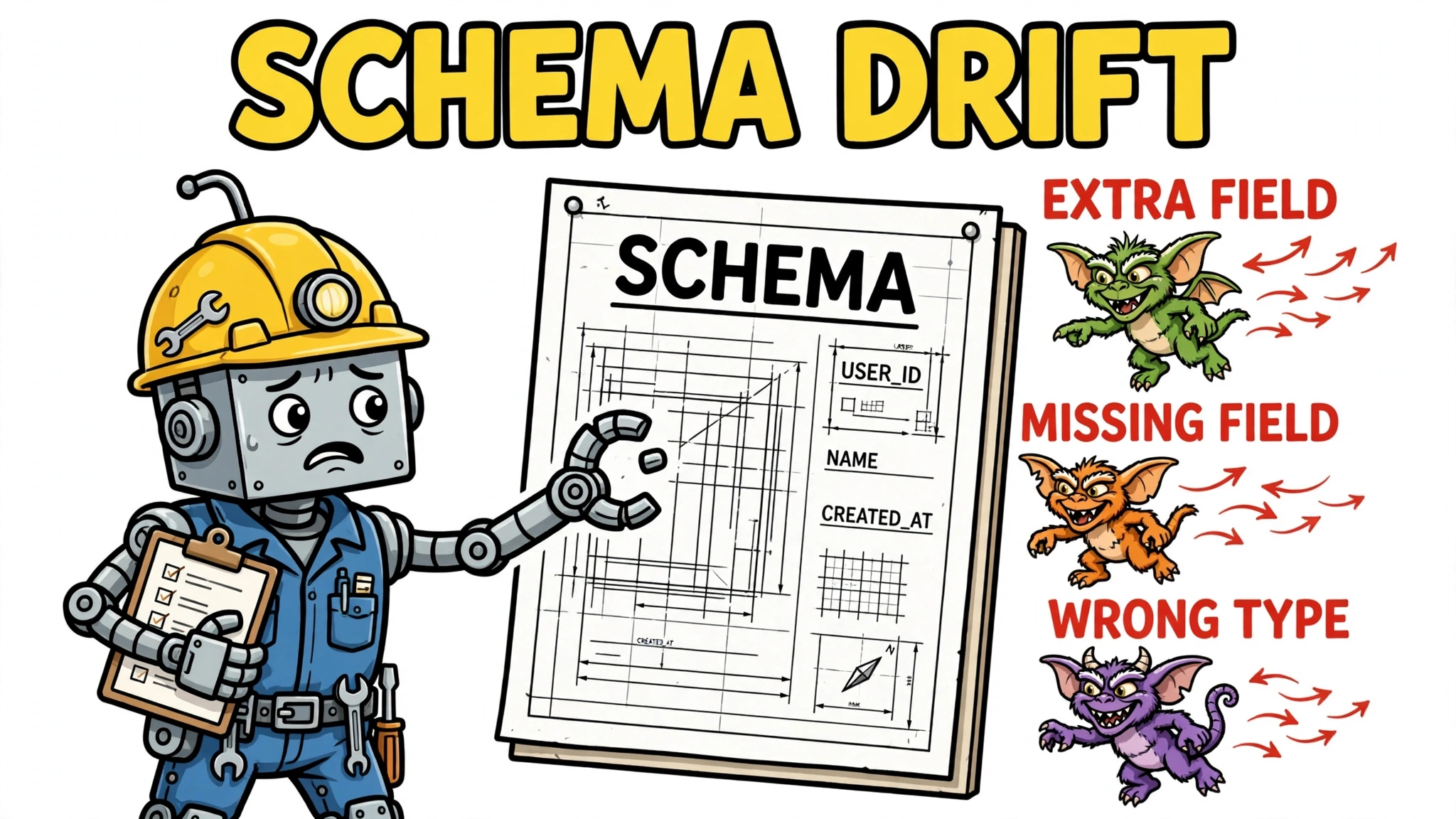
Constrained decoding is a guarantee about shape, not about sense — and even the shape guarantee has edges. The failure modes production teams actually hit:
Schema drift. Without strict mode, models add extra fields, drop required ones, emit strings where numbers belong, or hallucinate enum values. This is the classic failure that pushed the industry from JSON mode to strict mode in the first place.
Truncation breaks the contract. If the model stops early — a token limit, an interrupted stream — the output can be cut mid-object and fail to parse. Constrained generation cannot protect the tail of an unfinished response, so length limits and truncation handling belong in your design from the start.
Strictness has a subset. Constrained generation supports only a subset of schema features, and the subset differs by provider — a constraint you write is not automatically a constraint the provider enforces. Treat the schema as the request and your own validator as the enforcement.
The over-constraint trade-off. One tension practitioners debate is whether heavily constraining a model can dull its reasoning on open-ended tasks. Treat it as an open design question rather than a settled fact. As practical guidance rather than a proven mitigation: constrain the output contract, not the reasoning process — and validate the values downstream regardless.
Retry cost. Every validation failure costs a round trip: latency, tokens, and money. That is what makes the guarantee valuable in the first place — fewer retries — and what makes tight schemas worth the effort: fewer fields and stricter enums mean fewer ways to fail.
Choosing Your Approach: Practical Guidance
The decision tree is simpler than the landscape looks. Use provider-enforced schemas first whenever reliability matters. For everything else, fall back to tool calling as the structured interface or to parser-plus-retry layers: feed validation errors back to the model, and raise an explicit exception when retries exhaust rather than writing a silent bad record.
Three rules cover most of the rest. Validate everything at the boundary — never trust the model, even in strict mode. Keep schemas tight: fewer fields, strict enums, no “anything goes” fields, because every constraint you skip is a failure mode you accept. And design for incomplete responses: assume any response can arrive truncated or refused, and handle those paths before you touch the payload.
What Structured Output Unlocks: The Bigger Picture
The deeper reason structured output matters is that agents are becoming composable. Agent-to-agent communication needs contracts, not prose: when one agent hands work to another, a schema is what makes the handoff testable, chainable, and swappable. Structured outputs make agents into pieces you can assemble — chained, graded, and replaced independently — instead of monoliths held together by prompt luck.
The interface between language models and software is moving from persuasion to contract: from “respond ONLY with valid JSON” prompts and regex extraction, to JSON mode, to grammar-constrained generation as a standard approach. And the caveat travels with it — constrained output guarantees the shape of an answer, never its truth. Structured output makes an agent’s answers reliable to handle. Making them reliable to believe is still your job.