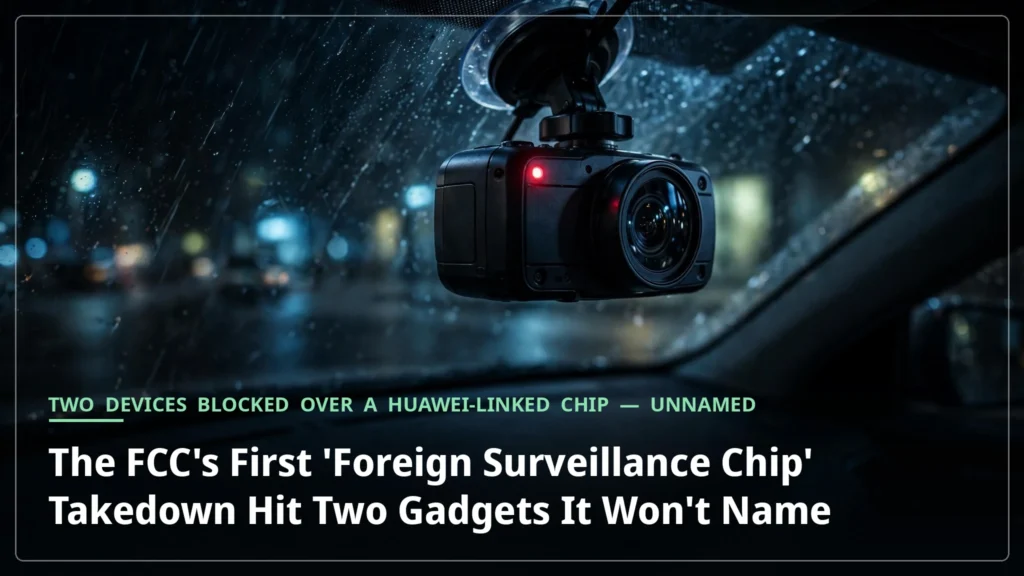



On October 22, the Federal Communications Commission did something it had never done before: it reached into two finished consumer gadgets and blocked them — on chip-based grounds the agency tied to a “foreign surveillance chip.” The agency has not publicly established any unauthorized surveillance or data transmission by either device, and it did not identify which gadgets it had blocked.
This is the first exercise of a power the FCC gave itself on October 13: the authority to deny equipment authorization to any device containing a computer chip made by a company on its national-security threat list. The rule, the FCC’s Third Report and Order, extends the old ban on finished gear from blacklisted companies down into the components — the silicon buried inside somebody else’s product. FCC Chairman Brendan Carr calls it closing the “component part loophole.”
The foreign surveillance chip, and why the FCC is worried about it
The agency did name the chip. It is a Hi3516CV610 UHD Smart Vision SoC, a processor that turns a raw camera sensor into a functioning camera — the brains of home security cameras, dashcams, and similar devices, often sold bundled with a camera sensor. The two gadgets caught in this first action were a dashboard camera and a wireless video transmitter.
Why does the FCC call this a foreign surveillance chip? The agency’s own explanation rests on two facts. First, the chip’s maker advertises it as “designed for the surveillance market,” with built-in detection algorithms for human faces — the label is, in part, a literal reading of the product’s marketing copy. Second, the chipmaker is a subsidiary of Huawei, and Huawei sits on the FCC’s Covered List of companies deemed national-security risks. The enforcement’s legal basis is that corporate connection: under the new rule, the agency looks past whose name is on the box to who designed the logic, who holds the intellectual property, and who controls fabrication.
As Carr has put it: “trust starts in silicon.” The principle is that a compromised logic-bearing component can undermine every security layer above it, so the chip itself is the threat.
What the FCC isn’t saying
Here is where the debut gets interesting. The FCC identified the product categories — a dashcam and a wireless video transmitter — but not the commercial brands, not the model numbers, not the manufacturers, not even the FCC application IDs. The exact two finished products cannot be reliably named from the information the agency released. The Verge’s request for comment went unanswered.
And one thing the FCC’s announcement does not establish, as trade press noted: there is no claim that either device transmitted information to Huawei or engaged in unauthorized surveillance. The action is preventive — authorization denied because of the chip’s parentage and the product’s marketing — not a punishment for observed behavior.
One discrepancy the reporting has not resolved: The Verge identifies the chipmaker as “HiVision,” while Reuters and trade coverage call it “HiSilicon.” What both accounts agree on is the corporate link that matters to the FCC — a Huawei subsidiary — and the preventive character of the action: an authorization restriction based on component parentage, not a finding of demonstrated surveillance.
That is not necessarily scandalous. Keeping details of an enforcement action quiet is a possible explanation for the nondisclosure — but it is only a possibility. Still, the public debut of this component-level enforcement power consists of what the agency chose to release: a chip named, a marketing brochure quoted, a subsidiary relationship diagrammed — and the actual blocked products withheld from view.
The pattern
This is not the FCC’s first self-granted enforcement expansion. The agency has previously given itself the power to retroactively ban gadgets and to block modular radio transmitters. The Verge places this action in the same lineage as the router ban and the Roomba ban — a steady widening of what the Commission can touch.
The mechanism matters because it shifts a burden onto applicants seeking FCC equipment authorization for covered radio-frequency devices. Under the new rule, they must certify that no logic-bearing hardware component in their device was produced by a Covered List entity — a determination the FCC makes on a totality-of-circumstances basis, examining who designed the logic, who holds the IP, and who controls fabrication. The Covered List includes Huawei, ZTE, Hytera, Hikvision, Dahua, DJI, and Autel.
Safer, or showier?
The reasonable reading, the one the FCC would offer, is that this is a loophole being closed in the open: banned-company silicon was legally flowing into the U.S. market inside other companies’ devices, and now it can’t. The component is made by a Huawei subsidiary; Huawei is on the list; the rule applies. Enforcement need not name names to be real.
The skeptical reading, the one The Verge landed on, is that a first exercise that identified no products and left the press’s questions unanswered can look less like security work and more like the performance of it. As the outlet put it: is the FCC keeping people safer, or just picking winners and losers while making a show of enforcement?
The honest answer is that we can’t know yet, because the FCC told us just enough to raise the question and not enough to answer it. That is the real story of this debut: the agency claimed a power that reaches all the way down to the silicon, used it for the first time, and asked the public to trust it with the details. The most basic question — what was actually blocked? — remains unanswered. It’s worth watching what comes next, and whether the FCC keeps enforcing at the component level, because the next unnamed gadget could be anyone’s.