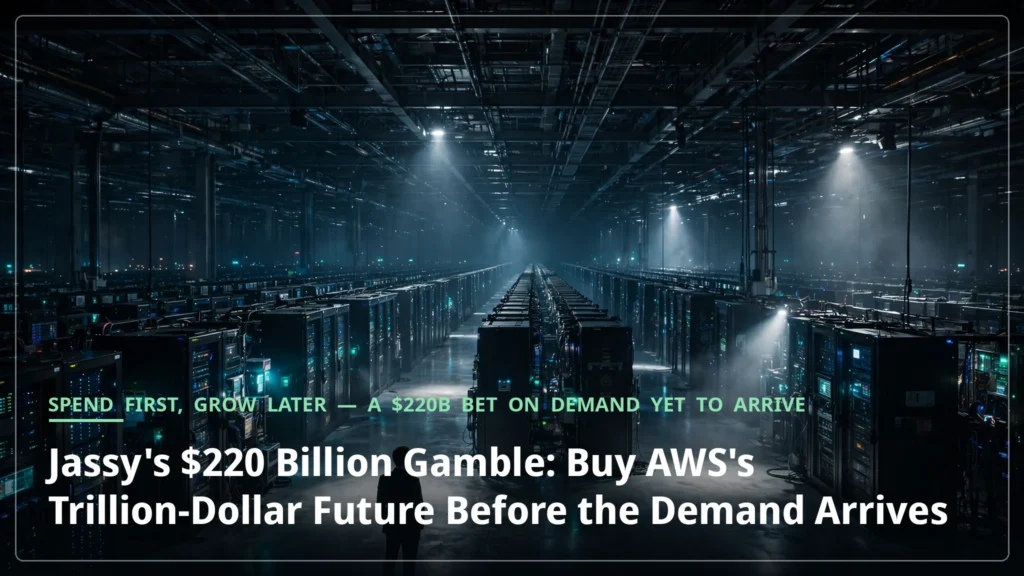



Andy Jassy did not come to Thursday’s earnings call to announce a product. He came to sell a sequence — the AWS trillion-dollar bet: spend first, grow later, and trust that the order works. Amazon will commit about $220 billion in cash capital expenditure in 2026, the majority of it for Amazon Web Services, and spend meaningfully more in 2027, all in pursuit of a business that, in Jassy’s telling, could one day take in a trillion dollars of revenue a year.
“There has never been a business with a trillion dollars of annual revenue,” Jassy said. He believes AWS could get there within five to ten years. It is a striking sentence, and it is worth pausing on what it actually claims. It is not a result. It is not a contract. It is a chief executive telling investors what the spending is for, and asking them to judge the bill by the future it is supposed to buy.
The AWS trillion-dollar bet, stated plainly
The mechanism at the heart of the pitch is timing. Jassy said the company is in the very early days of enterprise adoption of artificial intelligence, and that its strategy is working so far. The argument runs like this: if enterprises are only beginning to move their core and AI workloads into the cloud, then the company that has the capacity ready when they arrive wins the work. Capacity, however, cannot be conjured on arrival. It has to be built in advance, in data centres, servers and chips, and paid for in advance too.
That is why the numbers arrive in this order. First the outlay: about $220 billion in 2026 cash capex, with meaningfully more expected in 2027, and a claim from Jassy of a clear line of sight to attractive financial returns. Then the forecast that is supposed to justify it: AWS growing north of 40% in each of 2027 and 2028, from a business Jassy described as a $184 billion annualised revenue run-rate operation. The spending is the bet; the growth is the payoff; and the gap between them is where the whole story lives.
Jassy did not soften the scale of the commitment. He characterised the AI boom as a once-in-a-lifetime opportunity, said Amazon would invest to continue being the leader, and said the company can fund the plan. “It will forever change the size of Amazon,” he said. Those are the words of someone who believes delay is the expensive option.
What the quarter actually showed

The quarter behind the pitch gives Jassy something real to point to, and his critics something real to question. AWS revenue reached $46 billion in the third quarter, up 39% from the year-ago quarter, the sixth straight quarter of acceleration and, by several accounts, the segment’s fastest growth in nearly five years. Amazon’s total revenue was $201.9 billion, up 12% year over year, while earnings per share of $1.89 came in below Wall Street estimates. AWS operating income was reported at $17.8 billion, at a 38.7% operating margin, and the business was reported to carry a backlog of $578 billion in contracted future revenue, more than double a year earlier.
None of that settles the argument, because the argument is not about whether AWS is growing. It is about whether growth at this pace, bought at this price, continues long enough to pay for itself. The third quarter alone saw $75.9 billion in cash capital expenditure, according to secondary coverage of Amazon’s results. That is the run-rate reality behind the $220 billion annual figure: the build-out is not a future project, it is already consuming cash at a remarkable pace.
The sceptics in the room

If Thursday’s call had a second voice, it belonged to the analysts. They repeatedly asked Jassy to explain the spending, the signals that the growth really will come, and the profit margins expected. Those are not hostile questions. They are the only questions that matter for a bet structured this way, because a plan that spends before demand arrives has to answer, in advance, how anyone will know it is working.
The market’s same-day answer was unenthusiastic. Shares fell about 6% in Thursday after-hours trading, according to TechCrunch; other outlets put the decline at about 7%, a difference that reflects differing measurement times rather than a different story. Either way, a quarter featuring 39% AWS growth did not buy the stock a good evening. The AI infrastructure build-out has been an ongoing source of investor concern through the year, and Thursday did not remove it.
It is important not to over-read that fall. A share price on one evening is not a verdict on a ten-year plan, and the decline coincided with an earnings miss against expectations as well as with the spending debate. But the juxtaposition is the story’s tension in miniature: strong growth, large bill, and a market that wants proof the second is buying the first.
The case for Jassy
The counterargument deserves its full weight. If enterprise AI demand materialises at the pace Jassy describes, the spending looks less like extravagance and more like the entry fee for a market that may not wait. AWS is a $184 billion annualised run-rate business, and its revenue increased 39% from the year-ago quarter; Jassy said the company is in the very early days of enterprise AI adoption, with its strategy working so far. A business growing that fast from that base does not obviously need to apologise for investing.
Nor is Amazon alone in writing large cheques. Microsoft, for instance, just posted further record-breaking revenue growth driven largely by its cloud business, and it too has spent heavily. If every serious cloud provider is building at once, standing still may not be the cheap option; it could leave Amazon short of capacity if rivals build and demand arrives. One analyst firm, Canaccord, went further after the results, calling the selloff a spend-scare overreaction rather than a break in the investment thesis, and pointing to AWS growth and rising demand for AI computing.
That defence, though, still leaves the central question untouched. Rivals spending heavily shows other cloud providers see the same opportunity; it does not prove any one runner wins it, or at what margin.
What would settle it
Three questions will decide whether Jassy’s sequence holds. First, margins: what profit does Amazon expect on the new AI capacity, and over what timeframe? Second, conversion: what signals will show that capacity built in 2026 and 2027 is turning into the forecast growth north of 40% in 2027 and 2028? Third, composition: how much of AWS’s current 39% growth is AI workloads, and how much is the broader cloud business doing what it has always done?
Until those answers arrive, the trillion-dollar figure functions less as a forecast than as a frame. It tells investors how Jassy wants the spending judged: not against this quarter’s earnings, but against the trillion-dollar ambition Jassy set out. That is a legitimate way to present a long-term plan. The trillion-dollar outcome itself sits five to ten years out, but the nearer-term tests — growth in 2027 and 2028, margins, and capacity conversion — arrive much sooner.
The honest version of Thursday’s call, then, is neither triumph nor warning. It is a company with a fast-growing cloud business, a chief executive convinced the window for building is now, and a market that has heard the pitch and is waiting, with its chequebook half open, for the growth to arrive on schedule. Jassy has bought the future first. Now he has to show it was on sale.