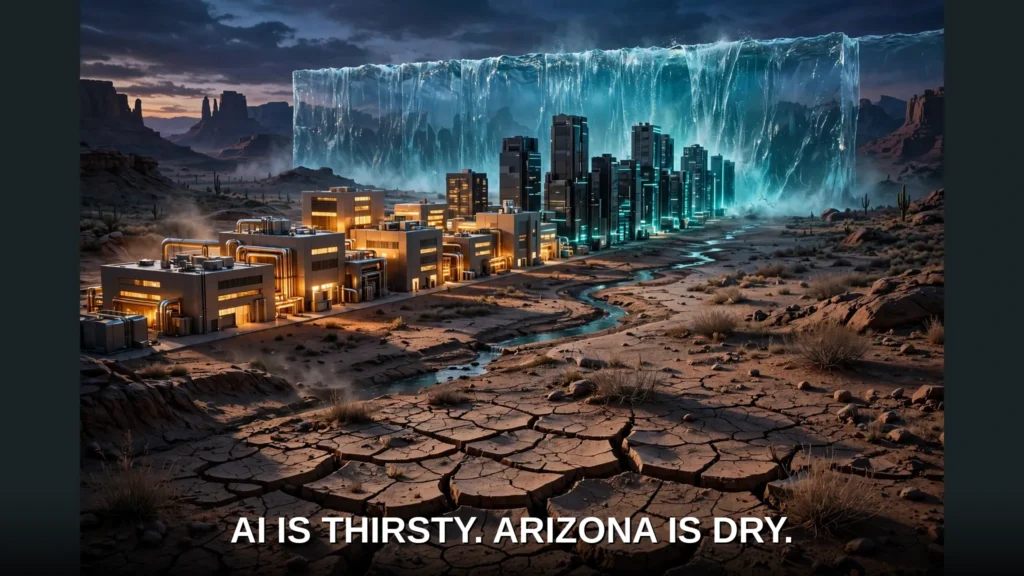



Arizona AI infrastructure did not arrive by accident, and it did not arrive quietly either. In a desert state where water has always set the limits of growth, the chip factories and data centers that power artificial intelligence now draw millions of gallons a day, compete for power and land, and face a grassroots backlash that would have seemed unlikely only a few years ago. The question at the centre of the dispute is not whether Arizona wants prosperity. It is whether a state facing cuts to its Colorado River supply can keep expanding industry that draws millions of gallons of water a day, and on whose terms.
This is the story of how Arizona became a hub for the physical side of AI, why the same state that welcomed chipmaking now resists new data centers, and what remains unresolved about measuring, disclosing and limiting the water that expansion consumes.
Why Arizona became an AI infrastructure hub
Long before the current AI boom, Phoenix was trying to revive its economy by landing a major manufacturer. The city’s economic development office, led by Christine Mackay, pursued Taiwan Semiconductor Manufacturing Company (TSMC) after the chipmaker had been shopping for a United States site since 2016. Mackay later described the approach in blunt terms: “We aren’t a group that takes no for an answer.” TSMC announced its Phoenix fab in 2020, and what began as a projected $12 billion investment by 2029 has since grown to a reported $265 billion, described in reporting as the largest foreign direct investment in United States history.
The result is a cluster that is hard to overstate. Arizona now hosts 172 data centers alongside what reporting describes as the largest chip factory this side of the Pacific. Chipmaking and data centers are different businesses, but they feed the same AI economy: fabs make the advanced chips that train and run AI models, and data centers house the servers that run those models at scale. When AI demand surged, Arizona already had the factories, the sites and the political welcome mat in place.
That welcome had a history. Arizona’s historic economy revolved around the “five C’s” — cattle, copper, cotton, citrus and climate. Mackay calls chips the state’s sixth C: “Chips.” The phrase captures how completely chipmaking has been folded into Arizona’s idea of itself, not as an outsider industry imposed on the state, but as the next chapter of an economy that has always been built on extracting value from a harsh landscape.
TSMC’s Arizona fabs and their water use

Chipmaking is, above all, a cleaning business. Each chip requires 50 to 250 wash cycles, and the water used must be ultrapure: as Paul Westerhoff, director of Arizona State University’s Global Center for Water Technology, put it, “If there’s a little particle in there, or an ion-like chloride in there, the thing doesn’t work, so they need to use a lot of water in each of these cleaning cycles.” It takes 1.4 to 1.6 gallons of municipal water to create a single gallon of ultrapure water.
That chemistry translates into a striking headline figure. TSMC’s Arizona complex draws nearly 5 million gallons of water a day from Phoenix’s municipal supply; a more precise figure cited in reporting is 4.75 million gallons per day. A second fab is completed, a third is under construction, and more are planned. When the three fabs are running, they are expected to require 17.2 million gallons of water per day, under a Phoenix development agreement for 11.4 million gallons per day. TSMC has invested more than $65 billion in the three Phoenix fabs and has broken ground on an industrial water reclamation project in Phoenix.
TSMC was welcomed, and the first wave of data centers was largely ignored. The difference, as the reporting makes clear, is not that chipmaking uses little water. It is that TSMC arrived as a celebrated manufacturing prize, with jobs, investment and prestige attached. The newer, larger data center proposals arrived later and bigger, and face opposition as the state’s water supply tightens. Whether the timing of that tightening explains the different reception remains an open question.
How data centers use water, and how much
Data centers use water mainly for cooling and operations. The servers inside them generate enormous heat, and removing that heat at hyperscale takes power and land, and, depending on the cooling design, water as well. Some designs use closed-loop air cooling instead of water cooling, and the indirect water cost of the electricity they consume is not yet quantified for Arizona. A useful comparison point comes from outside Arizona: a facility such as Google’s in The Dalles, Oregon, uses about 1.5 million gallons a day, roughly one-third of TSMC Arizona’s daily use. A single large data center, in other words, can rival a significant industrial water user on its own, and Arizona’s newer proposals are larger than the earlier wave.
That scale is the core of the local objection. Newer, larger developments proposed from Phoenix to Tucson demand more water, power and land than earlier developments did, and residents argue that the combined demand of many such projects is what matters, not any single facility’s brochure figure. Developers, for their part, point to efficiency measures and to cooling technologies that use less water on site. The dispute is partly about engineering, and partly about trust: whether a promised figure will hold once a facility is running, and who verifies it.
Arizona’s water scarcity in context
None of this would matter as much in a water-rich state. Arizona is not one. Its long-standing scarcity is the reason water, not just electricity or land, has become the binding constraint on AI infrastructure growth. The Colorado River, on which much of the state depends, is under strain, and Arizona is currently taking Tier 1 reductions for 2026: a 512,000 acre-foot reduction that constitutes 30 percent of the Central Arizona Project’s normal supply, about 18 percent of Arizona’s Colorado River supply, and just under 8 percent of Arizona’s total water use.
Those distinctions matter. The oft-quoted “30 percent” figure describes the cut to the Central Arizona Project’s normal supply, not a 30 percent cut to all of Arizona’s water. But the direction is clear, and it sharpens every siting decision: each new industrial water demand arrives as existing supplies shrink. Scarcity turns what might elsewhere be a routine planning decision — where to put a warehouse full of servers — into a public decision about a shared resource.
The grassroots backlash against new data centers

The backlash has been grassroots, bipartisan and organised. A coalition of residents opposing new data center developments stretches from Phoenix to Tucson, organising around zoning, land use and water consumption, and speaking at city council meetings. The movement’s breadth is part of its power: this is not a single neighbourhood fighting a single project, but residents across the state making the same argument in different council chambers.
The most visible flashpoint has been Project Blue, a Beale Infrastructure data center campus near Tucson. The Tucson City Council voted unanimously to reject annexation for Amazon’s planned Project Blue AI data center campus after packed public meetings, and Mayor Regina Romero said the city would look to place limits on future data centers. The project, as reported, covers a 290-acre site with up to 10 buildings totalling 2 million square feet and 600 megawatts planned, a reported $3.6 billion investment, and two approved construction wells that could draw up to 31 million gallons of groundwater per year.
Rejection of annexation at the council did not end the project. Beale nevertheless continued it, switched from water cooling to closed-loop air cooling, and secured a Tucson Electric Power supply agreement; Amazon reportedly withdrew as prospective tenant after the cooling change. A Beale spokesperson, Tony Burkart, said of the switch: “The use of air-cooled technology for this project does not increase overall energy use; while the energy allocation is different, the energy use is the same.” Critics argue air cooling may increase water use indirectly, because power plants also use water — while noting there is little data on how much water Arizona’s power plants consume. That data gap is itself part of the dispute: without it, neither side can fully prove its case about the true water cost.
What developers promise, and what residents doubt
Developers promise jobs, tax revenue and infrastructure. Data center developers argue that their projects bring investment, construction work and a larger tax base to host communities, with water use lower than critics fear — especially where closed-loop or air-cooled designs are used.
Residents doubt the assurances for reasons that go beyond any single project’s numbers. They have watched the state’s water supply tighten, they have seen a project continue after a unanimous council vote against annexation, and they question whether efficiency promises survive contact with round-the-clock operation at full scale. Arizona Attorney General Kris Mayes has called for limits on new data center construction, saying: “Data centers are power- and water-intensive, and Arizona is challenged on both fronts right now.” In June, Governor Hobbs signed a budget bill with a three-year moratorium on new data center tax breaks, according to Cronkite News reporting cited in secondary coverage.
Both sides claim to want a more prosperous Arizona. The disagreement is over what prosperity costs, who pays that cost in water and power, and whether the state should keep approving thirsty infrastructure while its river supply shrinks. That is a political question as much as a technical one, and it is why the debate has moved from engineering reports into council meetings and the attorney general’s office.
What happens next for Arizona AI infrastructure
What happens next will be decided project by project, and the open questions are concrete. Will new proposals be approved, scaled back, or have annexation rejected, as happened for Project Blue at the Tucson council? What water, power and land conditions would be needed for expansion to proceed in a way residents accept? And what remains unresolved about measuring and disclosing facility water use — including the indirect water cost of the power that air-cooled facilities consume?
The research leaves three questions unanswered for now: the most recent, verifiable water-use figures for TSMC Arizona’s operating fabs and for specific proposed Arizona data centers; whether Beale Infrastructure has found a new tenant for Project Blue, and the project’s current approval and construction status; and how much water Arizona’s power plants consume, so the indirect water cost of air-cooled data centers can be quantified. Those data gaps leave the water implications of expansion unresolved, and leave open how much weight they will carry in a debate that is also about who gets to say how much water is being used, and whether the state’s desert can carry the industry it worked so hard to attract.