

The uno reverse
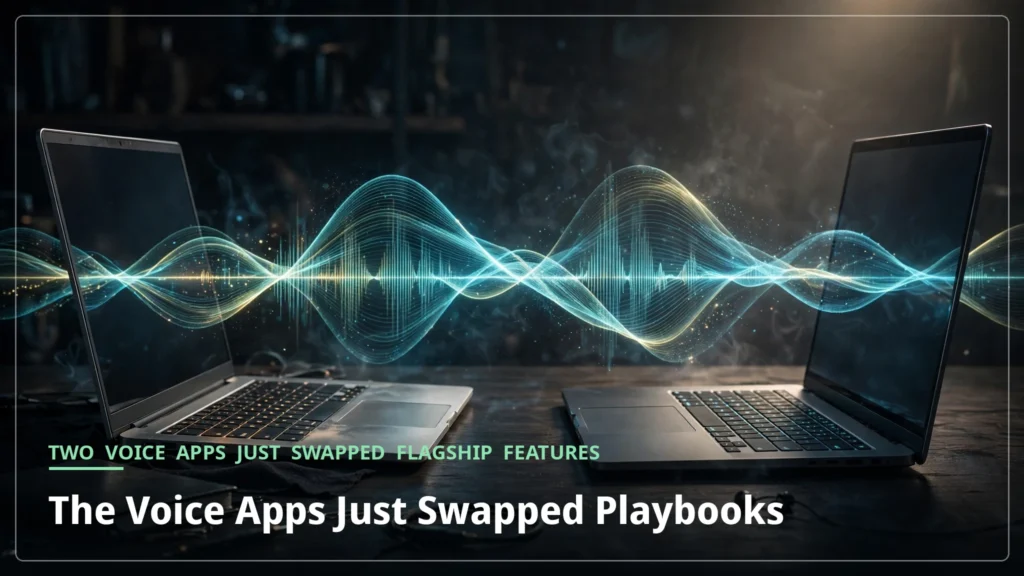
There is a particular kind of comedy that only the tech industry can stage: two voice apps become known for one thing, then each announces the other’s thing, within months, as if nobody will notice the symmetry. On 29 October 2026, Granola did exactly that. The app known for its meeting notetaker launched a dictation feature, months after Wispr — the app known for dictation — launched a meeting notetaker. TechCrunch’s headline for the Granola news said it plainly: the feature was built to compete with Wispr. Call it the uno reverse.
It is a funny image, and it is also the whole story in miniature. Granola and Wispr started at opposite ends of voice AI — meetings and dictation — and each has now added the other’s flagship feature. That symmetry suggests the contest is shifting from a single feature to the whole spoken workflow. It suggests it; it does not yet prove it. The distinction matters, because the evidence so far is two product launches and a category trend, not a verdict on what wins.
What Granola actually shipped

The feature itself is, by design, unremarkable to use — and that is the point. On the Mac, where it currently works, a user presses the Fn key and starts speaking. Granola cleans up and formats the speech and posts the final text, and it works across all apps, so the same voice can produce notes, dictate prompts, and reply to emails and messages. Granola announced it in its own voice: “Granola now does voice typing. Unlimited words, for free.” And then: “Granola already writes your meeting notes. Now it can do the typing for you, in any app.”
Two details deserve to be kept in their proper tense. The first is that “unlimited words, for free” is Granola’s announcement wording, and nothing in the reporting so far says how long that offer lasts or what, if anything, it will cost later. The second is that the feature is Mac-only for now. The company said it will land on iOS and Windows soon. Soon is the company’s word, not a delivery date, and until those versions arrive, the dictation story is a Mac story.
Even with those caveats, the move changes what Granola is. A meeting notetaker captures what other people say in a scheduled conversation. Dictation captures what you say, whenever you say it, in whatever app you happen to be in. One is about the meeting; the other is about the whole working day. Granola has gone from owning a slice of your spoken life to bidding for all of it.
Wispr moved first
Granola’s announcement only looks like a surprise if you missed the first half of the swap. Wispr Flow’s Notetaker launched on 5 August 2026 for Mac, with Windows following on 15 September, according to Wispr’s launch listings, and reviewers describe it as Wispr’s first product beyond dictation: it records from the audio on the user’s own computer, so no bot joins the call as a visible participant, It is included in every Wispr Flow plan, including the free one.
So the timeline is not a single launch in isolation. It is a sequence. Wispr, the dictation company, launched a meeting notetaker in August. Granola, the meeting-notes company, has now launched dictation. Each has walked into the other’s home territory, a few months apart, with the other’s flagship feature in hand.
Voice apps are converging

The swap is not exclusive to these two companies, and that is what turns a product announcement into a category story. TechCrunch reports that other voice startups — Fireflies, Speechify, and Monologue among them — have also converged into multifeature apps with meeting notetaking and dictation capabilities. Until earlier in the year, the piece notes, the play was around having a focused app that does one thing well. “But now, all of these apps are thinking about how to get more out of capturing users’ speech.”
Read that sentence twice, because it contains the question at the heart of this moment. Is the prize a better transcript or a faster dictation engine — or is it capture itself: more of what users say, in more places, flowing through one product? A focused app that does one thing well has one stream of speech. A multifeature app has the meeting and the memo, the email and the prompt. If the future of this category is an app that mediates everything you say to your computer, would owning one feature ever be enough — or would every app eventually have to build the other half?
The valuations show the scale of the companies making these moves, though they do not settle what wins. TechCrunch puts Granola at $1.5 billion and Wispr at $2 billion. The two companies are also placing visibly different bets underneath the feature race: Granola is focused on meeting-related automation and notetaking, while Wispr is trying to build its own models through a research lab exploring different human-computer interfaces. Same feature checklist, different theories of what the company underneath should be.
Or maybe it is just table stakes
Here is the strongest case against reading too much into the mirror. Feature parity is often just table stakes: once one app adds the obvious missing feature, the others must follow or look incomplete, and nothing fundamental has changed. Granola may stay, at its core, a meeting-automation company that happens to dictate. Wispr may stay, at its core, a dictation company with a research lab that happens to take notes. Users, faced with two apps that now do both things, may simply use both — one for meetings, one for writing — or stay wherever their notes already live. And there is a real cost to convergence that the announcements do not mention: every feature added is a chance to dilute what made the app good in the first place. The focused app that did one thing well had a virtue, and multifeature bloat is how virtues get spent.
That counterargument is why the careful version of this story is hedged. The launches suggest a shift toward breadth; they do not establish that breadth has displaced single-feature quality as what wins. A user choosing between these apps still has to ask the unglamorous questions: which transcript is more accurate, which summary is more useful, which app gets out of the way. The feature checklist is converging. The quality verdict is not in.
What to watch
The questions that would settle this are refreshingly concrete. Does Granola keep dictation unlimited and free, or was that a launch offer with an expiry date nobody has announced? Does Wispr answer with a further move, or does it treat meeting notes as a side feature while its research lab does the real work? Do users actually switch, or does the overlap just mean everyone now pays for two apps that do the same two things? And when the iOS and Windows versions of Granola’s dictation arrive, do they behave the same way across apps — or does the Mac-only launch turn out to have been the easy version?
Until those answers arrive, the honest summary is the symmetrical one. Two voice apps have each added the other’s flagship feature. The joke writes itself — uno reverse — but the question underneath is serious: in a category built on capturing speech, is an app that only hears half of what you say enough?