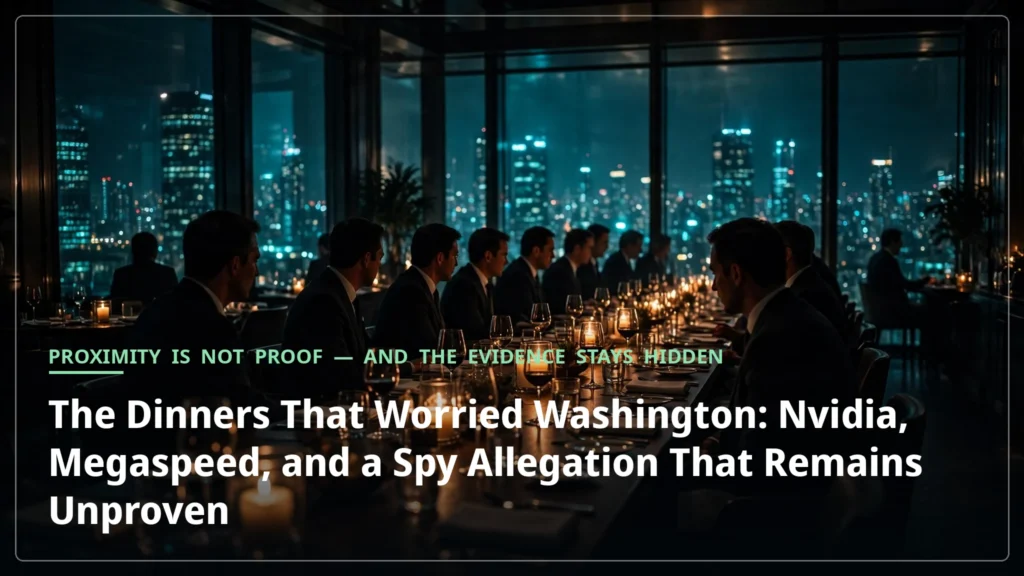



Some of the most consequential meetings in technology do not look consequential at all. They look like dinner. That is the uncomfortable centre of the latest report about the Nvidia Megaspeed spy allegation, involving chief executive Jensen Huang, and a Singapore-based AI cloud company called Megaspeed.
According to the New York Times, as reported by TechCrunch, anonymous sources said that a top Megaspeed executive, Alice Huang — also known as Huang Le, and not related to Jensen Huang — could also have been a Chinese spy. The same reporting said United States intelligence agencies had been surveilling Alice Huang for about a year to learn more about her ties with China. The allegation has not been publicly proven, and no charges against Alice Huang or Megaspeed are reported in the Times account as summarised by other outlets. That gap, between a grave reported concern and what the public can verify, is the story.
Proximity, not a break-in: the Nvidia Megaspeed spy allegation

The reported concern was not that someone hacked Nvidia. It was that someone got close. TechCrunch reported that Alice Huang was photographed as one of multiple people with Jensen Huang during various business dinners in the Singapore region. The sources’ reported concern, as TechCrunch put it, was that she had grown so close to Jensen Huang that she could have been gathering information about Nvidia’s plans and about the chief executive’s efforts to convince the Trump administration to allow Nvidia to ship more advanced technology to China.
Note the careful wording, because it matters. The reporting does not say, on the public record, that she did gather such information, or what that information was. It says intelligence agencies were concerned that she could have. A photograph from a dinner proves attendance, not access. A year of surveillance proves interest, not a conclusion the public has seen. Any honest telling of it has to keep that distinction.
Nvidia’s answer: this is what a CEO does
Nvidia did not treat the report as a minor misunderstanding. A spokesperson told TechCrunch that the chief executive’s relationship with the Megaspeed executive was the same as with any other regional customer. The company said, in full: “Jensen’s interactions with Ms. Huang are not unusual or unexpected. Meetings with customers are part of a C.E.O.’s job; Jensen talks with thousands of customer executives every year.”
The company went further, drawing a line around what a regional cloud customer actually receives. “Our regional cloud customers receive ordinary business information — not sensitive NVIDIA trade secrets — and zero information relevant to national security,” Nvidia said. On that account, proximity proves nothing, because the room itself contained nothing sensitive to take.
That defence has a force of its own, and it deserves to be stated plainly rather than waved away. A chief executive who meets thousands of executives a year cannot plausibly be expected to treat every dinner guest as a suspected intelligence asset, and a customer meeting is not, by itself, evidence of wrongdoing. If the intelligence concern rests on closeness, Nvidia’s reply is that closeness is the ordinary texture of its business in Asia, not a red flag.
The chip trail underneath the spy claim
The espionage allegation did not arrive on its own. It arrived on top of a separate, longer-running investigation into Megaspeed and the movement of Nvidia chips. In 2025, the Times reported that the Commerce Department had investigated Megaspeed over concerns that it was helping Chinese companies sidestep AI chip export regulations by reselling restricted chips to them. Alice Huang was said to be a top executive for the firm at the time.
Secondary summaries of the Times reporting fill in the chronology, and they should be read with their attribution attached. The investigation is said to have begun in late 2024, after a Commerce Department official visited a data centre in Malaysia and found Nvidia equipment still packed in boxes. Singaporean authorities questioned Alice Huang in 2025 before releasing her. Earlier in 2026, according to those summaries, the Commerce Department transferred the investigation to the Justice Department.
Trade records cited by the Times put the scale in stark terms: Megaspeed’s Malaysian sister company purchased at least $4.8 billion worth of advanced AI equipment containing Nvidia technology between June 2024 and February 2026. Megaspeed buys Nvidia-powered computing equipment and rents data centre capacity to businesses, including China’s Alibaba, according to the same summaries. That business model is itself part of the tension: renting computing power to Chinese customers in Southeast Asia is not the same thing as shipping restricted chips into China.
Here, too, the two sides do not meet. Nvidia has said that diversion allegations against Megaspeed were investigated and debunked last year. The Justice Department transfer reported for 2026, if accurate, suggests an investigation that did not end with that debunking, or a different strand of it. The public record, as it stands, does not reconcile those two claims. An honest article cannot pick one and present it as settled.
Why this story is hard to report, and hard to dismiss
Part of the difficulty is sourcing. The Times account, as relayed by TechCrunch and others, rests on people briefed on classified findings who spoke anonymously. That is a legitimate form of reporting, and it is also a limit: the reader cannot see the underlying evidence, test it, or know what was withheld. Nvidia, by contrast, is on the record denying the picture: it denies anything unusual or sensitive.
There is a second difficulty, and it is structural. The United States has restricted exports of the most advanced Nvidia chips to China since 2022, as a matter of national security, and Nvidia’s chips sit at the centre of the global AI build-out. A Singapore cloud company renting capacity to Chinese firms, a chief executive arguing for looser shipment rules, and an intelligence service watching a dinner guest are not three separate stories. They may be three views of the same export-control regime — or three separate stories that happen to share a subject. The reporting does not settle which.
What we do not know
The list of unknowns is longer than the list of settled facts, and it should be. Did Alice Huang pass any specific information to Beijing, and if so, what was it? What did a year of surveillance establish beyond the reported concern about closeness? What did the Commerce and Justice investigations conclude about Megaspeed, and does Nvidia’s claim that diversion allegations were debunked refer to the same allegations now under investigation? Was Jensen Huang warned about the reported concern, and what did Nvidia know, and when?
Until those questions have answers on the public record, the fairest summary is also the least satisfying one. US intelligence reportedly believed a Megaspeed executive close to Nvidia’s chief executive could have been gathering information for Beijing. Nvidia says the contact was ordinary, the information was ordinary, and the diversion claims were debunked. None of that, on its own, proves a spy plot, and none of it, on its own, disproves the concern that prompted a year of surveillance.
That is the affair, in the end. Not a thriller with a revealed villain, but a system in which reportedly concerning access can look exactly like dinner with a customer — and in which the reported concern and Nvidia’s evidenced denial remain unresolved, with the evidence still hidden.