


The stamp
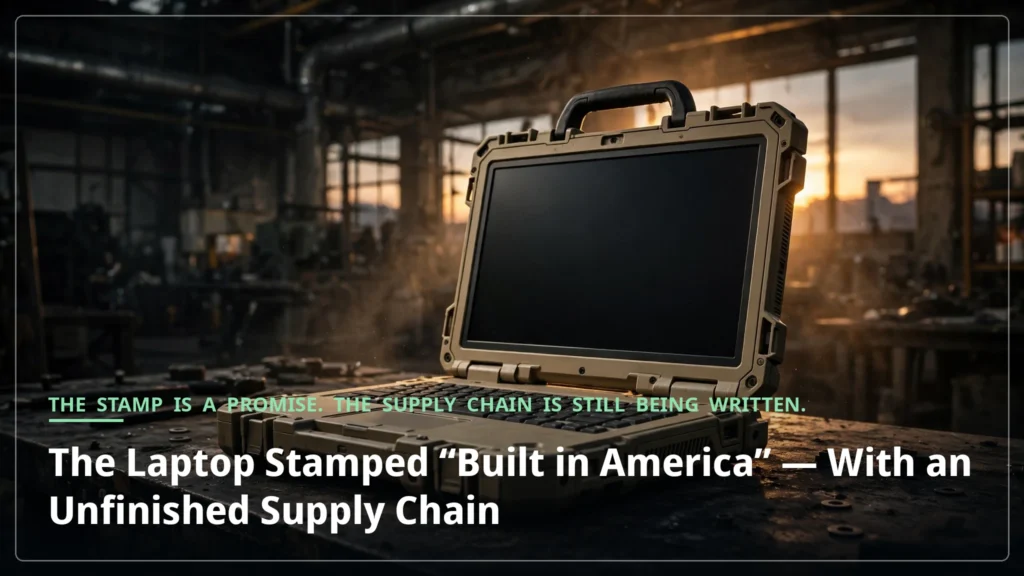
There is a photograph of the thing, and the photograph is the story. The BlueChip laptop is a tan, rugged machine with a carrying handle, built like field equipment, ready for rain and dust. Stamped on the hardware, in plain block letters: “Built in America.”
The laptop is BlueChip, announced on Tuesday by the defence contractor Anduril and the chipmaker Qualcomm. It is a real product, with working prototypes, assembly planned in Ohio, and an intended first market: the US military, whose officials have expressed informal interest in buying it. It is also, by the admission of the man whose company is making it, a claim the company itself has not yet quantified.
Asked at a media briefing what share of the laptop’s components will be made in the United States at launch, Anduril’s founder, Palmer Luckey, answered: “TBD… Those questions are not settled.” He went further in a separate interview, saying it is most likely the device that ships “won’t be 100% American-made.”
That is the whole story, really. A defence company famous for drones and autonomous weapons has decided that the laptop is a national security problem, and it is selling the solution before the solution fully exists. The stamp is a promise. The spreadsheet behind it is still being written.
What the BlueChip laptop actually is
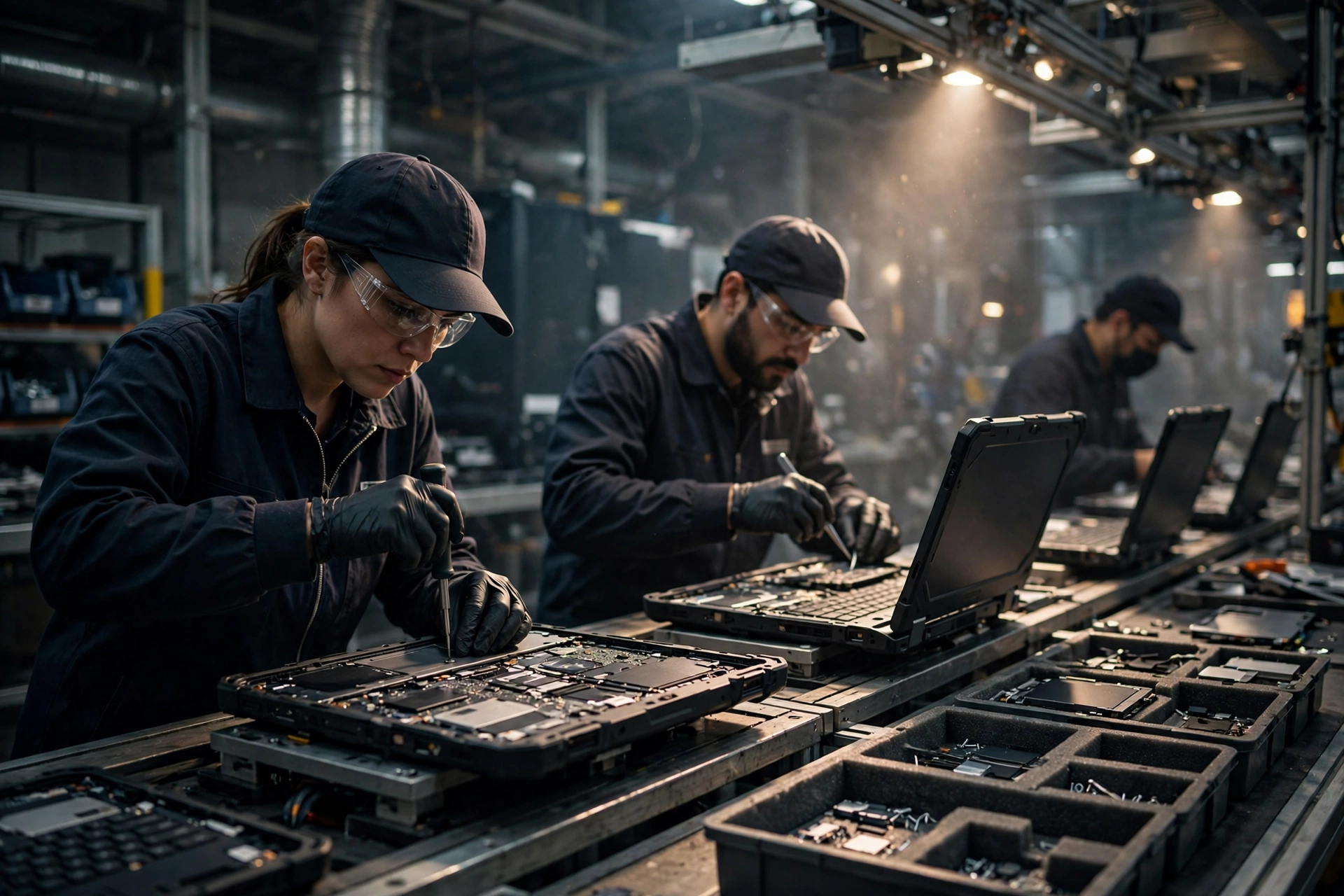
Strip away the flag-waving and BlueChip is a serious, specific machine. The first model is a hardened laptop built around Qualcomm’s Arm-based Snapdragon X series processors, which Qualcomm says will be manufactured at TSMC’s plant in Arizona. Final assembly, including circuit-board assembly and system integration, is planned for Anduril’s Arsenal-1 manufacturing site in Ohio.
The machine is designed for the people who buy rugged computers already: soldiers, government workers, police, first responders and national-security staff. It runs Windows and two Linux distributions popular with the US military, and Anduril’s own Lattice software natively — the AI command-and-control platform behind the military’s Next Generation Command and Control modernisation programme.
It will not be cheap, and Luckey does not pretend otherwise. He estimates it will cost roughly 20% more than a typical high-end personal computer, and has said plainly that a rational consumer with no patriotic reason to buy one would be better off buying a Dell. The venture is pitching first to buyers for whom the origin of every component is itself the selling point. Consumers come last on Anduril’s list, after government and public safety.
None of this is vapour. There are working prototypes. The company has a factory. The chips have a fab. What is missing is the last mile of the claim: the supply chain.
The gap between the stamp and the spreadsheet
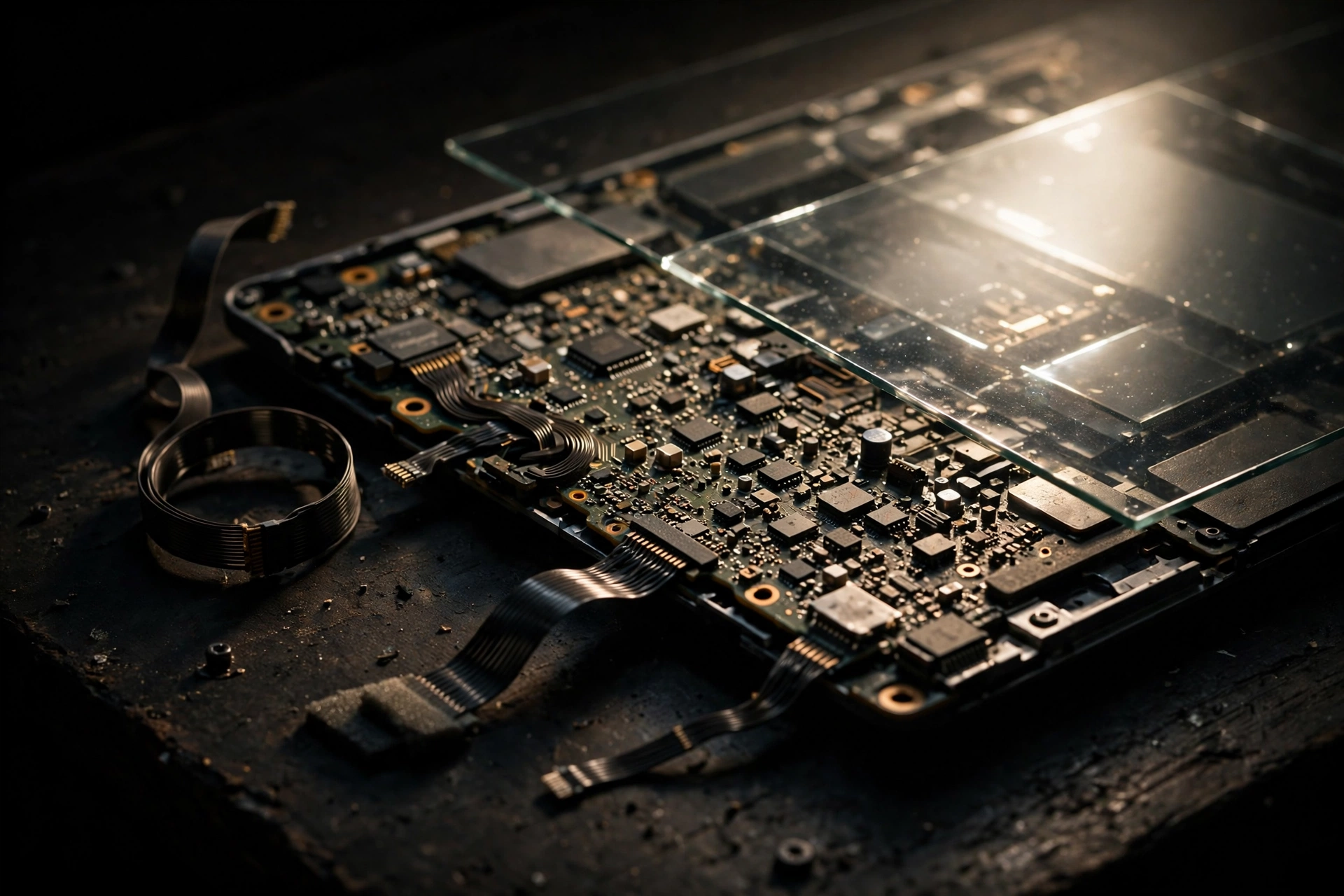
Anduril’s own press release is more careful than its hardware. It says the first BlueChip laptops will only be “designed and assembled in the United States” — assembled, not made. The components Luckey says will be American-made from the start are a short and humble list: the display glass, the frame around the display, and parts of the ribbon component. The display panel itself is still manufactured only in China, and Luckey says Anduril is working on developing such materials itself.
The number Luckey does give is about 90%: roughly 90% of the first generation’s bill of materials, he says, will come from the United States and allied countries. Read that phrase carefully: American and allied. The chip is to be made in Arizona by TSMC, a Taiwanese company. The allies are doing some of the work, which is the point of an alliance — but it is not the same as the stamp.
Anduril has not finished contracting with all of its component suppliers. The rugged-computing market Luckey is chasing is one he estimates at roughly $5 billion. The heavy protective reinforcement and environmental sealing add weight and constrain battery life. The one number that would settle what “American-made” means here remains undecided: the domestic share of the laptop that ships in 2027.
Two ways to count “American-made”
Here is where the story gets properly interesting, because “American-made” is not one claim. It is two different tests, and BlueChip’s fate depends on which one you apply.
The first test is the one that matters to BlueChip’s actual customers. Under the Buy American Act, a product counts as a domestic end product for federal procurement if it is manufactured in the United States and at least 65% of the cost of its components is domestic — a threshold that rises to 75% for deliveries from 2029. That 65% figure is the one that surfaced in coverage of the launch.
The second test is the one that governs the stamp. The Federal Trade Commission’s standard for an unqualified “Made in USA” advertising claim is far stricter: “all or virtually all.” A product can pass the procurement test and still fail the advertising test. It can be American enough for the Pentagon and not American enough for the box it ships in.
Whether BlueChip clears even the 65% bar at launch is, on Luckey’s own account, undecided. The honest reading is that the stamp’s accuracy is still an open question — which is why it is worth noting the press release says “designed and assembled” while the hardware says “Built in America.”
The case for taking BlueChip seriously
None of this makes BlueChip a fraud. It makes it the most honest version of a familiar pitch. Luckey said “TBD” on the record, in front of reporters, about his own flagship claim.
The 90% figure is real as far as it goes, and the direction of travel is real too: a technical roadmap to 100% domestic over time, in Luckey’s words, covering displays, metallics and magnetics — the unglamorous parts of a computer the roadmap is meant to bring home over time. The selling point, as Luckey puts it, is a machine you fully control: “These computers are the anti-surveillance computer. You fully control it.” For the agencies buying it, the value is a supply chain they can track and audit, component by component, rather than a finished box whose insides they must take on trust. For those buyers, the strongest case for the venture is that prioritization: the chip to be made in Arizona and the assembly planned in Ohio are the steps that matter for security, even while the display panel remains imported.
There is a logic to the venture beyond patriotism. Luckey’s argument is that a drone is basically a computer with a different shape. The laptop is the company noticing that the computer inside its weapons is a product in its own right, and that the customer for that product is the same government that buys the weapons. “Where you control the supply chain, you control everything,” Luckey said. “Nobody can use it as leverage against you.”
The ambition is a computer that is American-made in full — and the stamp states it before the supply chain is finished.
What to watch
BlueChip will be judged, in the end, by numbers Luckey has not yet given. The first is the share of American-made components in the laptop that actually ships in 2027, and how that share is measured — by cost, by part count, or by weight, each of which flatters a different answer. The second is the display panel, still made only in China, which Anduril says it is working on making itself. The third is the first order: who buys, how many, and at what price.
Until those numbers exist, the fair way to describe BlueChip is the way Anduril’s own press release describes it: designed and assembled in the United States, with a stated ambition to become something more. The stamp states the ambition as fact. The founder, asked for the numbers behind it, says they are undecided. Take him at his word — and then watch whether the factory catches up with the photograph.