


The quarter that broke the old equation
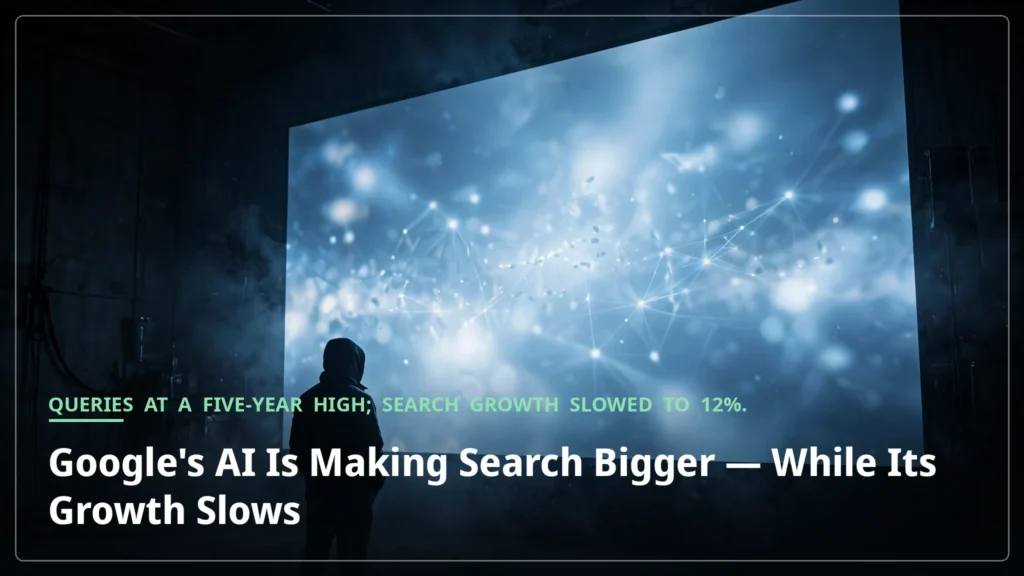
Alphabet just reported its third-quarter results, and the most interesting number in them is a slowdown. Total revenue reached $127.6 billion in the third quarter of 2026, up 25 percent from a year earlier. Search queries grew at their fastest year-over-year pace in five years, with AI Mode queries growing strongly. And yet Google Search and other advertising revenue grew just 12 percent, to about $63.3 billion, down from roughly 17 percent the quarter before. Sequentially, the line barely moved at all: $63.27 billion in the second quarter, $63.35 billion in the third.
That is the paradox at the heart of Google’s AI moment. The product is working. The usage is booming. But the revenue growth that usage produces is slowing. Understanding why means looking past the headline revenue record to the machinery underneath it: what a search query is becoming, and what it is worth.
More queries, cheaper queries

Start with the shape of the new query. On Alphabet’s earnings call, chief executive Sundar Pichai said AI investments were driving search usage, with query growth at its fastest in five years. But the queries themselves have changed. AI Mode queries run on average three times longer than traditional searches, and one in five uses voice, images or documents. They raise a question about what a query is becoming: could these longer, multimodal queries be conversations, not keywords — exchanges in which the user refines, follows up and wanders, rather than typing four words and clicking a link?
That change matters for the reported advertising metrics. On Google properties, paid clicks are priced per click. In the third quarter, paid clicks grew 8 percent year over year, down from 13 percent in the second quarter and below the 11 percent average for the first nine months of the year. Cost per click rose 4 percent. Total Google advertising revenue grew 10.6 percent, to $82.01 billion, down from 14.4 percent growth in the second quarter.
So the contrast is plain: the fastest query growth in five years, alongside paid-click growth down to 8 percent from 13 percent. This quarter, the two series pulled apart.
The headwind has a name: AI Mode
Alphabet’s chief business officer, Philipp Schindler, gave the mechanism a name on the earnings call. “The strong growth in AI Mode queries had an impact because of the lower monetization we were seeing in AI Mode,” he said. In another formulation reported from the call: “AI Mode query strength created a headwind because AI Mode currently monetizes at lower rates.”
Why would a longer, richer query be worth less? One possible explanation is that an AI answer satisfies the user inside the answer itself: a traditional search ends in a click — to a website, to an ad, to a product listing — while an AI Mode exchange can end in the conversation, with the answer as the destination. That explanation is plausible, but it is not established by the evidence; what management has confirmed is only the lower monetization and the headwind. And crucially, Schindler said most AI Mode queries are incremental, meaning they are additional searches rather than replacements for traditional ones. If that lower-monetizing volume grows fast enough, it would dilute the average: Google is adding queries that monetize less to a pool that used to monetize more, dragging on growth even as the total grows.
This is the mechanism the headline numbers only imply. It is not that people stopped searching. It is that a strongly growing kind of searching monetizes less, for now, than traditional search — and Google is the one growing it, deliberately, at full speed.
The defence: currency, one-offs, and a cloud that doubled

Before this becomes a simple story of self-cannibalisation, Schindler’s own ordering of causes deserves its full weight. He said foreign exchange was “the single largest driver of Search deceleration relative to Q2.” Then came vertical effects: retailers in Asia-Pacific hit by the European Union’s removal of its de minimis exemption, and media and entertainment spending normalising after a second quarter inflated by the World Cup. On that ordering, AI Mode is the third factor, not the main one — and the first two reverse on their own.
There is also the other side of Alphabet’s ledger, where AI is already paying handsomely. Google Cloud revenue rose 103 percent to $30.7 billion, with a backlog of $561 billion. Google Services, which includes Search and YouTube, generated $96.3 billion, up 11 percent. Whatever AI Mode is doing to the price of a query, AI infrastructure is doing wonders for the price of a contract. The company-level AI bet is monetising; the question is concentrated in one line of the profit-and-loss statement, not spread across all of them.
And one more caution against overreading a single quarter: paid clicks did not fall. They grew 8 percent. Cost per click rose. The search business is not shrinking; its growth is slowing while its usage accelerates. The distinction matters, because it separates a company in trouble from a company in transition — and because it keeps the honest version of this story from becoming a more dramatic, less true one.
What Google is doing about it
Google’s answer, stated on the call, is to bring the ads to where the answers are. The company says it is now scaling high-quality ads within AI Overviews and AI Mode to more users and queries, expanding AI Mode advertising internationally and introducing multi-turn ads in AI Mode in the United States. The logic is straightforward: if the conversation is the new search results page, the ad has to live inside the conversation.
Whether that works depends on questions nobody outside Google can answer: how many paid slots an AI answer can carry before users stop trusting it, and whether ads inside answers can monetize at rates comparable to traditional search. The success of ads in AI answers remains unresolved.
The questions the next quarters must answer
Several things remain undisclosed, and they are the things that would settle this story. Alphabet has not published AI Mode’s monetization rate relative to traditional search, nor its share of queries — the two figures needed to isolate AI Mode’s contribution to the deceleration and to judge whether 12 percent Search growth is a trough or a new pace. The third-quarter filing already supplies the aggregate breakdown, paid clicks up 8 percent and cost per click up 4 percent; what it cannot supply is the AI Mode slice.
There is also the hypothesis this article has deliberately not asserted: that AI answers are substituting for paid clicks. Paid clicks still grew, so displacement is unproven, not demonstrated. The same goes for the open web’s share of the loss: Alphabet does not report organic clicks, so no outside observer can measure how much traffic left publishers and websites this quarter.
What is demonstrated is narrower, and still striking. Google built the click economy, then built an AI that answers questions directly — and is now racing to rebuild the economics of the answer itself. The queries are longer, the conversations are richer, the usage has grown at its fastest pace in five years. The monetization of that usage has become the thing to watch. The next few quarters will tell us whether the headwind was a gust or a climate.