

Introduction to ToyBlocks framework
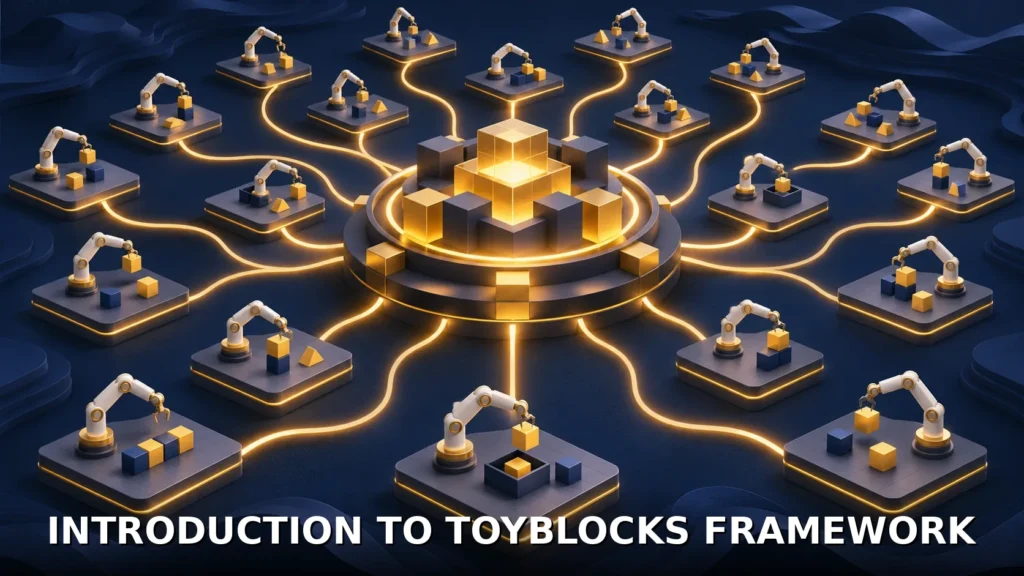
The ToyBlocks framework is an open simulation environment for studying how robots learn, plan and fail inside a deliberately constrained world: a robot arm manipulating blocks on a tabletop. Introduced in an Ai2 announcement published on Hugging Face, it automatically generates task demonstrations and lets researchers change the training experiences a model receives, then evaluate what those changes accomplish.
The central proposition is experimental control. A successful robot demonstration shows that a system can complete a particular task under particular conditions. ToyBlocks is designed to help investigate a harder question: which experiences and model components explain that success, and where does performance break down? Its narrow setting makes it possible to vary conditions, repeat tests and examine failures within a manageable domain.
ToyBlocks is the first environment in a broader framework the announcement calls FoundationWorlds. Each FoundationWorld pairs a controlled simulated environment with tools for generating tasks and training demonstrations, plus metrics for tracking robot behavior. The stated research agenda includes studying how models improve with additional data and how to combine high-level reasoning with precise physical control.
The blocks are more than objects to pick up and stack. Pictures and letters on their faces create searching, sorting and arranging problems. A robot may need to turn a block to expose a hidden face before deciding what to do with it. Pushing, flipping and stacking therefore involve both movement and decisions about what information to gather.
That combination makes ToyBlocks relevant to agent research as well as robot control. The environment can test a model that directly produces movements, a planner that selects skills, or an agent that acts through tool calls. The announcement reports experiments across these arrangements. Those results are evidence from the announcing team, rather than independent validation, and they concern a deliberately bounded setting.
Features of ToyBlocks

ToyBlocks is organized around four requirements: realistic physics and appearance, automatic generation of tasks and demonstrations at scale, challenges combining reasoning with dexterity, and broad coverage of tasks within the chosen domain. The authors argue that restricting the world to an arm and tabletop blocks makes those requirements tractable. Their ambition is coverage within that domain, rather than coverage of arbitrary robotic environments.
From short skills to complete demonstrations
The framework uses reinforcement learning and motion planning to generate skills for short-horizon tasks: behaviors involving brief sequences of actions. Skill training takes place in Isaac Lab, Nvidia’s open-source framework for robot learning in simulation. Through trial and error, policies learn actions such as pushing a block or flipping it onto another face without picking it up. These are non-prehensile skills, meaning the robot manipulates the object without grasping it.
Skill generation can use privileged information supplied by the simulator, including an object’s exact position and orientation. A physical robot would have to estimate those values from observations. Access to this information helps automate the production of skills that, according to the announcement, would require teleoperation in the real world.
A task-and-motion planner, or TAMP, then selects and sequences skills to solve a task and plans movements between them. Executing the plans in simulation produces recorded demonstrations, accompanied by labels identifying the task or skill. This separates generating a successful training example from asking a learned model to reproduce that behavior using sensor observations.
The authors report that ToyBlocks can generate and execute hundreds of plans in parallel on a single graphics processing unit, reaching up to 24 times real-time performance. That figure describes the reported data-generation process. It is not a measure of how quickly a trained policy learns or how reliably it completes a task.
Control over training data and evaluation
The data generator lets researchers emphasize particular skills or fill gaps in existing datasets. The announcement proposes testing whether adding rotation and pick-and-place demonstrations improves flipping, for example. It also describes changing the balance of examples inside and outside a defined workspace region, then evaluating on tasks excluded from training. These are examples of experiments the framework supports, not reported proof that every proposed data mixture improves performance.
Domain randomization varies properties such as block size and table height between scenes. This creates a way to test how models respond when geometry changes. Models trained to map raw sensor observations to actions must also solve a perception problem: they need to infer the block’s pose, or position and orientation, instead of receiving the simulator’s exact values.
Evaluation extends beyond whether a task succeeds. ToyBlocks reports execution speeds, forces exerted on objects and progress toward a task, using the same specifications employed by the planning module. Those measurements offer different views of behavior: completion alone does not describe the forces involved or how much progress preceded a failure.
A webpage interface also lets users connect Claude or another frontier model and issue natural-language instructions. This provides access to experiments in planning and action without requiring users to work directly with every part of the robotics system.
Applications in robot learning

The announcement uses ToyBlocks to investigate low-level control, high-level planning and agents acting through tools. The common value is the ability to change one part of the problem while keeping other parts controlled. That is particularly useful when a failed task could reflect perception, planning, execution or some combination of them.
Testing what action models generalize
Vision-language-action models, or VLAs, map language instructions and visual observations to robot actions. The source describes conflicting findings in prior research: some studies report brittleness under input changes, while others find stronger generalization. The ToyBlocks authors argue that limited flexibility in real-world datasets makes these questions difficult to study systematically. ToyBlocks supplies a controlled setting for probing them; its results do not by themselves resolve every disagreement across those studies.
The reported experiments consider Stack, Unstack, Flip and Rotate. Tests vary skill sequences, letters, colors, block counts and spatial configurations. Workspace experiments distinguish interpolation—new configurations within the training range—from extrapolation beyond that range. One setup trains with objects spawning in a left-hand region and tests them in a right-hand region. Another trains on stack heights of 2 and 5 blocks and tests heights of 3 and 4.
The source identifies ManiFlow, π0.5 and MolmoAct 2 in these spatial generalization studies. The authors report poor generalization in their initial results despite large-scale pretraining, then describe improvements and analysis of the techniques contributing to them. The announcement excerpt provides no numerical values for these charts or the planning comparisons below, so neither supports a precise quantitative comparison. The supported conclusion is narrower: the team found shortcomings worth investigating under these controlled tests.
Separating planning from physical execution
For longer tasks, ToyBlocks can provide reference components, described as oracles, at both the high and low levels. A correct reference plan or action helps isolate whether a failure arose in planning or execution. This is a useful diagnostic distinction when a robot selects the right objective but fails to manipulate the block, or executes a movement correctly after selecting the wrong objective.
One experiment uses Molmo 2 as the high-level vision-language planner and ManiFlow as the low-level policy. Molmo 2 chooses a skill and the relevant block; ManiFlow executes the instruction, pauses and queries the planner for the next instruction. A documented example is stacking blocks to spell “Ai2.” Hidden letters can require the system to reveal information before assembling the stack.
The evaluation has three difficulty settings: characters initially upright and facing the camera, characters that may be rotated, and characters hidden at the beginning. The announcement describes comparisons using ManiFlow or a motion planner for low-level manipulation.
Evaluating agents through tool calls
The agentic experiments expose ToyBlocks skills through the Model Context Protocol, or MCP, which connects AI applications to tools. The agent observes camera images and selects actions such as picking, flipping or rotating by pointing at a pixel. It must decide when to search, when to build and when to declare a task complete or impossible.
The same tools can invoke either the skills used to generate demonstrations—motion-planned pick and place, with reinforcement-learning-based rotation and flipping—or learned ManiFlow skills. This makes the choice of execution component explicit within the tool interface.
The source reports that a system using Claude Opus 5.5 solved all 30 tasks in a classical block-stacking group using text descriptions. It also reports 30 out of 30 with repeated camera observations and action selection in a closed loop. A more demanding search-and-spell experiment required three-letter stacks among up to eight blocks. Half of its scenes lacked all the required letters, so correctly identifying infeasibility was part of the evaluation.
In that experiment, the authors report 63% of tasks successfully solved or correctly declared infeasible. They attribute errors mainly to confusing similar-looking letters, reported at 13%, and choosing incorrect letter orientations, reported at 15%. The 63% figure combines completion and correct infeasibility judgments; it should not be read as a stack-completion rate alone. Nor are these search-and-spell tasks interchangeable with the classical planning group.
There is also a model-attribution discrepancy in the announcement. The experiment narrative identifies Claude Opus 5.5, while a demonstration caption identifies Claude Fable 5.1. The available evidence does not explain that difference, so the caption cannot establish that its demonstration used the model named for the reported experiments.
Future implications for robotics research
The authors say they intend to extend FoundationWorlds to increasingly complex environments. ToyBlocks supplies the first example of the approach: constrain the world sufficiently to generate demonstrations automatically, vary training conditions and measure behavior in detail. Whether the same combination remains practical in broader domains remains an open question.
The immediate research implication is methodological. A controllable generator can support comparisons between training mixtures; held-out tasks can test whether their effects extend beyond familiar examples. Reference planners and action components can help locate failures within a hierarchy. Together, those capabilities offer a way to ask more specific questions than whether an entire robot system succeeded once.
The agent results also illustrate why task design matters. Strong performance on the reported classical stacking tasks coexists with perceptual and orientation errors in search-and-spell. A model’s ability to plan with tools therefore needs to be assessed alongside its interpretation of observations and its judgment that a goal is achievable. ToyBlocks makes those distinctions visible within one constrained environment, without establishing that the same results hold elsewhere.
The announcement excerpt lists sections on action-conditioned world models and real-world experiments, but stops before providing their substantive results. It therefore does not establish physical transfer performance, the fidelity of a learned simulator or a quantitative advantage on real robots. The framework’s use of privileged simulator information also makes the distinction between generating demonstrations and acting from observations essential.
ToyBlocks’ strongest supported contribution is a testbed for examining robot behavior under controlled changes. Its value to further research will depend on what those experiments reveal about data, perception, planning and control—and on evidence showing how far findings from this tabletop world extend.