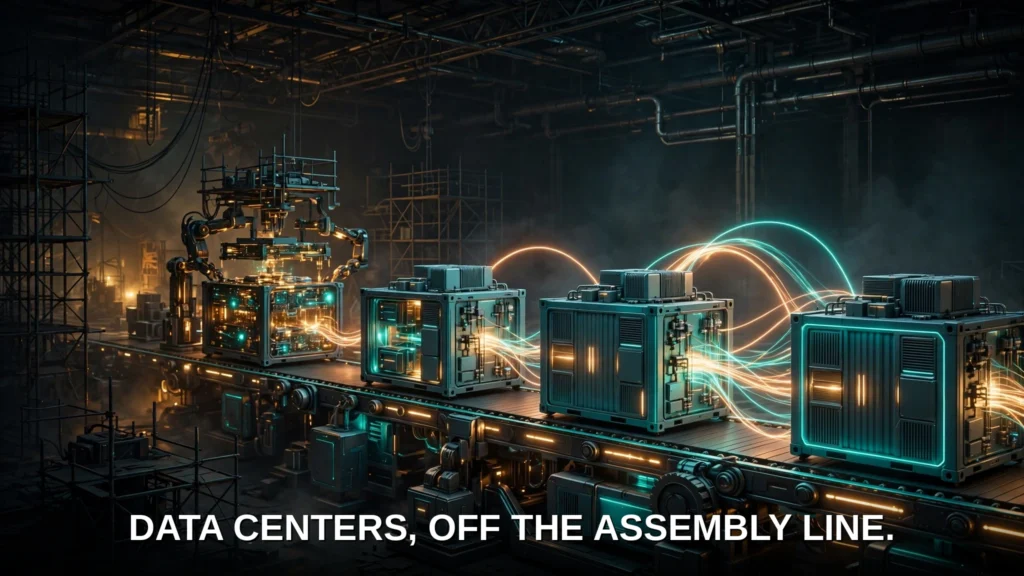



Runware, an AI infrastructure company, wants to build mass-produced AI data centers the way carmakers build cars: on an assembly line, in a factory, with finished units rolling out ready to install. The idea sounds simple, and that is the point. Building a conventional data center today is a slow, bespoke construction project. Runware argues it should be a manufacturing job instead, and it has just announced the factory it says will prove it.
The announcement, reported by TechCrunch on October 30, 2026, is the company’s most ambitious claim yet. It follows the unveiling, months earlier, of the Sonic Inference Pod, a modular data center built in a factory and shipped to customers ready to install. Now Runware says it will scale that idea to a full production line. Whether it can is a different question, and the company’s own history, funding, and supply chain all bear on the answer.
Mass-produced AI data centers: Runware’s factory plan, in plain terms
Runware’s plan is to assemble its Sonic Inference Pods on a production line, as if they were cars. The company told TechCrunch it already has two factories: one it has used for a few years to build the pods, and a second it started building earlier this year. The second factory is expected to be finished within months and to go online early next year, with production increasing gradually from then on.
The goal of the factory is to change the timeline of AI deployment. Runware says customers should be able to plan a hyperscale data center around factory-built pods from the beginning and have it working in months instead of years. In the words of co-founder and chief executive Flaviu Radulescu, “Customers should be able to plan a hyperscale data center around factory-built pods from the beginning and have it working in months instead of years.”
Runware has also given the factory concrete dimensions in its own announcement: a 538,000-square-foot campus in Europe, a 237,000-square-foot manufacturing facility, production beginning in the first quarter of 2027, and a run rate of 10 gigawatts of new AI compute capacity per year by year-end.
What the Sonic Inference Pod is
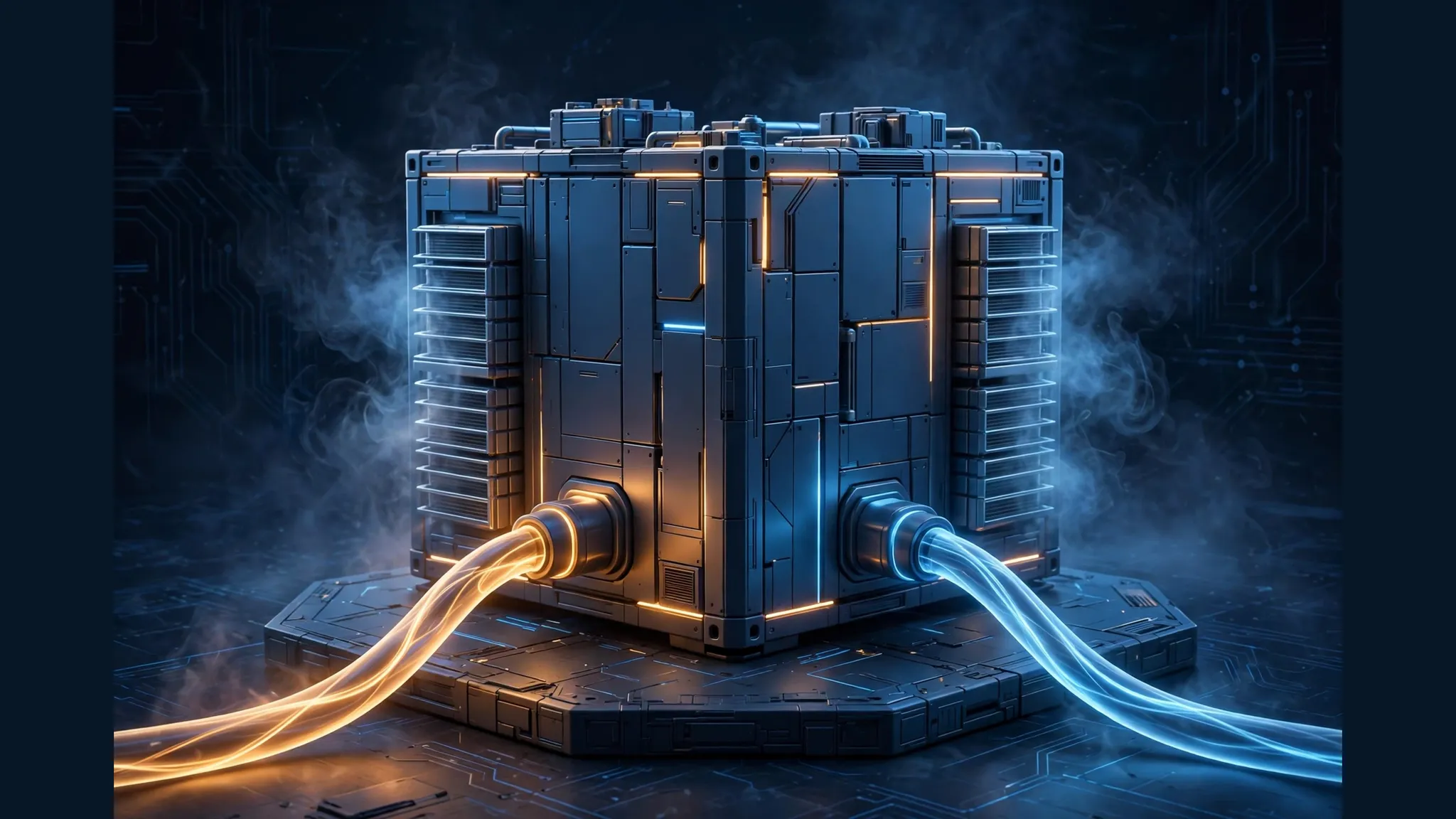
The Sonic Inference Pod is a self-contained, modular data center designed for AI inference, the work of running trained models to answer questions, generate images, or process requests. It is built in a factory and shipped to customers ready to install, rather than constructed on site. Runware says the factory will deliver Sonic Pods in two formats: a 1-megawatt data center in a 20-foot shipping container and a 2-megawatt data center in a 40-foot shipping container, each leaving the production line assembled, tested, and ready to ship.
The pods need only two things at the destination: power and an internet connection. They use a closed-loop liquid cooling system with air-cooled radiators to release heat, so they do not need a water connection. Runware says the pods run completely silent up to temperatures of 86 degrees Fahrenheit, and that it uses energy from renewable sources whenever possible.
The production targets and timeline
The headline target is scale. Runware told TechCrunch it plans to scale production at its Romania-based factory to 30 megawatts of data center capacity per day by 2028, or nearly 1 gigawatt per month. At that pace, the company would produce roughly as much in a year as the entire United States was expected to add in data center power in 2026, about 10 gigawatts.
Speed is the other headline number. Runware says it aims to bring pods online within 48 hours. That window covers installation and set-up time, not build time. A pod once took three weeks to build, but the company says it will soon take one day as production ramps up.
Runware also claims commercial traction. It says it has received $1 billion in committed interest for its Sonic pods since it began offering them to outside customers about a month ago, representing over 20 megawatts, which it is now working to deliver. That figure is a company claim, not an independently verified order book, and what “committed interest” means contractually is one of the open questions the article returns to below.
How this compares with the rest of the industry
Runware’s idea is not entirely new. Companies like Crusoe and Schneider Electric also sell prefabricated pods, but Runware says it can ship its pods faster. Its claimed distinction is that it has actually built a factory rather than just designed the infrastructure that would let others build one.
Nvidia is pursuing the same faster-deployment goal from the other direction. It announced the Vera Rubin AI factories and the DSX POD earlier in 2026, both meant to make it faster and easier for companies to build their own AI data centers. DSX POD is a reference design for complete Vera Rubin AI factories that partners assemble and test inside modular containers before shipping them to a prepared site. Nvidia says deployment at a prepared site drops from six months to as little as 14 days, with partner deliveries beginning in early 2027.
The difference, in Runware’s telling, is that it is the manufacturer, not just the designer.
The business model and the customer pitch
Customers can provide their own site for assembly, or Runware can find one for them. Buyers can rent compute from Runware or supply their own GPUs and pay a monthly fee for the pods and operations, with power and internet charged separately.
The pods have a standard design but can be configured to customer requirements and the latest GPU chips. That configurability is central to the pitch, because chips can take a long time to arrive after they are ordered. As Radulescu put it, “Our pod delivery times are also shorter than current GPU lead times, giving us time to adapt the infrastructure to the hardware being ordered.” Runware says it designs and builds its own cooling and other pod systems with standard components, and the pods can be configured for new GPU generations.
Runware is also pitching smaller footprints. It says it is deploying its modular data centers on sites much smaller than those used by hyperscalers like Amazon, Microsoft, and Google, and that those sites typically already have power. It says it is working with power providers on a site pipeline covering 397 megawatts, with potential to expand to 1.2 gigawatts.
Why it might not work: execution, supply chain and energy
The new factory launch and production ramp remain plans, and execution is the test. The factory will need a lot of people, inventory, supply-chain logistics, and money. There are cautionary tales about reinventing manufacturing, notably the electric vehicle startup Arrival, once valued at over $13 billion, which struggled to mass-produce electric vehicles cost-effectively compared with traditional plants.
Runware says its case is different. “Our cost structure is very different,” Radulescu said. “We do have headcount and materials cost. But our factory staff is cost-effective relative to the value of deploying compute for AI.” He added that the company designs its own systems with standard components.
Component sourcing could still be a challenge. Runware says it designs and builds its own cooling and other pod systems with standard components, but some parts, such as pumps and fans, come from Germany, and it still depends on Nvidia for networking. Financing is the other constraint: Runware has raised more than $60 million to date, says it plans to raise a Series B, and is for now finishing and launching the factory with the $50 million Series A it raised last December. That is modest money against the scale of the plans described.
Energy scrutiny is the third risk. Data centers in the United States and abroad have come under fire for how much energy they consume and how that affects the grid and other resources. Runware’s answer is that its pods only need power and an internet connection, that its sites typically already have power, and that it uses energy from renewable sources whenever possible.
What to watch next
The plan will be judged on milestones, not announcements. The first is whether the second factory goes online early next year as planned, and whether production really does begin in the first quarter of 2027 at the announced facility. The second is whether the 48-hour online claim and the one-day build claim hold on real customer deployments, rather than in the company’s own operations. The third is whether the claimed $1 billion in committed interest converts into delivered megawatts, and whether expansion to the United States and other regions worldwide follows.
If those milestones land, Runware will have shown that its own factory model can deliver AI data centers as manufactured products rather than construction projects. As Radulescu put it, “Modular systems are the future and will soon become the standard for large AI deployment.” If they do not, the question will be which constraint — execution, supply, financing, or energy — proved binding.