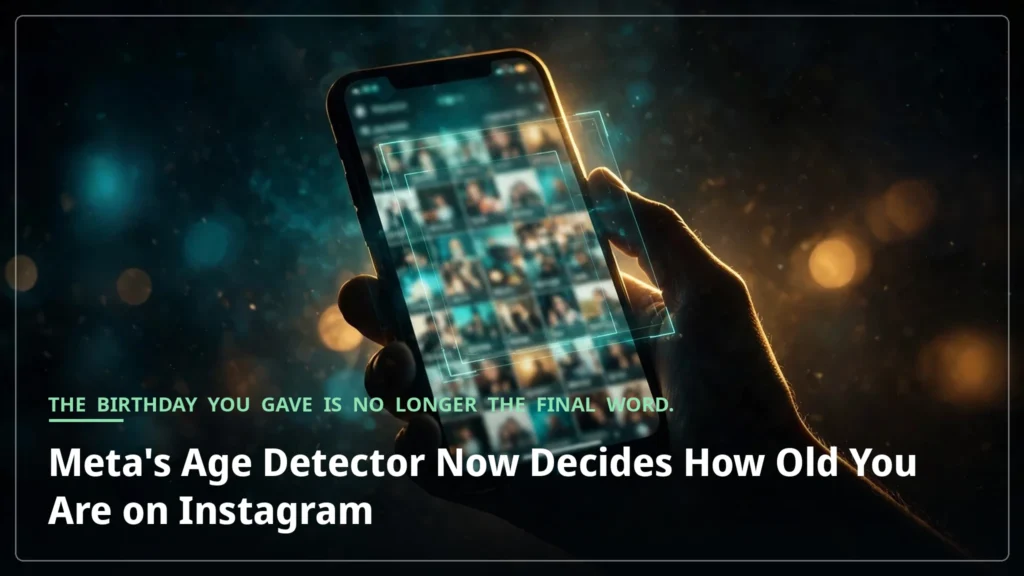



Instagram is done asking how old you are — or, more precisely, it is done believing the answer. Meta announced on Monday that Instagram age detection is expanding worldwide, a system that looks for teenagers who did not correctly disclose their age and moves them, automatically, into the platform’s restricted Teen Accounts. Meta says the rollout will place “millions more teens” under those protections.
The announcement is the latest step in a project Meta has been building for years. The company says it has enrolled hundreds of millions of teenagers in Teen Accounts across Instagram, Facebook and Messenger since 2024, and reports more than 54 million active Teen Accounts globally. In a trial in the US in April, Meta said more than nine in ten active teen accounts stayed in the protective settings designed to reduce exposure to harmful or unwanted content. Now the detection net is going global.
How Instagram age detection reads your photo

What makes this expansion different from a routine safety update is the way the age is decided. The system does not simply trust the birthday on the account. Instead, it looks for signals that suggest a user is under 18: the profiles and types of content they interact with, the birthday messages they receive, and “general themes and visual cues” from the photos and videos they upload — including, Meta says, height and bone structure.
In Australia, Meta has also started using Apple’s age-range signal as an additional detection method — a hint of where this may be heading, with the operating system itself vouching for how old you are. Meta’s regional policy director, Mia Garlick, has called on Apple and Google to verify age at the point of download, so app stores could pass an age-range signal to apps like Instagram.
The consequences are automatic. Users the system believes are under 13 are removed — 13 is the minimum age for a Meta account. Users it judges to be 13 to 17 are moved into Teen Accounts even if they signed up with a fake adult birthday. The placement is automatic. The platform’s inference wins over the user’s word.
The birthday stops being the final word
That is the real shift here. For the users its systems flag as underage, Meta now treats its own judgment as more authoritative than the birthday they gave. The age on your account is no longer, in those cases, something you declare. It is something the platform infers about you — from your behaviour, the profiles you follow, and your face in photographs — and that inference decides what kind of account you get. The fake adult birthday, the oldest trick in the teenage internet playbook, has met a system designed to see straight through it.
It is worth being precise about the scope. The system targets users it suspects of misrepresenting their age; it is not re-deciding the age of every person on Instagram. But for those it flags, the override is total: the declared birthday counts for nothing against the machine’s reading.
What the protections actually do
The accounts these teenagers land in are genuinely more restricted. Teen Accounts are private by default, limit the kind of content teens can see, and prevent strangers from sending them direct messages. Parents and guardians can supervise the accounts. Users aged 16 or younger cannot adjust Teen Account settings without a parent’s or guardian’s permission. The protections are designed to make the experience safer and more age-appropriate — and for a parent, that design is the point.
But design is not the same as outcome, and this is where the story gets uncomfortable. Meta has not published sufficient independent evidence to establish how accurately the system identifies teenagers across different age groups and countries. What happens to an adult wrongly swept into a Teen Account — or a teenager wrongly judged an adult — is an open question, as is what appeal exists when the machine gets it wrong.
The body-reading problem
Then there is the question of what the machine is actually looking at. In July 2026, Meta issued a correction to its own announcement, clarifying that its AI “does not use biometric data to identify whether a person is underage,” does not create facial fingerprints, and does not identify who is in a photo. It is, Meta says, trained to recognise general visual patterns that suggest someone underage is in the photo.
That distinction matters — but it also raises a question. How different is “recognising visual patterns that suggest someone is underage” from identifying a child from a photograph, seen from the child’s point of view? And what happens to the photo and video analysis data — whether it is retained, for how long, and who can see it — remains unanswered.
The regulators are already watching

The expansion lands against a backdrop of regulatory pressure that Meta cannot ignore, even if no source has shown the two are causally linked. On 29 April 2026, the European Commission issued preliminary findings that Meta had breached the EU’s Digital Services Act by failing to keep children under 13 off Facebook and Instagram. The Commission’s evidence suggested that approximately 10 to 12 per cent of children under 13 in the EU access Instagram and Facebook, and found “no effective controls in place to check the correctness of the self-declared date of birth.” If the findings are confirmed, Meta faces fines of up to 6 per cent of its global annual turnover.
The Commission’s case is, in a sense, the mirror image of Meta’s announcement: the old system failed precisely because it trusted the birthday on the form. Meta’s answer is to stop trusting the form. Whether regulators will accept inference as a substitute for verification remains an open question.
The question nobody can answer yet
Strip away the announcement language and the open questions are stark. How often does the system get it wrong? What recourse does a misclassified user have? How long does the analysis of your photos live on Meta’s servers? And if the operating system starts telling apps how old you are, who audits the operating system?
For now, the facts are these: the net is widening, the protections are real by design, and the judgment is made by a machine reading your behaviour and your photographs. Your birthday is still on the form. It just isn’t the final word anymore — not when the platform’s own reading disagrees.