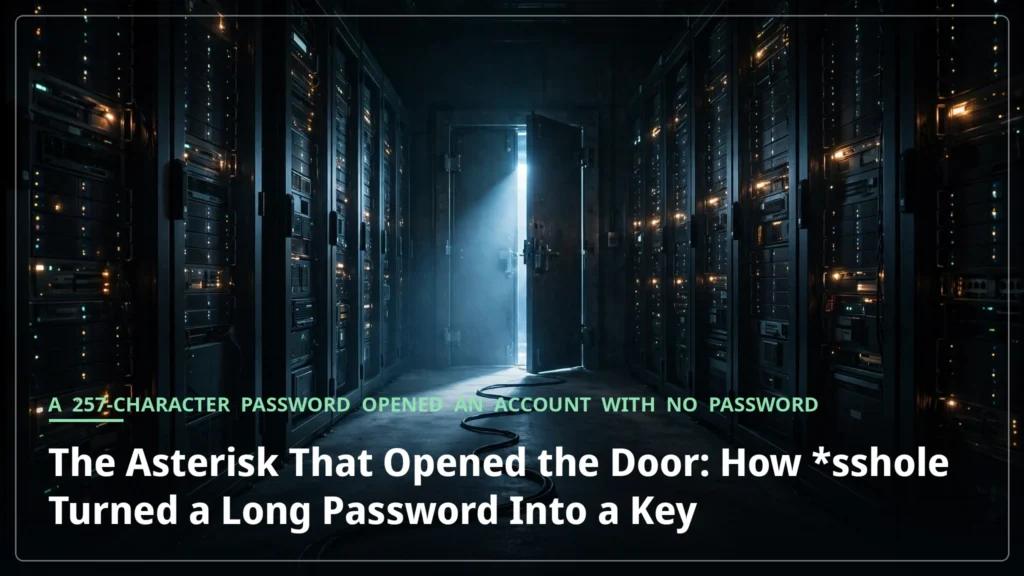



It took a password of 257 characters to open an account that had no password at all. No stolen credential, no brute-force campaign, no exotic exploit chain — just a long string of characters typed into a login prompt, and the door swung open.
The vulnerability is called *sshole, tracked as CVE-2026-123158, and it is now being actively exploited. It is a story about a misunderstanding: two pieces of trusted software disagreed about what a single character meant, and that disagreement gave unauthenticated attackers access to high-privilege accounts in seconds.
The asterisk that meant two things

On a Linux system, the file /etc/shadow holds a password field for every account. For accounts configured to reject password logins, that field holds a single asterisk: *. It means, in effect, “no password will ever be valid here.”
That is where the trouble starts, because * is also what the musl C library returns when its password-hashing function fails. Musl is a lightweight alternative to the standard C library, used by Alpine Linux and other minimal systems. Since 2012, its crypt() function has refused passwords longer than 256 bytes for SHA-256 and SHA-512 hashes — reporting the failure by returning the string * instead of an error.
Put the two together, remove the component that would have caught the collision, and you have *sshole. When OpenSSH runs on musl without PAM — the pluggable authentication modules that would normally handle password checks — it hashes the password supplied and compares the result with the stored hash. An attacker types a password of more than 256 characters for a passwordless account. OpenSSH hashes it, borrowing the salt settings from another account that does have a SHA-256 or SHA-512 hash. Musl refuses the overlong password and returns *. The stored field says *. The two strings match. The door opens.
Red Hat, describing the flaw, called it a case of exploiting the “misinterpretation of whether a string is intended to be a password hash.” The asterisk was never a password. It was an error message wearing a password’s clothes — and the system that should have told the difference was not in the room.
Three sensible decisions, one hole
What makes *sshole worth telling is that no single person wrote it. Researchers tracing the bug found three separate decisions, made years apart and each reasonable on its own, that combined into a hole.
The first was musl’s, in 2012: on error, return *. The second was OpenSSH’s, in 2016: when an account has no usable hash, borrow the salt from another account’s hash before checking, so attackers cannot use response times to guess valid usernames. The third was Alpine’s, in 2022, when the distribution began storing root as * by default.
Together, they built a machine in which a deliberately unusable account could be entered with any password between 257 and 1,024 bytes long. The components dated back years — musl’s behaviour to 2012, OpenSSH’s borrowed salt to 2016 — and Alpine began storing root as * by default in 2022. Security researcher Özgün Kültekin of Wakefield reported the flaw.
Who is actually exposed
The conditions are narrow, and that narrowness matters. A server is exposed when OpenSSH before version 10.6p2 runs on musl Linux without PAM, with password authentication enabled, with one account whose password field is * and at least one other with a SHA-256 or SHA-512 hash to borrow the salt from.
Alpine Linux is the notable case because its default openssh-server package is built without PAM — exactly the exposed configuration. Other musl-based systems that meet the same conditions can be exposed the same way. The systems that are not affected include Debian, Ubuntu, Fedora and other glibc distributions, any system that checks passwords through PAM, the Dropbear SSH server, and OpenBSD.
Alpine, a lightweight Linux distribution, is the system most notably affected. How many servers meet every condition is unknown: the reporting so far comes from honeypots and sensors, not a census of vulnerable machines. What is documented is the ease of the attack itself — unauthenticated access to a high-privilege account in seconds, with no password to steal.
Four hours from fix to exploit

The timeline is the part that should make administrators uncomfortable. Version 10.6p2 was released on 5 November, the day the vulnerability became public. MITRE assigned it CVE-2026-123158, scoring it 8.1 out of 10 — High — under CVSS 3.1. Alpine shipped patched packages for every branch from 3.16 to edge the same day.
Proof-of-concept exploit code appeared about four hours after the fix was released. Exploitation attempts began the same day: SANS honeypots logged 232 long-password login attempts on 5 November and 713 on 6 November — suspicious attempts, not confirmed break-ins. WatchTowr said on Friday 6 November that it was seeing exploitation activity related to botnets and crypto miners. Previdian’s sensors recorded 20 exploitation attempts from 13 unique attacker IP addresses geolocated to nine countries between 6 and 8 November.
Then came the confirmed break-ins. GreyNoise, which runs decoy servers built to be attacked, recorded the first successful exploitation on 7 November at 00:46 UTC — about 40 hours after the fix shipped — and has since logged 16 successful attack chains from six source IP addresses. GreyNoise stresses that its observations cover only the systems it monitors, and no real-world victim has been publicly confirmed so far. But the sequence is unambiguous: disclosure on Thursday, exploitation reports on Friday, confirmed break-ins by the weekend.
The people already inside
GreyNoise said on Monday that its honeypots in Southeast Asia came under attack by a group it tracks as GT10, which conducted “mature intrusions”. GreyNoise subsequently gained access to a GT10 server that revealed potential other victims and tools used in the campaign.
What the intruders did once inside is the familiar shape of a modern break-in. In at least one case an attacker obtained root, looked for passwords and keys, added their own SSH keys, and installed TAC Agent, a Python command-and-control implant that supports shell commands, system reconnaissance, and persistence. The backdoor contains Chinese-language comments and appears to have been generated with the use of AI. GT10 also installs Python3 on machines that lack it, because the backdoor requires it.
The fix is small. The restart is the catch.
The fix itself is almost comically small. OpenSSH’s patch adds a single guard: a stored password hash shorter than four characters can never match. “We consider the root cause of this bug to be outside sshd,” the release notes say, “but it is exploitable via sshd and can be avoided there.” Musl’s maintainer, Rich Felker, has said the behaviour is not a bug in musl but a caller using it wrongly — while noting it will very likely change in musl’s next release cycle.
OpenSSH maintainer Damien Miller, announcing 10.6p2, did not mince words: “If you operate a Linux system that uses musl libc without PAM (Alpine Linux is one example) then stop reading and set PasswordAuthentication=no or disable SSH for these systems IMMEDIATELY.”
For anyone running Alpine or another musl system, the prescription is: upgrade to the patched OpenSSH package and then restart sshd, because upgrading does not replace the running daemon. If an update is not possible yet, set PasswordAuthentication no. As Ars Technica put it: “Anyone using OpenSSH should install the update promptly. Those using musl should investigate further.”
The lock, in the end, was never picked. It was asked a question it had been taught to answer wrongly — and it answered, politely, with the one character that meant both “no” and “come in.” The machines that understood the difference were never at risk. GreyNoise’s first observed successful break-in on its honeypots came about forty hours after the fix shipped. Patch them, restart them, and check whether anyone has already walked through the open door.