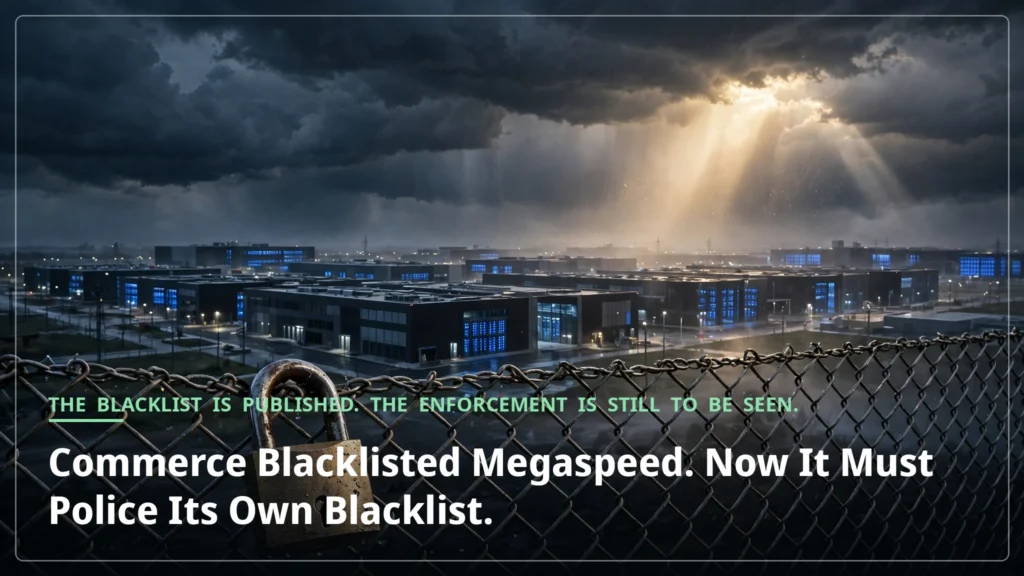


Two decisions landed together. Nvidia’s board brought Jensen Huang back as chief executive, with the backing of the Trump administration. Hours later, the Commerce Department added Megaspeed, the Singapore-based cloud company at the centre of the reporting around Huang, to its Entity List, the trade blacklist that bars a company from buying advanced technology without a US government licence. The Hindu BusinessLine, reporting the filing, put the timing plainly: Commerce posted its decision hours after Nvidia’s board acted.
Either decision would have been news on its own. Together, they set up a stranger test. The department that will now enforce the restriction on Megaspeed is the same department that faced accusations, reported by The New York Times, that Commerce Secretary Howard Lutnick was too close to Huang and Nvidia and had failed to adequately police chip sales to China. The listing hands that argument to the accused enforcer.
Added to the Entity List, two years in the making
The Commerce Department has investigated Megaspeed since 2024 over alleged smuggling of advanced AI chips to China. The Verge, reporting the Commerce filing, says the department added Megaspeed and its affiliates in Malaysia and Thailand to the list because of the significant risk that they were, or were becoming, involved in diverting advanced computing goods to unauthorised end uses or end users. Other reporting puts the total at seven entities across Singapore, Malaysia and Thailand, including Apex Enterprise Solutions and Speedmatrix; Reuters reported Alibaba’s Singapore subsidiary was also added.
The suspicion did not arrive with the scandal. In late 2024, a Commerce official visiting a Megaspeed data center in Malaysia grew suspicious after noticing American-made AI chips packed in boxes, according to New York Times reporting. In May 2025, Commerce officials requested Megaspeed sales records from Nvidia, according to a joint statement, and BIS agents interviewed Alice Huang, the former Megaspeed executive at the centre of the affair reporting. Nvidia had put Megaspeed on its own no-sell list last year, after Commerce requested its records on direct or indirect sales to the company, according to the Justice Department as reported by The Verge.
Megaspeed has denied wrongdoing throughout. It has said it complies with applicable US and local laws, and a week before the listing it said it conducts legitimate and lawful business. Alice Huang left the company in August 2025, Megaspeed has said, and is now in China. US officials suspect her of being a Chinese intelligence asset, a claim China has described as groundless. The Justice Department said last week that it had taken over the Commerce investigation, which remains ongoing.
The pressure was public
The investigation was long-running, and pressure to act on it increased after the scandal reporting. Semafor reported Lutnick had faced increasing pressure to list Megaspeed after reports revealed Huang’s affair with Alice Huang and the suspicion against her. Treasury Secretary Scott Bessent blamed Lutnick publicly. On CNBC, as reported by The Hindu BusinessLine, Bessent said that many other departments had been pushing for the listing and that Commerce had the pen, and that his department, the Pentagon, the State Department and the US Trade Representative had backed listing for months. Senator Pete Ricketts proposed legislation forcing a decision within 30 days.
None of that proves the pressure caused the timing, and the record contains a counterweight. The investigation began in 2024, before the scandal reporting. The Times reported a White House confrontation, which the Commerce Department denied took place. The pressure is documented. Whether it moved the filing, or merely accompanied a process already under way, is not settled by the record.
The same caution applies to Huang’s return. Reuters reported that Nvidia’s board reinstated Huang less than a week after its chair had said the company would not rehire him because his personal behaviour was inconsistent with its code of conduct. Nvidia said that, based on US government input, the board was confident the reinstatement posed no national security risk; Trump told CNBC his intervention had been very important in getting Huang back. The board’s independent investigation remains unfinished.
The enforcement question

This is where the listing stops being an announcement and becomes a job. The Times noted that Commerce will now be responsible for enforcing the trade restrictions on Megaspeed, after the accusations against Lutnick. Enforcement means licence decisions and end-use checks. The test is not whether Commerce can publish a list. It is whether the department accused of lax policing will police the restriction it has imposed, against a firm linked in reporting to the chief executive whose return the administration backed.
The first sign of trouble for that test arrived with the filing itself. Chris McGuire, a former National Security Council official, questioned whether the interim rule had enough authority to block purchases of AI chips at all, because it left out a footnote often present in such listings to make clear that foreign-produced items containing US technology are included. Gizmodo reported McGuire’s view that the omission left the rule’s authority in doubt. BIS officials rejected that reading. A BIS spokesperson, Thomas Wackman, said it is now unlawful to export advanced chips to Megaspeed even if the chips are produced outside the United States. What Commerce actually blocks or licenses will settle that.
A second rule points in the same direction. Last week, Commerce unveiled a rule designed to limit the ability of Chinese firms to access Nvidia AI chips remotely from data centers outside China, requiring data center operators in Singapore, Malaysia, Thailand, Indonesia and Brazil to obtain a US licence before exporting advanced AI chips to customers in those countries. The Hindu BusinessLine reported that the rule was written by and at the direction of the Treasury Department and the National Security Council. Who controls that architecture is still a live question.
What would settle it
The strongest case against reading too much into the coincidence is also the simplest. The listing follows an investigation running since 2024, with a filing process of its own. Huang’s return is a board governance decision, answering a different question: who should lead Nvidia. Two decisions can land on the same day without being coordinated, and a blacklist can be the ordinary working of export controls rather than a response to a scandal.
That case deserves its weight, and it is why the honest framing is a question, not a verdict. Did the listing arrive because pressure finally forced it, because a long process reached its end, or because both happened at once for unrelated reasons? The reporting does not say. What it does establish is the consequence: Commerce now owns the enforcement.
A hearing is scheduled. Huang has agreed to testify before the Senate Banking Committee in a public hearing on 3 December. Senator Elizabeth Warren has said Huang, Nvidia executives and the board still owe Congress answers about export-control compliance, and that the administration must explain what input senior officials gave to support the reinstatement, and who gave it.
Until they do, the honest summary is narrow. A company investigated since 2024 has been blacklisted, with its denial of wrongdoing on the record and an investigation still open. A chief executive ousted over a scandal has been restored, with the administration’s backing. And the department accused of failing to police the trade between them is now in charge of policing it. Whether that is coincidence or a test Commerce is about to fail is not yet in the record. The blacklist is published. The enforcement — the part that would make it real — is still to be seen.