

Anthropic is pressing ahead with its listing. The company behind Claude plans to set a valuation range this week and begin trading Thursday or Friday next week, the Wall Street Journal reported — and investors will look to the Anthropic IPO valuation to gauge the strength of the AI boom. The listing goes ahead. The valuations under discussion have shifted down overall — from $2 trillion months ago toward figures below $1.5 trillion — though not every successive report has been lower: a retracted pricing email on Monday implied roughly $1.4 trillion, above the $1.2 trillion to $1.3 trillion range discussed days earlier.
That is the strange position Anthropic finds itself in: nothing has been cancelled — the filing is still live, the banks are still in place, and the plan is still to proceed — though the timing is unresolved, with prospective investors doubting the roadshow can finish in time for a November listing — but the valuations under discussion have moved down overall, from $2 trillion floated months ago to figures below $1.5 trillion, before a single share has traded, and the final figure will be read as a verdict on an entire sector, not just one company.
The Anthropic IPO valuation so far
The sequence is the story. A few months ago, a $2 trillion valuation was floated. As recently as last week, the figure under discussion was $1.5 trillion. Now some institutional investors are pushing below that target, the Journal reported — a figure that was itself considerably below the $2 trillion floated a few months ago.
Bloomberg reported that prospective investors were discussing a valuation of $1.2 trillion to $1.3 trillion, down from $1.4 trillion to $1.5 trillion, with some weighing a value as low as $1.1 trillion. The Journal reported separately that major backers were pushing to cut the $1.5 trillion target, with one suggesting pricing could fall closer to $1 trillion. Nasdaq Private Market, meanwhile, puts Anthropic’s private-market valuation at $1.46 trillion.
The reported IPO figures are negotiating positions, not a price, and that is what makes this listing unusual: the price appears to be discovered in headlines before a share trades. The sequence can be read that way — but that is an interpretation, not a confirmed account of how the negotiations actually moved. The $1.46 trillion figure from Nasdaq Private Market is different in kind — a private-market mark, not an IPO negotiating position.
The company’s own handling of the pricing has added to the confusion. On Monday, Anthropic emailed bankers saying it was pricing its IPO shares at $70 to $80 apiece, Reuters reported — then redacted the communication and said it will announce the correct pricing soon. The retracted filing said Anthropic plans to sell 867 million shares, targeting up to $69.3 billion, — a valuation of roughly $1.4 trillion, Futurum Equities calculated.
Anthropic had aimed to raise up to $100 billion before Thanksgiving, which would have topped SpaceX’s June listing — $86.2 billion at about $1.77 trillion — as the largest offering ever. Whether that target still stands is unresolved: the retracted filing targeted up to $69.3 billion, and corrected terms have not been announced. The Journal reported Anthropic could still delay, though doing so would risk sparking panic in the market.
The week the weather changed
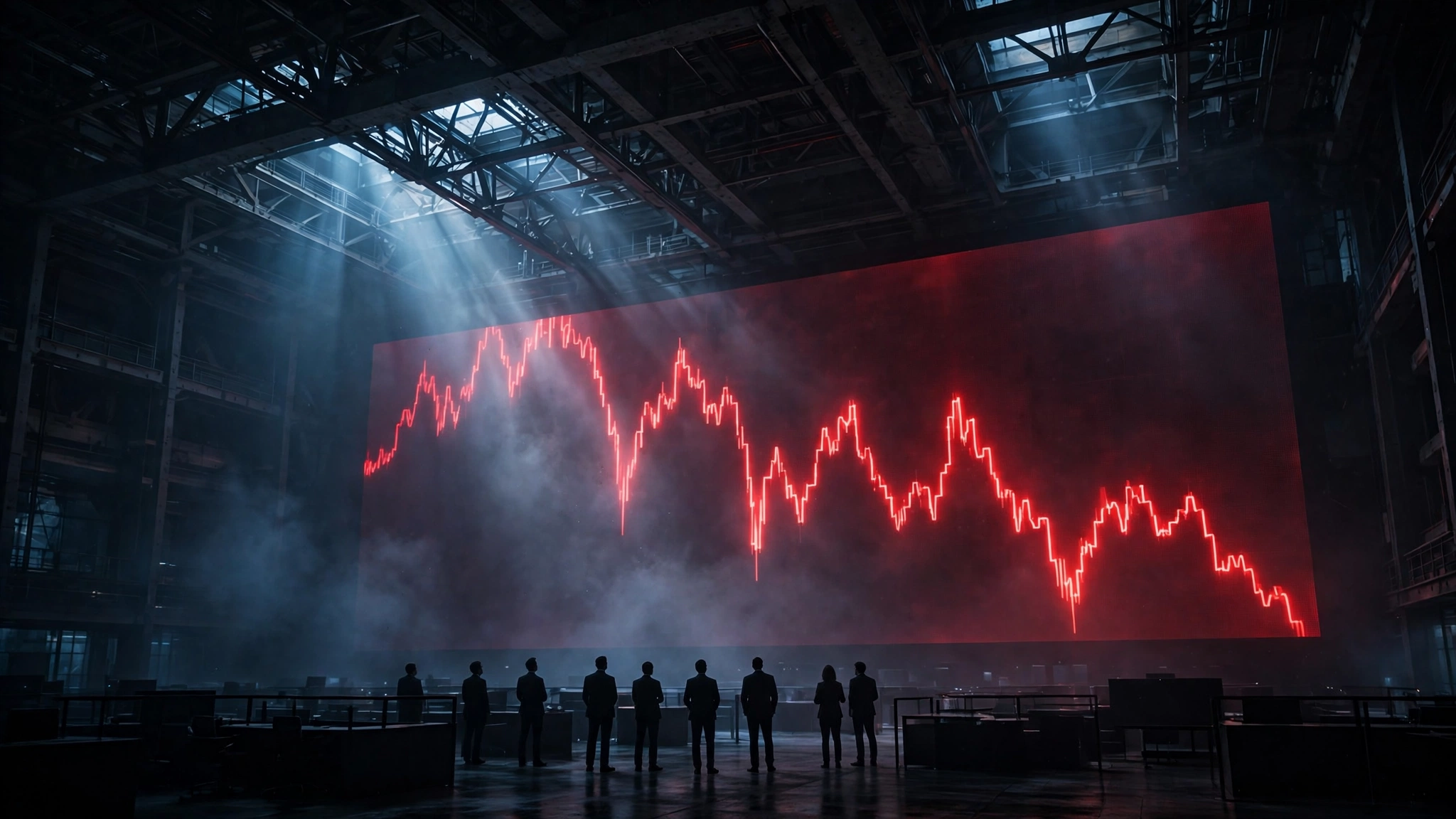
The decline began before November 5 — the figure had already moved from $2 trillion to $1.5 trillion to $1.6 trillion in discussions on November 2–3 — but that Thursday was one of the worst days the market has seen in years. On Thursday, November 5, the Nasdaq Composite fell 5.5% to 24,315, its worst day since April 2025 and more than 10% below its October 6 record. The Nasdaq 100 plunged 6.4%, and about $2.5 trillion of market value vanished in a single session. Nvidia fell 9%, wiping out roughly $450 billion; AMD dropped 17% and Micron 17.5%. Twelve AI stocks tracked through the sell-off closed a combined $1,447.4 billion lower.
The sell-off followed Democrats sweeping the midterms in both chambers, raising fears Washington and some states will slow the AI data-centre build-out, and a weak Qualcomm forecast added pressure. The Nasdaq has since rebounded — but the timing was brutal for a company about to ask the market its price.
The same week brought a scandal at the heart of the boom. The New York Times reported on October 29 that Nvidia chief executive Jensen Huang was the target of a Chinese spy plot involving Alice Huang, a former executive US intelligence believes was recruited by Chinese intelligence; the Financial Times reported US officials believed the relationship was romantic. On Sunday, November 8, Huang admitted the affair in a memo to employees and apologised. Nvidia’s board opened an independent investigation and Congress is demanding answers; Nvidia says it has no reason to believe the affair compromised the company or US national security.
The OpenAI yardstick
There is now a second number on the table. OpenAI, its main rival, has reportedly raised $11 billion so far in a funding round valuing the ChatGPT maker at $1.25 trillion. The round could total about $20 billion and has not closed; OpenAI originally sought $30 billion at $1.4 trillion in September. It has also delayed its own IPO plans, with a listing now expected in 2027.
The two valuations together offer a comparison point for Anthropic’s prospective pricing — and both point the same way: OpenAI raised less than it sought, at a lower valuation than it wanted. Anthropic is being pushed the same way, in public, before it has even set a range.
What the filing actually says
The filing portrays a company growing fast — and spending at a scale to match. Anthropic’s amended S-1, filed November 2, shows third-quarter revenue of about $17 billion, up 1,127% from the same quarter a year earlier and up 47% from the second quarter’s $11.6 billion. It also shows a net loss of $23.29 billion and an operating loss of $567 million, against a $974 million profit in the second quarter. The filing lists $895.4 billion in spending commitments through 2045, against $146.6 billion in cash and liquid assets.
The mechanics of the listing are in place: a 22-bank underwriting syndicate led by Goldman Sachs and Morgan Stanley, shares to list on the Nasdaq Global Select Market under the ticker ANT. The filing contains no share price, share count or target raise — the numbers still being argued over in the press.
The counterargument matters. A single IPO price reflects Anthropic’s own fundamentals — revenue, growth, margins — more than the health of the whole AI sector, so reading it as a verdict on the boom may overreach. The leaked figures are negotiating positions, not market verdicts, and the final price could still land at or above $1.5 trillion. The product is still landing well: Anthropic’s new flagship model Fable 5.2 scored high in SemiAnalysis tests.
Jim Cramer is not hedging. “Without it, I don’t see how the AI-related stocks can make a real recovery,” he said. “I don’t think it’s hyperbolic to say that this could be one of the most consequential IPOs in history.” Aswath Damodaran put it more coolly: “We are at a point in AI disruption, where their interests and payoffs will diverge, with implications for both the businesses and investors.”
The question no one can answer yet
So the listing goes ahead, and the argument with it. What valuation range does Anthropic set this week, and will the corrected pricing replace the retracted $70-to-$80 range? Will the roadshow complete in time for a November listing, or slip past Thanksgiving? And how much of the drift from $2 trillion is Anthropic-specific, and how much a sector-wide repricing?
The downward drift suggests investors are repricing AI growth expectations rather than haggling over one company — but that is an inference from headlines, not a settled fact. What the evidence has settled is narrower: the discussed valuations have shifted down overall, while the plan to list has not changed — though whether it happens in November is still open, with investors doubting the roadshow can finish on schedule and a delay still possible. The final valuation is still unresolved — and when it is set, it will be the first number in this affair that is a final IPO price rather than a provisional valuation figure.