
Theranos whistleblower Tyler Shultz has a warning for investors, founders and buyers in the AI era: the risk of AI boom deception is real, and it is harder to spot than the last great startup fraud. Shultz, whose first job out of college was at Theranos, helped expose a company whose blood-testing devices delivered faulty results to real patients. Now, he says, the same conditions that let Theranos raise money on claims its technology could not support are present again, at far larger scale, in artificial intelligence.
What Shultz warned, and why now: ai boom deception in his words
Shultz gave his warning in an interview with The San Francisco Standard, reported by TechCrunch on 30 October 2026. His central claim is blunt. “A huge danger with AI is that I think it is really hard to do due diligence on it,” he said. “It’s really hard to tell the difference between what is something truly unique and new versus like, a ChatGPT wrapper… If you want to deceive people, I think this is a great opportunity to go deceive people.”
The timing matters. The warning arrives as “You Can See Everything,” the documentary directed by Nathan Fielder and Lance Oppenheim about disgraced Theranos founder Elizabeth Holmes’s final weeks before prison, is sparking a national conversation. TechCrunch describes it as one of the highest-grossing documentaries of all time. Holmes is in federal prison, serving a sentence of over 11 years. The value of revisiting Theranos now lies in what its story reveals about how money moves when a compelling founder meets investors who have not checked the technology.
Theranos in brief: the cautionary tale
Theranos built blood-testing devices that were later shown to be dangerously inaccurate, delivering faulty results to real patients. At its peak, the company carried a private valuation of around $10 billion. The technology, however, never actually worked as claimed. Theranos used its own machines for only a fraction of tests, outsourcing others to third-party equipment, while its devices made their way into Walgreens stores and delivered faulty results to real patients.
Shultz was a key whistleblower in exposing those dangerously inaccurate devices. The legal outcome is settled: Holmes was convicted in January 2022 on four federal fraud counts for deceiving investors about the capabilities of the company’s blood-testing technology, and she was sentenced to over 11 years in federal prison. The harm was not only financial. Patients received unreliable results, and the company’s story unravelled only after reporting and whistleblowing forced the evidence into the open.
How Theranos raised its money is central to Shultz’s warning. Its funding often came from individual investors, such as the DeVos and Walton families, rather than venture firms. The company did not share scientific information or evidence that its machines worked with potential investors, citing concerns about revealing trade secrets. That secrecy, Shultz’s account suggests, warded off many top venture capitalists in Silicon Valley, while leaving wealthy individuals exposed to a pitch they could not independently verify.
Why AI claims are harder to check

Shultz’s argument is not that every AI company is a fraud. It is that AI claims are structurally harder to verify than a physical medical device was, even though that device went unverified for years. A blood-testing machine either returns accurate results or it does not, and that can, in principle, be tested. An AI product is different. A polished demo can look like a breakthrough while running, underneath, on someone else’s model with a thin layer of customisation on top. That is the “ChatGPT wrapper” problem Shultz names: from the outside, a wrapper and a genuine innovation can look identical.
Opacity compounds the problem. A diligence obstacle can arise when key details, such as how a model was evaluated or how often it fails, are not disclosed, for example on competitive grounds, as Theranos withheld scientific evidence on trade-secret grounds. Benchmarks and demos can be chosen to flatter a product. Performance in a controlled presentation is not the same as reliability in real use, and where claims lack independent verification, investors should be cautious about judging the pitch, the team and the momentum instead of the technology.
Scale raises the stakes. TechCrunch frames Shultz’s warning against AI-era companies that have never turned a profit raising capital at trillion-dollar valuations. When valuations are that large, the gap between a company’s claimed capability and its proven capability is not a rounding error. It is the investment itself. A single unverified claim, repeated confidently and funded generously, can absorb capital that might otherwise have gone to work that actually functions.
The funding pattern Shultz fears is repeating
Shultz describes the Theranos funding model in terms that are deliberately small-scale, because that is where he thinks the danger starts. “I think the days of having a thirty-minute coffee with someone and sending them $100,000 should be over,” he told the San Francisco Standard. “Elizabeth took that model and scaled it to $100 million.”
“I believe that what [Holmes] did was raise the biggest angel round of funding of all time,” Shultz added, “but even at the smaller levels, I think investors need to recognize that when they put that type of money in someone’s hands, they are giving them tremendous power.” That sentence is the heart of his warning. The problem is not only the size of the cheque. It is what the cheque buys: power without a corresponding obligation to prove the claim before the money is spent.
Theranos was once treated as a wake-up call for investors, a lesson that due diligence had to come first. Shultz worries that investors may forget these lessons in the AI era. Pausing to verify can feel costly when a round is competitive, which is why verification needs to be a precondition rather than an afterthought. But the Theranos record shows what happens when verification is skipped: the money moves first, the evidence arrives later, and by then patients, customers and investors have already borne the cost.
Haemanthus and the second act question
The documentary adds a further reason for unease. In the film, Holmes and her partner, Billy Evans, are shown working on Haemanthus, a diagnostics company described as “Theranos 2.0,” which has reportedly raised about $20 million in funding. Shultz’s reaction is restrained but pointed: “I have this feeling of unease about what might come next. She’s certainly preparing and beginning her second act, and I don’t know exactly where it’s going to go.”
What is actually known about Haemanthus is thinner than the label suggests, and the reporting itself is careful on this point. Haemanthus says it can use lasers to detect disease in blood, saliva and urine. Reporting derived from Forbes notes that the company has at least one granted patent, but has no commercial product customers can buy and has not published independently validated data showing its technology works. Its former chief technology officer, Joseph LaChapelle, left in March 2026, and the two sides describe that departure differently. Haemanthus has publicly denied that Holmes has any involvement, and her name does not appear in the company’s incorporation documents, according to Wired reporting cited in that coverage. None of this proves wrongdoing by Haemanthus. It does show why Shultz’s unease is framed as a question rather than an accusation: a familiar pattern, a new company, and claims for which independently validated results have not been published or supplied in the cited reporting.
A due-diligence checklist for AI claims

Shultz’s warning is most useful when it is turned into checks that can be applied before money changes hands. The following checklist follows directly from the Theranos record and from the specific difficulty he names for AI.
- Demand evidence that the core technology works, not just a demo. Ask what was tested, on what data, with what failure rate, and who verified it. A demo alone does not establish reliable performance in the buyer’s intended conditions.
- Ask what is genuinely new. What does this system do that the underlying model, used directly, does not? If the answer is a nicer interface and a pitch deck, the company may be a wrapper, however impressive it looks.
- Check who has verified the claims independently, and what was withheld as proprietary. Secrecy may be legitimate, but an investor who cannot see any independent verification is being asked to trust rather than to judge.
- Treat charisma, momentum and valuation as signals to investigate, not as proof. Theranos combined a high valuation with withheld evidence: it reached around $10 billion while declining to share scientific evidence that its machines worked. None of that made its devices work.
For buyers rather than investors, the same logic applies at smaller scale. Before adopting an AI product that will handle customer data, medical information or financial decisions, ask for evidence of reliability in conditions like your own, for clear limits on what the system cannot do, and for a human route back when it fails. Until a vendor provides adequate evidence of its limitations and reliability, buyers should withhold reliance on the product for high-stakes decisions.
What the warning does and does not prove
It is important to be precise about what Shultz has and has not shown. His warning is an expert caution from someone who watched a fraud from the inside, not proof that any particular AI company is fraudulent. High valuations alone do not prove deception: genuinely valuable companies can be expensive, and unprofitable companies can become profitable. A warning about deception is not a verdict on the field.
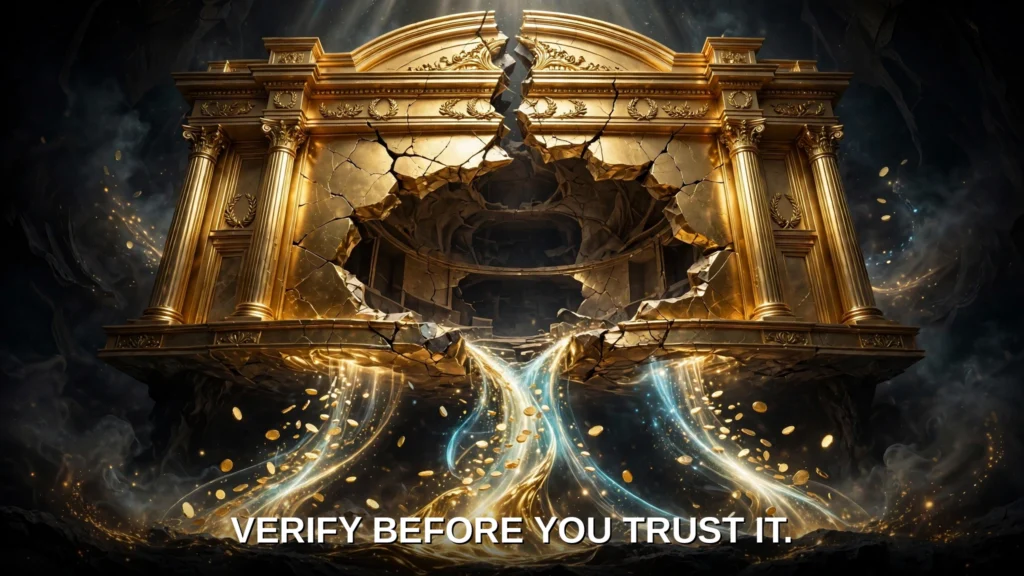
What the warning does establish is narrower, and more actionable. Verification is the bottleneck. When claims cannot be checked, money and trust flow on the strength of the story rather than on verified evidence. Theranos proved that a closed, secretive, charismatic company could reach a valuation of around $10 billion on technology that did not work. Shultz’s point is that AI makes that pattern easier to repeat, not harder, because the difference between a breakthrough and a wrapper is harder to see from the outside.
The open questions remain. The full San Francisco Standard interview may contain more detail than the quotes TechCrunch carried. Haemanthus’s technology and funding rest largely on reported figures and disputed claims, not on independently validated results. And the AI boom’s valuations need to be judged company by company, on evidence, rather than by the excitement of the sector as a whole. Until that evidence is demanded as a condition of funding, Shultz’s warning will keep applying: in a boom where it is hard to tell the real thing from the imitation, deception does not need to be sophisticated. It only needs to be unverified.