

Deploying an AI agent is not the same as shipping a chatbot that answers a question and stops. An agent keeps going: it plans, calls tools, reads data, remembers context, and takes actions that affect real people. That is why ai agent ethical guidelines matter before launch, not after something goes wrong. This guide sets out the principles most frameworks share, and turns each one into a concrete deployment decision: who owns it, what control enforces it, and how you test it.
What deploying an AI agent actually means
An agent acts toward a goal with some degree of autonomy. It does more than generate text in response to a single prompt. It may search, send messages, update records, move money, book appointments, or change settings in another system. Deployment means giving it real permissions, real users, and real consequences. A mistake is therefore not just a wrong answer on screen. It can be a wrong payment, a message sent to the wrong person, data shared with the wrong system, or a decision that cannot easily be undone.
The ethical bar should scale with autonomy and impact. An agent that drafts internal notes for a human to review may carry a lower risk than an agent that acts on customer accounts overnight without supervision, but only after an assessment that the drafting task, the data it can access, and the potential consequences are low risk. Where that assessment holds, it can run with lighter checks, consistent with the approval tiers for reversible, low-risk actions set out below. The second needs approval gates, audit trails, and a way to stop it quickly. Before you decide on controls, write down exactly what the agent is allowed to do, what it is never allowed to do, and what happens if it is unsure. If you cannot answer those three questions, the scope is too broad to deploy safely.
The core principles in ai agent ethical guidelines
Different frameworks use different words, but they converge on the same core. The OECD AI Principles, first adopted in 2019 and updated in 2024, set out five principles for responsible stewardship of trustworthy AI: inclusive growth and well-being; respect for human rights and democratic values, including fairness and privacy; transparency and explainability; robustness, security and safety; and accountability. The frameworks covered in the research overlap on several of those ideas, including accountability, transparency, fairness and privacy.
The NIST AI Risk Management Framework, released in January 2023, organises the work into four functions: Govern, Map, Measure and Manage. Govern covers policies, roles and accountability. Map covers the system’s context, intended use and potential impacts. Measure covers testing and monitoring. Manage covers how risks are treated and how incidents are handled. It also describes trustworthy AI through characteristics that include being valid and reliable, safe, secure and resilient, accountable and transparent, explainable and interpretable, privacy-enhanced, and fair with harmful bias managed.
For a working guide, it helps to expand those principles into six checks a deployment team can actually use: safety and avoiding foreseeable harm; fairness and non-discrimination; privacy and data minimisation; transparency and explainability; accountability and human oversight; and respect for human autonomy and choice. Use these six checks as a practical organising aid: they cover the main decisions a deployment team must make, while additional safeguards may be warranted by the deployment context and the frameworks cited here.
Accountability: who owns what the agent does

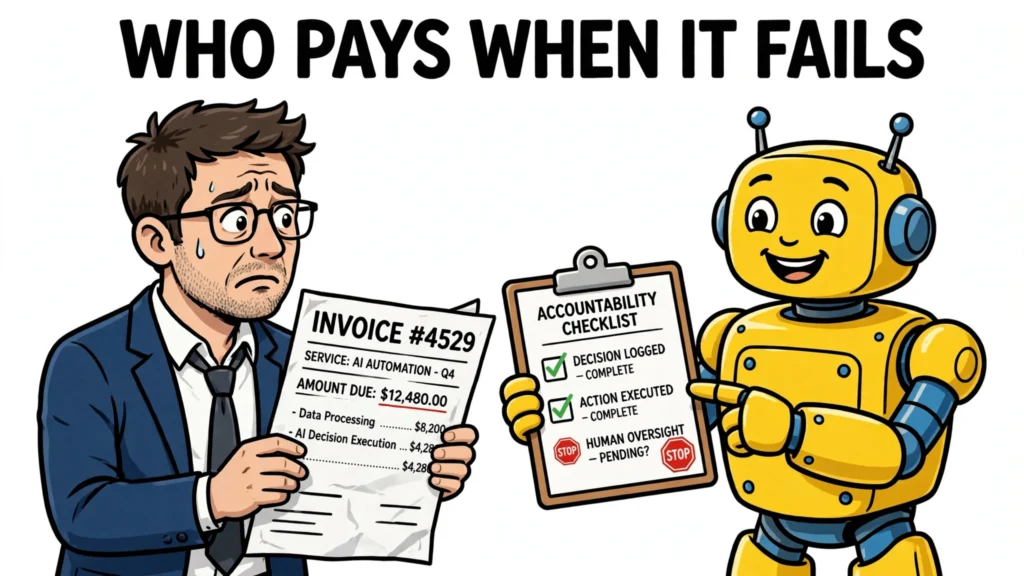
Accountability fails when everyone is responsible in general and no one is responsible in particular. Every deployment needs a named owner who can answer three questions: who approved this agent, who can pause it, revoke its access, or roll back reversible changes, and who reviews what it did. That owner does not need to watch every action in real time, but they must have the authority and the tools to intervene. An agent without a way to stop it, revoke its access, or roll back reversible changes, or without an owner with real authority, is not supervised. It is merely logged, and a log nobody acts on is not oversight.
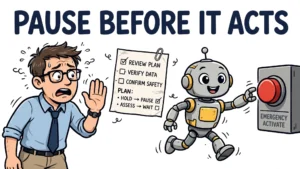
Scale approval to consequence. Reversible, low-risk actions, such as drafting a summary or searching internal documents, can run autonomously. Irreversible or high-stakes actions, such as sending money, publishing content, deleting data, or making a decision about a person’s eligibility, should wait for human approval, or at least for a human review of the agent’s plan before execution. A useful pattern is plan approval: the agent shows its intended steps up front, a human reviews and edits the plan, and the agent then executes only that plan, with the ability to stop it at any point.
Audit trails make accountability real. Record what the agent did, which tools it called, what data it used, and what reasoning or key factors it relied on, in enough detail that a reviewer can reconstruct the decision afterwards. This matters for debugging, for answering a user who was affected, and for proving that a safeguard was actually in place. If an incident happens and the team cannot reconstruct the agent’s actions, the deployment was not accountable, whatever its policy document said.
Data, privacy and consent

Agents are risky precisely because they can reach so much: inboxes, calendars, customer records, internal documents, and other systems. The ethical rule is least privilege. Give the agent only the data and tools it needs for its specific task, not everything it could conceivably use. Credentials should be scoped to that task, and permissions should be granular and revocable. A user or administrator should be able to narrow or withdraw the agent’s access without rebuilding the whole system.
Memory deserves its own rule. An agent that remembers past conversations can be helpful, but retained context can also leak across tasks, users, or purposes. Decide what is retained, for how long, and for what purpose, and keep user context separate from other data the agent can access. Do not let a convenience, such as keeping everything forever, become the default. Consent should also match the agent’s real actions. A generic acceptance of terms does not tell a user that an agent will contact third parties, share their data with another system, or act on their behalf while they are away. Consent should cover the actions themselves, in plain language, and it should be possible to change it later.
Fairness, bias and harm testing before launch
An agent can be accurate on average and still harmful in practice. Bias can enter through training data, through the data the agent reads at run time, or through repeated actions that compound: the same routing, ranking, or eligibility decision applied thousands of times. Testing therefore needs to look at outcomes across different user groups, not just overall accuracy. It also needs realistic failure cases: ambiguous instructions, missing data, adversarial inputs, and edge cases where the agent’s first interpretation is wrong.
Testing does not end at launch. Monitor outcomes after deployment for disparate or harmful patterns, and set thresholds that trigger review. Accuracy alone is not a sufficient monitor. A team should also watch for complaints, overrides, blocked actions, and cases where users challenge the agent’s decisions. When monitoring finds a problem, there must be a remediation path: narrow the agent’s scope, add an approval step, fix the data or prompt, or pause the deployment. An agent that cannot be corrected quickly should not be running at scale.
Transparency: what users and reviewers must be told
People should know when they are interacting with an AI agent. This is both an ethical expectation and, in some jurisdictions, a legal one. Under Article 50 of the EU AI Act, providers of AI systems intended to interact directly with natural persons must design them so that users are informed they are interacting with an AI system, unless that is obvious from the circumstances. Those transparency obligations apply from 2 August 2026. Even where a specific law does not apply, hiding the agent’s nature undermines trust and removes the user’s chance to adjust their expectations, check the output, or ask for a human instead.
Transparency also means explanation. A user who is affected by an agent’s action should be able to learn, in plain language, what the agent did and the key factors behind it. That does not mean publishing the model’s internal workings. It means giving a useful account: what request was acted on, what information was used, what decision was taken, and how to challenge it. Reviewers need a similar account, plus the audit trail behind it. Affected people need a route to question a decision and seek correction, and that route must be staffed by people who can actually change the outcome.
From principles to a deployment checklist
Principles only help if they become gates. Before launch, run through this checklist and record the answer for each item, with a named owner:
Scope: what is the agent allowed to do, and what is it never allowed to do? Owner: what named person can pause the agent, revoke its access, or roll back reversible changes? Permissions: does the agent have least-privilege access, and can that access be revoked? Approval: which actions require human approval before they happen, and which can run autonomously? Records: can the team reconstruct what the agent did, with what data, and why? Testing: has the agent been tested across user groups and failure cases, not just for average accuracy? Disclosure: will users know they are dealing with an agent, and can affected people challenge a decision? Monitoring: what will be watched after launch, what threshold triggers review, and what happens then?
Watch for common failure modes. Blanket permissions: for example, in a hypothetical rush to launch before scoping was finished, an agent might be given admin access it does not need. No way to stop it: a deployment that can be started but not safely paused, with its access revoked and reversible changes rolled back. Monitoring only accuracy: a team that tracks how often the agent is right, but never looks at who it harms when it is wrong. Treating a policy document as a control: a written principle with no owner, no test, and no enforcement is not a safeguard.
Finally, know when to slow down. Narrow the agent’s scope, add an approval step, or delay deployment when the consequences are high, the audit trail is thin, the permissions are broad, or the team cannot explain how a decision would be challenged. An agent that is useful but not yet governable is a draft, not a deployment. The ethical guideline that matters most is the simplest one: do not give an agent power you cannot oversee, explain, and stop — with prior human approval for irreversible actions and a plan to remediate their effects.