

On Monday, Anthropic filed the paperwork to go public. The numbers in the filing are the kind that stop a room: $16.3 billion in revenue in the first half of the year, up from $1.2 billion a year earlier. But the numbers are not the story. The story is the Anthropic IPO governance — who gets to vote.
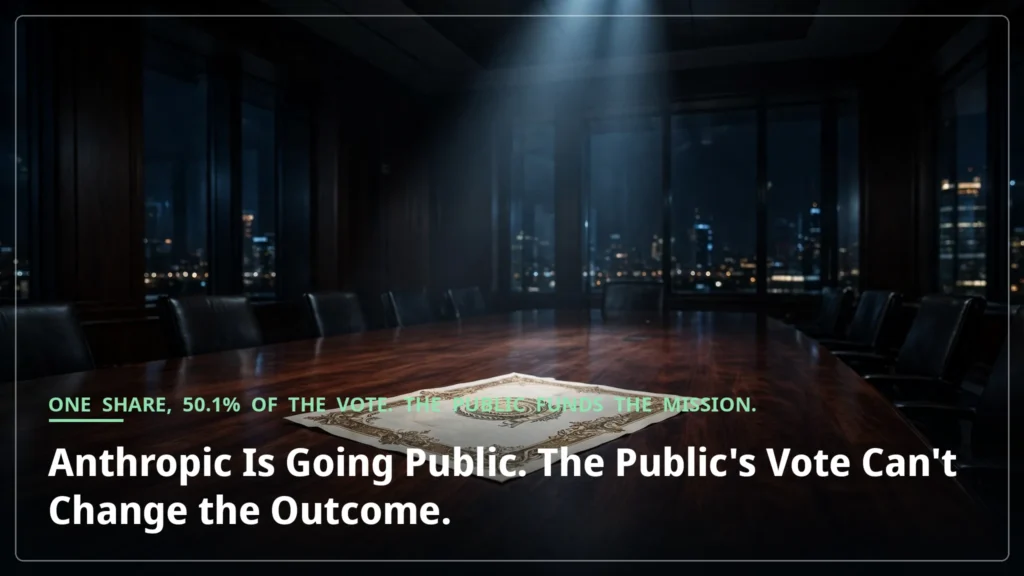
Anthropic is asking the public markets for money while keeping the public out of the decisions. Under its S-1, filed 26 October for a Nasdaq listing as ANT, a single share held by a company of its seven co-founders carries 50.1% of the voting power. Every share sold to the public combined carries at most 49.9%. You can own the economics. The control is not for sale.
Anthropic IPO governance: one share, 50.1% of the vote
The mechanism is a share class called Class F: a single Class F share held by a Founder LLC made up of the seven co-founders: Dario Amodei, Daniela Amodei, Tom Brown, Jack Clark, Jared Kaplan, Sam McCandlish and Christopher Olah. That one share carries 50.1% of the total vote on matters submitted to stockholders.
The shares the public buys, Class A, carry one vote each. Together they are capped at 49.9%. The filing’s risk factors say it without varnish: holders of Class A stock “generally will not be able to affect the outcome of any matter submitted to a vote of our stockholders or the election of our directors, regardless of how they vote.” The filing adds that the structure may effectively eliminate Class A influence altogether.
There is one exception: if a majority of the co-founders cannot agree on how to vote, the Class F votes are generally cast in proportion to the Class A votes. The founders’ lock holds only while the founders agree with each other.
The trust that picks the board
The vote is only half the design. The other half is the board, and the board is picked, in the majority, by a body the public never votes for.
Anthropic’s Long-Term Benefit Trust was created in 2023 as five financially disinterested trustees. Through Class T stock, the trust elects and removes the Class T directors, a board majority: four of seven seats. The other three are elected by Class A and Class F holders together, with the founders holding the controlling vote. Between them, the Founder LLC and the trust effectively choose every director; public investors cannot independently elect one.
Trustees are paid a flat $400,000 a year, the chair an extra $25,000, and the pay does not rise or fall with profits. Trustees are barred from holding Anthropic securities. Anthropic set aside $8.425 million to fund the trust for the nine months ending 30 September 2026.
Four of the five seats are filled: chair Neil “Buddy” Shah (since June 2023), Richard Fontaine (April 2025), Ben Bernanke (June 2026) and Christopher Stubbs (October 2026). One seat was vacant as of October, and three of the four arrived within roughly the last 18 months, so the body guarding the mission is still settling in.
The trust’s own powers have a back door: the board, the trustees and specified majorities of other share classes can amend or redeem Class T, and 80% of the board plus 80% of the trustees can amend or end the trust’s powers, with no public vote.
What the public actually buys
So what does a Class A shareholder get? The economics, the disclosures, and a vote the filing itself says will generally not change an outcome. Class E shares vote only on limited matters. Class N shares, held mostly by strategic partners, carry no general voting rights.
Because the trust can elect a board majority, Anthropic qualifies as a “controlled company” under Nasdaq rules, though it says it will use the exemption only for its nominating and corporate governance committee. Its board has a majority of independent directors, with fully independent audit and compensation committees. Removing the trust against the trustees’ wishes needs a majority of Class A votes cast, one of the few levers the public holds.
The filing does not hide the costs: the structure could make directors harder to replace, could lead to decisions that may negatively affect Class A stock, and could make the stock ineligible for some indexes, and therefore the funds that track them.
The sunset that isn’t on a clock
There is no date on which the founders’ control expires. The Class F share ends only when fewer than three of the seven co-founders remain for 90 days, followed by a 450-day transition. It is a bet that the mission outlives the people who wrote it, with the trust as backstop, and the backstop’s own powers can be amended by the board and the trustees themselves.
Anthropic is a Delaware public benefit corporation. Its stated purpose is “the responsible development and maintenance of advanced AI for the long-term benefit of humanity.” It has also put about 5% of its shares, 846,840,960 Class N shares, into its own Public Benefit Fund, and the co-founders have each pledged 80% of their personal equity to philanthropy. Whether the mission survives contact with the market is the open question.
The rival that stayed private
The contrast writes itself: Sam Altman, chief executive of Anthropic’s archrival OpenAI, has cited investor pressure as a reason OpenAI is not pursuing an IPO this year, while Anthropic is going public with a structure designed to make investor pressure toothless in the boardroom.
University of Pennsylvania law professor Elizabeth Pollman told The Verge the structure is a “unique and complicated governance structure that has not been used before”, “creatively designed for this founder-led and mission-driven company.” Experts say it should let Anthropic pursue profits without shareholders forcing it to cut corners on safety or rush systems out before they are adequately tested.
But the same reporting carries the caveat that matters most: even the strongest legal protections can only go so far, and no corporate structure can completely insulate a public company from market demands. Legal insulation is not market immunity. How investors will react to having almost no vote if returns falter, and what that does to the share price, is still an open question.
The scale of the spending
The filing shows the scale of the spending ahead. The headline loss, $80.7 billion in the first half of the year, is mostly a noncash charge of about $72.4 billion from revaluing convertible notes; the operating loss narrowed to $693 million from $2.1 billion. But the spending ahead is staggering: about $417 billion in new compute obligations this year, plus an estimated $125 billion to $150 billion more for capacity arriving between 2028 and 2031. More than 11,900 customers now pay at least $100,000 a year, and Goldman Sachs and Morgan Stanley lead 22 underwriters. Those figures are the context for the capital the company is raising, and for why the question of who controls it matters.
The filing is candid about what the company is building, too: its models may behave in unintended, misaligned or autonomous ways, and the business faces an evolving and uncertain regulatory and political environment.
The bet
Strip away the share classes and the question is simple: can a company take the public’s money without taking the public’s orders? Anthropic’s filing answers with an arrangement written into its legal architecture, down to the single share carrying 50.1% of the vote and the trustees who pick most of the board.
It might work: the structure is disclosed, the trade-off priced in or walked away from, and the trustees are paid a flat fee and barred from holding the company’s securities. It might also fail, not in a courtroom, but in a quarter where the numbers disappoint, a founder leaves, or a safety incident forces a choice between mission and market. Whether either happens is still an open question.
For now, the paperwork says the quiet part out loud. The public is invited to fund the mission. It is not invited to run it.