


The Nvidia securities lawsuit, in one word
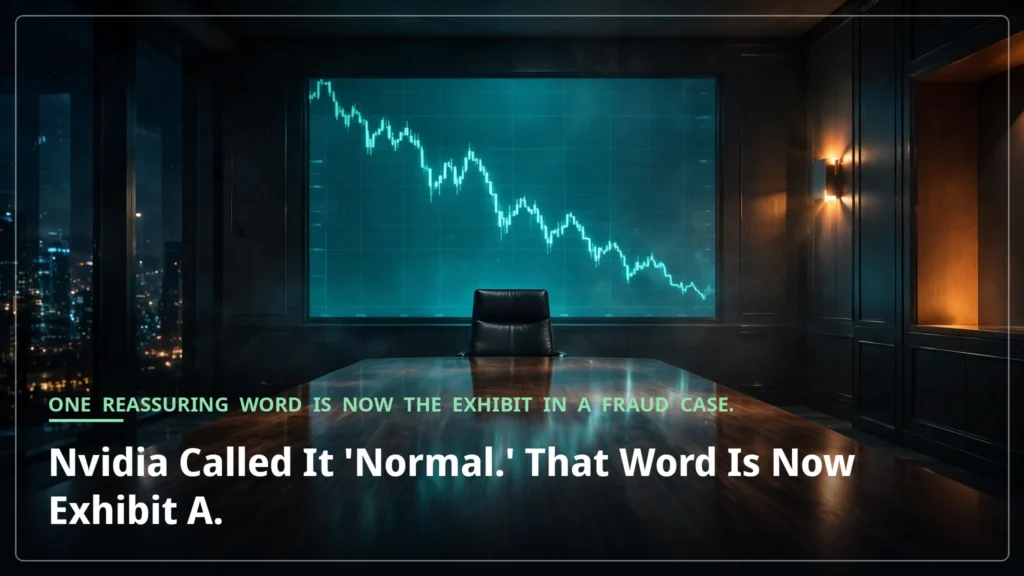
On Monday, Nvidia’s shares fell $7.97, or 4.27%, to close at $178.67 — the first trading day after the board announced an independent investigation into chief executive Jensen Huang over his relationship with Alice Huang, an executive U.S. intelligence believes was spying for China. By Monday afternoon, the Nvidia securities lawsuit had been filed.
But the lawsuit is not really about the affair. It is about a word. Twice in two days, Nvidia described the relationship at the centre of the story as normal. The complaint says those reassurances were false or misleading — and a Stanford expert agrees the company’s earlier statement was “clearly a misleading statement.”
Nvidia’s securities case turns on what the company said, not on what its board investigation may yet find.
Four statements, one omission
The complaint, filed by the Rosen Law Firm on behalf of retail investor Mark Kistenmacher in the Northern District of California, challenges four public statements. The first two date from October 9, 2025. Megaspeed is the Singapore data centre company where Alice Huang was a top executive. Spokesman John Rizzo said then that Nvidia’s compliance team had found Megaspeed was “wholly owned and operated” outside China with “no China shareholders,” and that a site visit found “no evidence of diversion” of Nvidia chips. The same day, Rizzo also responded to the Times’ account of Huang joining Alice Huang at a Taipei bar.
The two statements that matter most came more than a year later. On October 29, 2026, after the Times reported that U.S. officials had concluded Alice Huang was a Chinese intelligence asset, Rizzo told the paper: “Jensen’s interactions with Ms. Huang are not unusual or unexpected. Meetings with customers are part of a C.E.O.’s job; Jensen talks with thousands of customer executives every year.” The next day, Huang told Bloomberg that Nvidia’s dealings with Megaspeed were “normal and not unusual,” adding: “We’ve studied all their deployments of our GPUs and counted every one.” The complaint alleges all four statements were false or misleading because they omitted the same thing — that Huang had an affair with Alice Huang. It is a case about omission: it does not allege Rizzo’s specific 2025 factual claims were untrue.
“Clearly a misleading statement”
Robert Bartlett, a Stanford Law professor and securities law expert, told TechCrunch that the company’s earlier statement was “clearly a misleading statement.” And because Huang is the chief executive, Bartlett said, “his knowledge gets imputed to the company” — Nvidia is treated as having known what its chief executive knew.
Bartlett predicted a “classic fraud on the market” claim, in which investors argue they paid prices reflecting false or incomplete public information and lost money when the truth emerged. The proposed class covers anyone who bought Nvidia securities between October 9, 2025 and November 8, 2026, and Kistenmacher is asking for unspecified damages, interest and attorneys’ fees, plus a jury trial.
Damages in such cases are tied to the stock’s decline, and Monday’s drop gives the lawyers a lot to work with. Bartlett said a settlement could prove exceedingly expensive — typically paid by the company and its insurers, with no personal consequences for the CEO or the board. It is a civil matter, so Huang is not facing prison over it.
The sharpest irony: the suit is brought in the shareholders’ name, and shareholders ultimately pay for the settlement, directly or through insurance premiums.
Six sentences on a Sunday
The board’s own statement, published on Sunday, November 8, runs to six sentences: an independent investigation, overseen by independent directors assisted by outside counsel, “in light of recent reporting that founder and CEO Jensen Huang has been the target of a foreign intelligence effort.” It says the board has “no reason to believe that either national security or NVIDIA secrets were compromised,” that “Jensen fully supports the review,” and that “the Board has confidence in Jensen and his leadership team.”
What the statement leaves out is considerable: no deadline is set, and Megaspeed, Alice Huang, China and any personal relationship go unmentioned. It also omits what Huang had already told the board. According to The New York Times, reporting the same day, Huang acknowledged to the company’s board that he had been intimate with a business executive U.S. intelligence determined was a Chinese spy, and told the company: “I was unfaithful to my wife. My actions hurt her and our children. There is no excuse for what I did. I am deeply sorry.”
Three buckets of exposure

Bartlett sorted Nvidia’s wider exposure into buckets. The first is the securities fraud claim, the clearest immediate problem for the company and potentially for Huang. The second is governance: what the board knew and when. Directors may have been kept in the dark, and it is an open question whether reporting lines failed to bring a critical risk like this to directors once the Times began reporting on Megaspeed. If they did not, or if directors did not act, board-level liability is possible.
A third category, one that would change everything, would arise only if the board’s investigation finds Huang knew about the intelligence connection. That would be “a whole other ball game,” as Bartlett put it. The reporting so far cuts both ways: the Times said U.S. officials initially did not believe Huang knew Alice Huang was gathering information, and that it is unclear whether that assessment has changed. The board said on Sunday that it has no reason to believe national security or Nvidia secrets were compromised.
There is also the question of government action. The SEC can seek an officer-and-director bar for intentional securities-fraud violations, which Bartlett said is technically on the table — but he doubts the current SEC under Chairman Paul Atkins would have the appetite, given President Trump’s support for Huang. A roughly two-year clock after discovery would leave room for a future administration, but the window would be tight.
The race to file first
If the legal theory is straightforward, the scramble around it is pure theatre. At least four firms, including Schall, Brown & Schwartz and Levi & Korsinsky, announced investigations on Monday. Bartlett told TechCrunch he would “definitely wager that there’ll be a filing” by the end of the day. He was right: the Rosen case surfaced on Monday afternoon.
Plaintiffs’ lawyers have good reasons to be first in line. Under federal securities law, the first complaint triggers a public notice, and investors then have 60 days to seek appointment as lead plaintiff — a head start on signing up investors with large losses and shaping the story of the case. Rosen’s notice sets January 8, 2027 as the deadline for lead-plaintiff motions; the court decides later, usually on which investor suffered the biggest loss.
It is worth underscoring that neither the law firm announcements nor the newly filed complaint is a sign of a strong case. Plaintiffs’ firms are quick to publish these notices when they see an opportunity, the complaint draws on news reports, and none of the allegations has been tested in court. It does not say when the relationship began — a gap that matters, because the statements could yet be defended as describing business dealings as they were understood at the time.
The word that may do the damage
Strip away the spy story, and what remains is a lesson in corporate language. Nvidia did not need to describe the relationship at all. It chose, twice, to describe it as normal — once through a spokesman, once through the chief executive himself. Rizzo’s comment came on October 29, the same day the Times reported officials had concluded she was a Chinese intelligence asset “funnelling information to Beijing”; Huang’s came the next day, October 30.
The securities claim concerns allegedly misleading public statements, and it need not await the board investigation’s findings. The court case will ask whether what Nvidia said, in public, about a business relationship it called normal, misled the people who bought its shares. One reassuring word is now the exhibit at the centre of a securities-fraud case. That may prove the affair’s real cost to Nvidia — not the scandal, but the sentence.