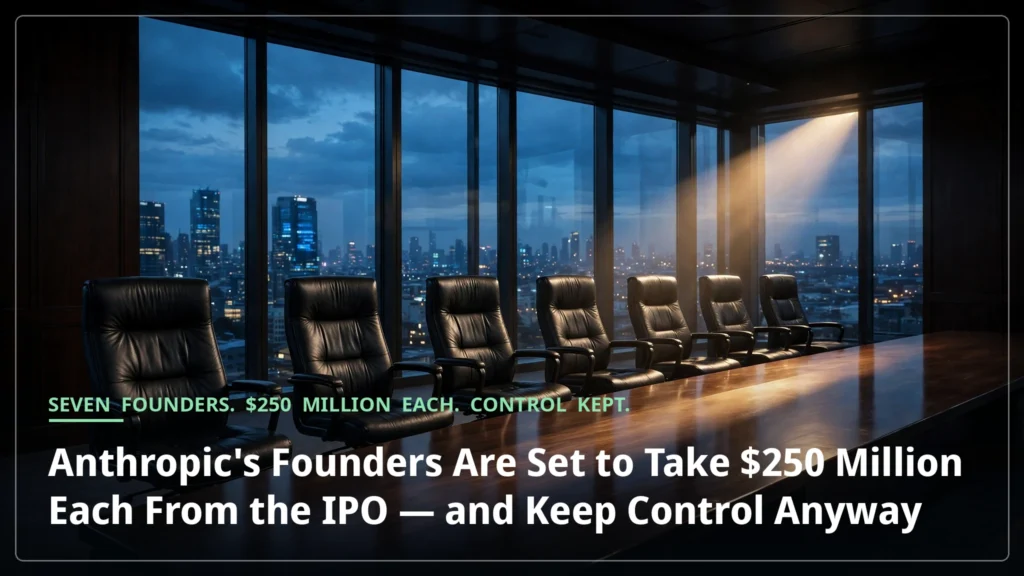

Seven founders. One number, repeated seven times: 3,378,378 shares each. That is how many shares each of Anthropic’s co-founders plans to sell in the Anthropic founders IPO, according to the amended S-1 filing Anthropic submitted on November 10. At the $74 midpoint of the $70-to-$78 price range, each of them would take in just shy of $250 million. The symmetry is the first thing to notice about this IPO. The second is what the sale does not cost them.
Anthropic is heading for an offering that could value it at up to about $1.4 trillion, with 825 million Class A shares on offer and a raise of as much as $64.35 billion. Pricing is expected on November 18, with trading to begin on November 19 on the Nasdaq under the ticker ANT. Against numbers that large, the founders’ slice looks almost modest: the 23,648,646 shares they plan to sell between them are the entire block coming from existing stockholders, and Anthropic itself receives none of the proceeds from their sales.
The same number, seven times
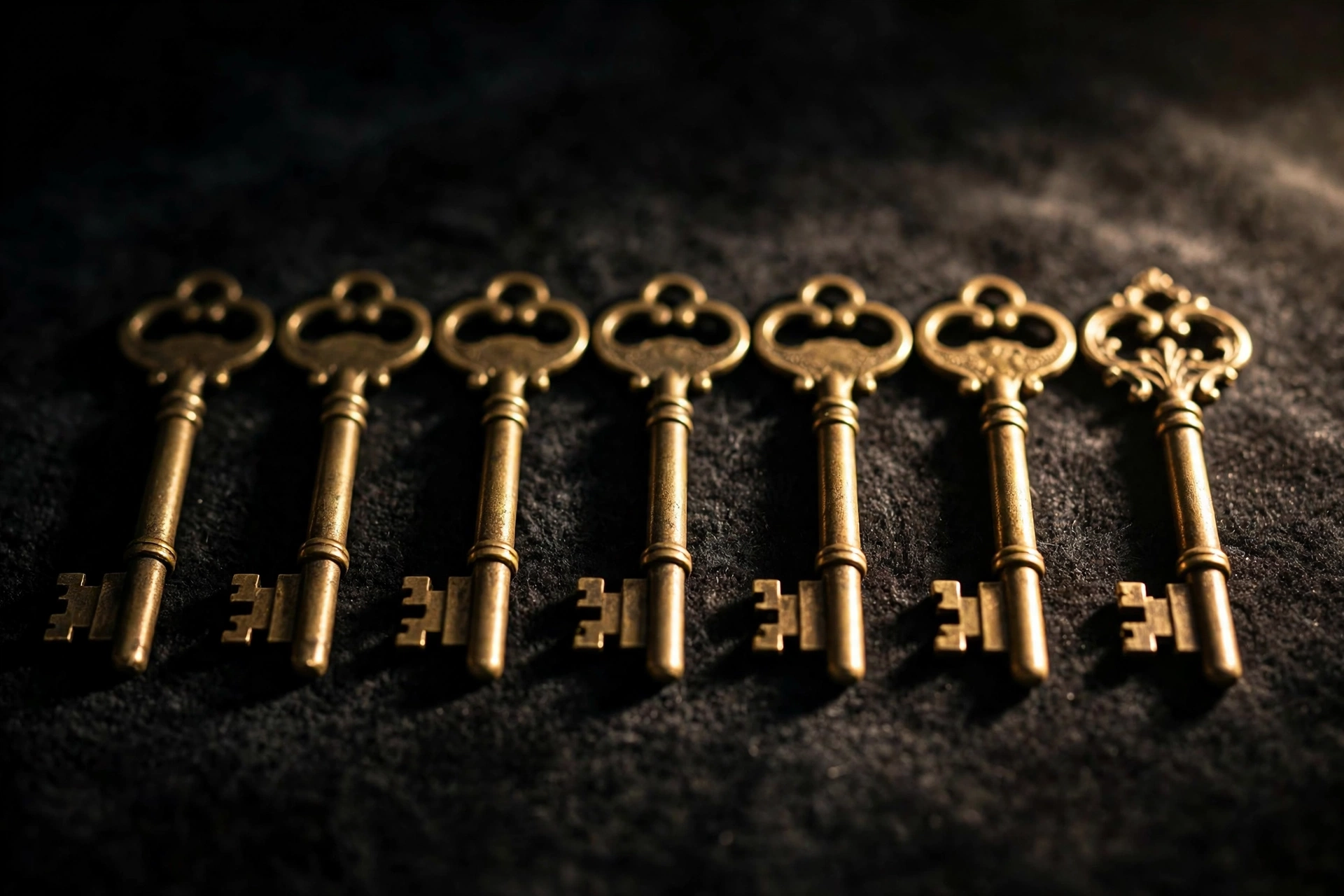
The identical share count is the detail that makes this filing worth reading closely. Each founder is selling precisely the same number of shares, which means each of them would receive precisely the same amount of money: just over $236 million at the $70 low end of the range, just under $264 million at the $78 high end, and just shy of $250 million in the middle.
There is no first among equals here, and the filing makes that explicit. After the sale, no single founder would hold significantly more shares or votes than the others. The seven are Dario Amodei, the chief executive; Daniela Amodei, president and chair of the board; Tom Brown, chief compute officer; Jack Clark, head of public benefit; Jared Kaplan, chief science officer; Sam McCandlish, chief architect; and Christopher Olah, interpretability research lead.
It is worth putting the payout in proportion. Each founder beneficially owns between 240.6 million and 244.2 million shares before the offering, so the 3,378,378 shares each plans to sell amount to about 1.4 percent of their holdings. Each of them would keep more than 98 percent of their stock. The identical sale, in other words, may be arithmetic as much as design: founders with near-identical holdings selling the same number of shares is what equal stakes would produce. They have also agreed to transfer restrictions lasting up to 365 days after the prospectus date on the shares they keep. The chief financial officer, Krishna Rao, is not selling any shares at all.
What $250 million does not buy in the Anthropic founders IPO
Here is the part of the filing that matters more than the money. After the sale, each founder would own about 3.2 percent of the total outstanding Class A shares, or roughly 22 percent collectively. That sounds like a retreat from ownership. It is not, because Class A is only one of Anthropic’s share classes, and the founders’ stake in the company’s total equity would be considerably smaller still: Amazon and Google hold nonvoting Class N shares.
Control, it turns out, was never going to be measured in Class A shares. Each founder would also receive one share of Class F stock, which carries supervoting rights. Collectively, the seven would control 51.1 percent of the votes. They would have sold a quarter of a billion dollars’ worth of stock each and still, as a group, remain in control of the company.
That is the real story inside the S-1. Supervoting founder control is a familiar IPO arrangement, and nothing in the filing suggests Anthropic invented it. What the filing does document, precisely, is the combination: identical payouts on one side, majority voting control on the other. The mechanism is not subtle: one supervoting share each, and the arithmetic of control follows. Separately, the filing states that after the offering, Anthropic’s Long-Term Benefit Trust will elect a majority of the board. What that means for the balance between the founders and the trust is not spelled out in the filing.
The small print of staying in charge
None of this is an accident of the filing. The November 2 version of the S-1 already named the co-founders as selling stockholders; it simply left their share counts blank. The November 10 amendment filled in the numbers and set the price range in the same stroke. The registration statement is not yet effective, so no shares can be sold yet and the final price has not been set. The Financial Times has reported that Anthropic’s bankers are preparing to raise the valuation to $1.5 trillion or more.
The demand signals in the filing point the same way. Board member Reed Hastings has indicated he wants to buy $300 million of shares through his donor-advised fund; fellow board member Christopher Liddell wants $3 million. A separate $26 billion private placement with Google, Nvidia and AMD has been reported, and Goldman Sachs and Morgan Stanley are reported to lead the deal.
The 2021 bet
There is a backstory to the seven people at the centre of this filing. The seven left OpenAI to start Anthropic in 2021 after disagreements with OpenAI’s leadership over how AI should be built. Dario and Daniela Amodei were joined by five fellow OpenAI colleagues. The company has said, very publicly and from the start, that it is more focused on AI safety than its rivals, including the founders’ former employer.
That history is the context for the filing’s governance details. Whether the voting structure exists to protect that argument is a question the filing does not answer; what it does show is that the seven would keep majority voting control once the public markets arrive. The IPO will test whether outside shareholders accept that bargain: a company worth more than a trillion dollars, run by seven people who would each take home just under $250 million from selling a small slice of their stock — and keep their seats.
They would sell the stock. They would keep the company. The filing says so in numbers.