


Amplitude product improvements through OpenAI collaboration
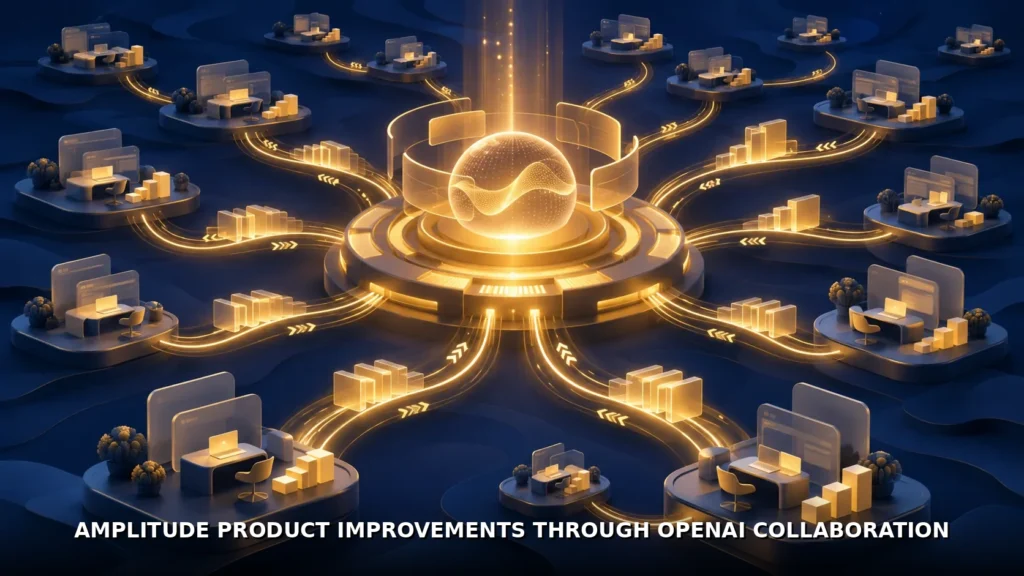
Amplitude product improvements illustrate the potential of Wave, its proactive product agent built primarily on OpenAI models: the company estimates that Wave can help teams ship product improvements in 1–2 days, down from roughly a month. The proposition extends beyond finding something wrong: Wave connects product analysis to an implementation plan, hands work to coding agents, and measures what happens after a change reaches users.
That estimate comes from an OpenAI customer story published November 12, 2026. It is an account of Amplitude’s experience and evaluations, rather than an independently verified benchmark. Its strongest evidence combines a specific homepage experiment, internal model comparisons, and timing milestones for customer changes that reached launch. Those measures answer different questions and should be read separately.
Amplitude describes Wave as roughly 80% powered by OpenAI models, including GPT‑6.1 Sol, GPT‑6 Luna, and GPT‑Image‑2.5 Flare. The models serve different roles: investigating opportunities, performing frequent checks, and producing visual proposals. Codex is among the coding agents to which teams can send implementation work.
The central question is whether product insights can become shipped improvements faster when an agent carries context across those stages. Amplitude’s account offers evidence that this can happen, while leaving important questions about generalizability unresolved. The reported speed is promising, but the package does not establish a universal delivery time for every opportunity Wave identifies.
The collaboration is therefore most useful to examine as a concrete workflow. Its significance lies in the connection between discovering an opportunity, specifying a response, arranging implementation, and checking the outcome. Faster analysis alone would address only part of that process.
Overview of Wave as a product agent

Teams start by giving Wave a product area and the goals and metrics they want to improve. Wave brings together Amplitude data, session replays, customer feedback, and code to identify and prioritize opportunities. It develops solutions and coordinates implementation with people and coding agents, then tracks outcomes to inform subsequent improvements.
In this account, “proactive” refers to the agent’s role in finding useful work within that assigned scope. A team defines the area and objectives; Wave investigates potential improvements within them. That distinction matters because the system’s initiative still operates in relation to goals supplied by people.
The handoff to implementation includes a technical plan and acceptance criteria. These connect the identified problem to what a coding agent should build and how the result should be judged. Wave can also generate mockups from screenshots in session replays, giving teams a visual proposal alongside the written plan.
Amplitude’s own homepage provides the clearest example. Generic suggestion cards were intended to help users begin conversations with an AI agent. In a sample of 100 session replays, Wave found that 80 users typed their own questions and 12 selected a suggestion. The account does not describe the remaining users’ behavior; those figures should not be expanded into a complete breakdown of the sample.
Wave proposed personalizing the cards using recent charts, dashboards, or the page a user had come from. It illustrated the proposed change and produced a technical plan. The plan preserved free typing and specified generic suggestions when personalization context was unavailable. After a brief review, the team passed the work to a coding agent and A/B tested the change.
Those fallback requirements are a useful detail. The recommendation addressed both the desired personalization and the experience when its required context was missing. That makes the example more informative than a claim that an agent simply suggested a new feature: the supplied account describes a proposal with implementation conditions and a subsequent experiment.
The documented workflow also preserves a role for human judgment. Wave supplies recommendations and coordinates work, while teams control the degree of automation. The evidence supports an agent-assisted product development process, with different review choices for different changes.
Impact of Wave on product improvement timelines

Amplitude’s headline estimate—1–2 days instead of roughly a month—describes a substantial shortening of the path to a product improvement. It should retain its attribution and estimated status. The customer story does not provide a controlled comparison establishing that every team, product area, or type of change achieves that reduction.
The account also supplies more granular timing information for customer changes that launched:
| Reported milestone | Scope of the observation |
|---|---|
| One in four went live the same day | Customer-launched experiments, flags, and guides, measured from when Wave surfaced the opportunity |
| Half went live in under four days | The same described group of launched changes |
| Two in three went live within a week | The same described group of launched changes |
These milestones have a narrower denominator than all opportunities Wave discovers. They concern changes that reached launch. They do not establish how many recommendations were declined, remained under review, or never shipped. Nor does the source provide enough information to calculate an average delivery time across all identified work.
The 1–2-day estimate and the launch milestones therefore should not be collapsed into one benchmark. One is Amplitude’s estimate of potential delivery time; the others describe the timing distribution for a specified set of customer launches. The supplied account also notes that an accompanying curve was interpolated from milestones and was illustrative, rather than a set of individual observations. The milestones are the appropriate evidence to report.
The homepage experiment provides a separate outcome measure. Amplitude reports that messages sent through suggestion cards increased 160% relative to control after one day. That supports a claim about use of the cards in that experiment. It does not establish a 160% increase in overall product engagement, retention, or revenue. Although the story’s headline framing calls this an agent engagement lift, its detailed readout identifies the measured behavior more precisely.
The plausible operational benefit, as an interpretation of the described workflow, is reduced friction between finding a problem and preparing actionable work. Wave carried the homepage issue through investigation, a proposed design, and a technical plan before implementation. The evidence does not isolate how much time each stage saved, but it shows why the full handoff matters to the speed claim.
Role of OpenAI models in enhancing product development
Amplitude assigns different models to different demands rather than using a single model for every step. According to the customer story, GPT‑6.1 Sol supports the opportunity manager and deep investigations into code and data. GPT‑6 Luna handles frequent tasks such as code scanning and small evaluation checks, while GPT‑Image‑2.5 Flare creates mockups using session replay screenshots as references.
The underlying capability, as described by Amplitude CEO Spenser Skates, is iterative investigation: models can examine a problem, write and run code, and use the results to determine their next action. In Wave’s workflow, that capability connects analysis to further investigation rather than ending with an initial answer.
Amplitude says it evaluates quality, latency, and cost for each task. Its supplied results illustrate why those dimensions need separate treatment:
| Evaluation | Reported result | Qualification |
|---|---|---|
| Opportunity Investigator | GPT‑6.1 Sol scored 4.06 out of 5; three alternatives scored 3.62, 3.52, and 2.94 | Amplitude’s internal evaluation; the alternatives are unnamed in the supplied text |
| Investigation time | GPT‑6.1 Sol had the fastest median investigation time, at 54 minutes | Reported within the Opportunity Investigator evaluation |
| Data Science Agent | GPT‑6.1 Sol scored 67.5 out of 100; another leading model scored 69.3 | Sol’s overall score was lower in this comparison |
| Data Science Agent cost | Mean model cost was $1.28 per dispatch for Sol versus $2.63 for the comparison model | A task-specific model cost, not a total deployment price |
| Solution wireframes | OpenAI’s image model scored 80.3 out of 100 versus 63.9 for another image model | Evaluation covered 15 opportunities |
For Opportunity Investigator, the criteria included corroborating findings, avoiding false positives, incorporating evaluator feedback, recovering from tool failures, and keeping claims aligned with evidence. GPT‑6.1 Sol led on all five criteria. These categories are relevant to an agent whose conclusions may initiate implementation: an unsupported finding can affect the work that follows it.
The Data Science Agent results present a trade-off. Sol scored below the comparison model overall, while costing less per dispatch. It also scored higher on tool-contract compliance, estimation and uncertainty, and evidence grounding. The source summarizes the cost difference as a 51% reduction. This supports a task-specific quality-and-cost comparison, rather than a claim that Sol was superior on every measure.
A separate headline metric lists $1.34 as Sol’s model cost in the Opportunity Investigator evaluation. That figure belongs to a different evaluation from the $1.28 Data Science Agent mean cost per dispatch. The supplied text does not give enough detail to treat them as directly interchangeable cost measures. Neither figure establishes the full cost of operating Wave or shipping a change.
The wireframe evaluation considered communication quality, product fidelity, instruction adherence, text and UI legibility, and visual coherence. Its scope was visual proposals across 15 opportunities. It does not by itself demonstrate better shipped interfaces or stronger user outcomes.
Taken together, the evaluations support Amplitude’s stated strategy of matching models to tasks. They provide evidence for choices within Wave’s workflow, with the limits of internal evaluations and unnamed comparison models. They do not establish a general ranking across unrelated product development workloads.
Current usage and future potential of Wave
The November 12 account says customers across industries were already using Wave in beta to identify and ship improvements. It does not name those customers, quantify the beta population, or provide an industry-by-industry breakdown. The documented usage supports a deployment claim, while leaving the breadth of adoption uncertain.
Teams control how recommendations proceed. The source says most teams send bug fixes straight to coding agents, while new features and larger bets receive human review. Wave’s recommendations include a proposed fix, technical plan, and acceptance criteria, providing material for either route. The account does not describe a universal review policy or guarantee that every recommendation can proceed automatically.
This division helps explain the practical relevance of the agent. Work that a team considers suitable for direct implementation can move quickly; work requiring more judgment can enter review with an investigation and plan already prepared. That is an interpretation of the documented operating model, rather than a measured claim about the time saved by each review path.
Amplitude’s stated ambition is to make self-improving products a normal way to build software. In the supplied account, the present foundation for that ambition is a loop: agents surface opportunities, help prepare and implement changes, and measure outcomes that inform subsequent work. Broader delegation as models improve remains the company’s expectation, rather than an established result.
For teams assessing the claim, the unresolved questions are concrete. The supplied evidence does not establish the share of all recommendations that ship, the durability of the homepage engagement lift, or the full economics of the workflow. Those gaps limit how far the reported results can be generalized without diminishing what the specific examples show.
Amplitude’s case demonstrates a documented route from product evidence to a tested change, alongside internal evaluations explaining its model choices. Whether Wave consistently compresses delivery toward the estimated 1–2 days will depend on evidence beyond the launches and experiment described here. For now, the strongest supported finding is that Amplitude has connected investigation, implementation planning, coding-agent handoff, and outcome measurement—and reports faster delivery from that connected process.