


Introduction to Duco and its role in financial services through financial data automation
Duco has rebuilt its agentic AI stack around Amazon Bedrock and Amazon Bedrock AgentCore to accelerate financial data onboarding and help analysts investigate reconciliation exceptions. The architectural change combines managed model access, a dedicated agent runtime for each customer, and an approach that loads tool instructions only when needed. Its significance for financial data automation lies in how those pieces support financial operations where understanding unfamiliar data must coexist with strict access controls.
According to the AWS account of Duco’s implementation, Duco processes 20 billion transactions monthly for more than 200 clients, including seven of the top 20 banks and 10 of the top 20 asset managers. Those figures describe the platform’s scale; they do not establish that agents handle every transaction. AWS describes the platform as supporting data processes from extraction through downstream publication, using AI and no-code models.
Reconciliation onboarding and exception investigation are the two concrete workflows documented in the account. The first involves converting existing configurations and unfamiliar data structures into working Duco processes. The second involves gathering evidence about discrepancies between systems and preparing cases for analysts. In both, the challenge extends beyond predicting a label: the system must select relevant tools, retrieve context, and interpret the results.
The reported benefits are substantial, but their provenance matters. AWS is describing a customer implementation of its own services, rather than presenting an independent comparative study. Its account reports faster reconciliation deployment, lower onboarding costs at one bank, and a large reduction in agent context size. These are useful implementation results with distinct scopes, not interchangeable measures of overall financial performance.
Transition from traditional machine learning to AI capabilities

Duco already used traditional machine learning for predictive labeling and pattern recognition, helping banks consolidate and automate more than 20,000 processes, according to AWS. The reported limitation was adaptability. Those models needed extensive historical training data, struggled with unfamiliar situations, and required significant customization for new use cases. Changing file formats and business rules made those constraints particularly relevant.
The move to agents expands the work the system attempts. Rather than relying only on patterns learned from historical examples, Duco’s documented agent design includes planning, interpreting rules, investigating exceptions, and selecting tools. That does not establish that agents can resolve every unfamiliar problem. It shows why Duco sought a different architecture for work that requires several steps through changing information.
Amazon Bedrock supplies managed access to foundation models, while AgentCore provides the runtime for agents. Duco already had LangChain and LangGraph in production. AWS says most of that code continued to work without modification when Duco adopted AgentCore, reducing the need to rebuild its existing agent logic. The managed runtime also shifted infrastructure operation away from Duco’s engineering team.
Duco assigns different model families to different responsibilities. The following division is described in the AWS account; it is a description of Duco’s design, rather than an independent ranking of the models.
| Model | Assigned responsibility | Documented work |
|---|---|---|
| Anthropic Claude Opus | Planning | Complex reasoning and plans for other agents to execute |
| Anthropic Claude Sonnet | Main reasoning and complex decisions | Exception investigation, reconciliation logic, and rule interpretation |
| Anthropic Claude Haiku | Lightweight tool routing | Routing choices, classification, and first-pass triage |
| Amazon Nova 2 Pro | Tool output summarization | Condensing MCP responses into readable analyst summaries |
Bedrock’s common interface allows Duco to switch models through a configuration parameter, according to AWS. The architectural rationale is flexibility: planning, routing, and summarization need not all use the same model. The account describes this as supporting quality and cost efficiency, but supplies no model-by-model cost comparison or controlled benchmark that would quantify that trade-off.
The transition also exposed a problem that model selection alone did not solve. Each tenant had 300–400 tools available through AgentCore Gateway, with roughly 200,000 tokens of tool descriptions loaded before work began. AWS reports that response quality deteriorated as conversations grew. Duco therefore changed how tools entered the model’s context, rather than treating a larger collection of instructions as inherently more useful.
Automation of data processes and its implications

Duco’s onboarding workflow addresses the effort required to establish new reconciliation processes. AWS describes the previous approach as manual and dependent on substantial professional services resources, with banks taking years to migrate thousands of processes at roughly one per week. That is the account’s description of the earlier workflow, not a universal migration rate for financial institutions.
The new system can, according to AWS, interpret diverse file formats and data structures across legacy and modern systems, translate legacy configurations into structured Duco processes, and parse complex spreadsheet macros written decades earlier. These capabilities target the work of understanding and converting an existing process before a reconciliation can be deployed.
AWS reports that Duco can deploy new reconciliations 10× faster. Separately, it describes one global bank that reduced onboarding costs for new reconciliations by 70% and achieved an increase of over 20% in straight-through processing through improved match rates and allocation rules. The account does not identify that bank or provide enough methodological detail to establish how broadly those results apply. The processing improvement should also retain its reported wording: the source does not specify a percentage-point change.
Exception investigation is a different application of the same agent infrastructure. Financial institutions run thousands of quality gates between systems, according to the account, and analysts traditionally investigate the resulting breaks. Duco’s agents handle the initial investigation: grouping related exceptions, checking whether a break is known or already being worked, and considering whether it reflects a timing difference expected to clear.
Agents then retrieve evidence from source data and systems to investigate possible causes. The documented categories include data quality issues, missing or late records, mapping or reference data problems, and genuine mismatches. The output is a case containing a likely cause, a proposed resolution, alternatives considered, and supporting evidence. Proposals can include an adjustment, a rule change, or an escalation. An analyst reviews the case and makes the final decision, which is recorded in the audit trail.
Making these workflows practical required controlling the information presented to the agent. Duco introduced on-demand loading through Model Context Protocol (MCP) resources. Its skill:// resources contain tool descriptions, system:// resources supply dynamic system prompt sections, and ui:// resources hold interface-specific material. These are the resource types described for Duco’s implementation.
Three meta-tools in Duco’s agent harness replace the large initial tool-description payload: load_skill fetches skill descriptions when needed, find_tool locates relevant tools, and invoke_tool executes a selected tool. AWS reports a 90% reduction in main context, from 200,000 tokens to approximately 20,000, through this change and limits on tool response size.
The smaller, stable prompt prefix also preserves prompt caching because skills load into the conversation rather than changing the tool list. AWS says evaluations confirmed improved response quality with the same underlying models, tools, and tasks, without infrastructure changes. It does not provide numerical quality scores or the evaluation methodology. The supported lesson is that Duco reports better results after changing context management; the evidence does not quantify the quality gain.
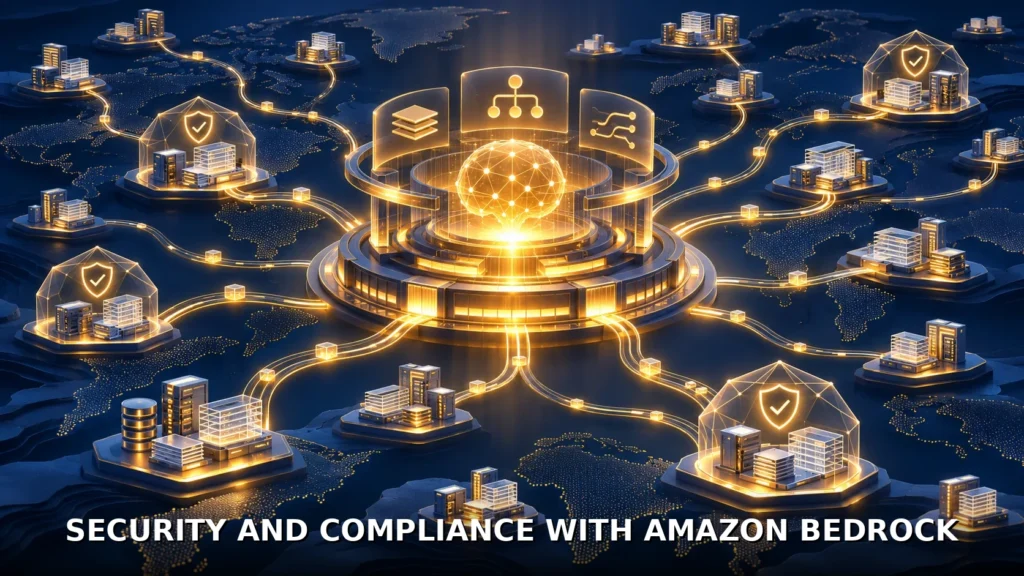
Security and compliance with Amazon Bedrock
The security argument rests on several layers of controls. AWS states that customer data remains within its environment and is not used to train models. Private endpoints keep traffic to Bedrock and AgentCore on the AWS network. Those are concrete architectural properties in the account; they do not, on their own, establish compliance with every obligation that might apply to a bank.
Duco operates a multi-tenant service with both shared infrastructure and dedicated tenant resources. Tenants share a virtual private cloud and an Amazon Elastic Kubernetes Service cluster, with separation enforced through namespaces and network policies. Each tenant receives a dedicated Amazon Aurora MySQL database, Amazon S3 bucket, AWS KMS encryption keys, Amazon SES and Amazon SQS messaging stack, Amazon ElastiCache layer, and Amazon Cognito user pool.
That distinction matters when interpreting AWS’s description of isolation. The account says clients have no shared data infrastructure, while also explicitly identifying the shared network and Kubernetes cluster. Read together, the architecture combines dedicated data resources with segregation inside shared infrastructure. It should not be described as a completely separate cloud environment for every bank.
Isolation extends into the agent layer. Each tenant has its own AgentCore runtime and Gateway, configured for that tenant’s Cognito user pool and Kubernetes namespace. AWS says this arrangement, combined with AgentCore session isolation, prevents clients from sharing agent memory, context, or tooling. Each runtime operates in VPC network mode, with network interfaces in private subnets and outbound traffic governed by security groups.
Identity checks connect those infrastructure boundaries to individual actions. Each request carries a JSON Web Token issued by the tenant’s Cognito user pool. The runtime’s inbound authorizer validates it before agent logic executes. Agents reach tools through the tenant’s Gateway, which forwards calls to that tenant’s container-based MCP services running in Amazon EKS.
The user’s identity continues downstream. Each MCP server validates both the agent and the user against the tenant’s Cognito user pool, so tool calls are authorized for the calling user as well as the trusted agent. This makes authorization part of service execution, rather than relying solely on instructions telling an agent what it may access.
AWS describes Bedrock and AgentCore as meeting Duco’s requirements for regulated deployment. The supplied evidence does not identify particular regulatory certifications, present an independent security assessment, or demonstrate compliance for an individual customer. The defensible conclusion is that Duco has documented controls designed to support regulated financial operations, with analysts retaining final decisions in the described exception workflow.
Impact of AI on financial data management
Duco’s implementation suggests that the value of agents in financial data management depends on more than model reasoning. Its reported results combine workflow design, selective context loading, identity propagation, and tenant isolation. Onboarding uses AI to interpret existing systems; investigation uses it to assemble evidence for a human decision. Each workflow gives the agent a defined role within a broader operational process.
The architecture also changes how capabilities become available. When a service is deployed, its MCP server is registered as a target on the tenant’s AgentCore Gateway. At boot, the agent harness builds a registry of exposed tools and shares their names. Detailed discovery and execution then happen on demand through find_tool and invoke_tool.
According to AWS, this lets agents gain a newly deployed capability without agent redeployment or reconfiguration. The documented discovery step occurs at boot; the account does not establish continuous discovery by an already running agent. Access remains subject to checks in the underlying services using the passed-through user identity. Adding an available tool therefore does not, by itself, grant a user permission to perform its actions.
For teams assessing the results, the measures answer different questions. The context reduction concerns the information loaded into an agent. The 10× deployment figure concerns new reconciliations. The 70% cost reduction and over 20% straight-through processing increase concern one bank’s experience. None supplies a general accuracy rate for exception investigation or a platform-wide return on investment.
What the evidence supports is a concrete shift toward agents that prepare operational work under explicit boundaries. Duco reports faster onboarding and more focused initial investigation while keeping final exception decisions with analysts. The remaining questions are how consistently those gains hold across customers and how investigation quality is measured. The supplied account leaves those questions open, making the architecture more fully documented than the generalizability of its outcomes.