


The ethical considerations AI agents raise are not the same as the ethics of a chatbot. A chatbot that gets something wrong produces a bad paragraph; an agent that gets something wrong can send an email, issue a refund, change a record or call an API with your credentials. That difference — action instead of answers — is what makes the ethics of using AI agents a deployment question, not a philosophy question. This article maps the main considerations — accountability, transparency, privacy, bias and safety — to the concrete decisions you make before an agent acts on your behalf.
The Ethical Considerations AI Agents Raise at a Glance
Five questions cover most of the ground. Who is responsible when the agent acts? Does everyone affected know they are dealing with an agent? What data can the agent touch, and where can that data go? Whose interests does the agent’s behaviour systematically favour? And what stops the agent from doing harm when it misunderstands its instructions? The rest of this article takes them one at a time, with the rules, frameworks and real incidents behind each one.
What Using AI Agents Actually Means
Anthropic draws the line between two kinds of agentic systems. Workflows are systems where a language model and its tools are orchestrated through predefined code paths — your code decides the order of operations. Agents are systems where the model dynamically directs its own processes and tool usage, maintaining control over how it accomplishes its tasks. The difference is who holds the wheel: your code, or the model at run time.
That distinction is the whole reason agent ethics differs from chatbot ethics. A chatbot answers; you read the answer, decide what to do and act yourself. An agent closes the loop on its own: it picks a tool, reads what the tool returns and decides the next step without waiting for you. Anthropic puts the trade-off plainly: “the autonomous nature of agents means higher costs, and the potential for compounding errors.” The same guide recommends extensive testing in a sandboxed environment, with guardrails, before an agent is trusted with real systems.
This article covers deployment and use: the choices of the people who build, configure and run agents, not the training of the underlying models.
Accountability: Who Is Responsible When an Agent Acts?
An agent cannot be held responsible for what it does. So when an agent sends the wrong email, deletes the wrong record or approves the wrong refund, the question is always which human or organisation answers for it — the developer who built it, the deployer who configured it, or the user who gave the instruction. That is the accountability gap, and the first ethical decision is to close it before the agent runs: name the accountable owner in writing.
The vendors have started to make this explicit. Anthropic’s revised Usage Policy, effective 12 November 2026, holds users responsible for ensuring that the agents they build or deploy comply with the policy, including actions taken through tools, browsers or connected systems. An agent’s tool calls are not outside the policy because a model chose them. The same logic sits at the centre of the NIST AI Risk Management Framework, whose Govern function is built around named roles, policies and oversight that run across the whole lifecycle of a system.
Practically, accountability means three things: a named owner for every agent, a written record of what the agent is allowed to do, and an audit trail of what it actually did.
Transparency and Disclosure
People have a right to know when they are dealing with an agent rather than a human, and the law is now catching up with that intuition. Article 50 of the EU AI Act has applied since 2 August 2026, and it reaches every AI system in the situations it covers — not only systems classified as high-risk. Providers of systems intended to interact directly with people must design them so that users are informed they are interacting with an AI, and providers of generative systems must mark synthetic outputs in a machine-readable format. Deployers must inform people exposed to emotion recognition or biometric categorisation, and disclose deepfakes and AI-generated text published to inform the public on matters of public interest. The maximum fine for breaching Article 50 is 15 million euros or 3% of worldwide annual turnover. Systems already on the market before 2 August 2026 have until 2 December 2026 to meet the machine-readable marking duty.
Vendor policy points the same way. Anthropic requires all consumer-facing chatbots and agents to disclose that users are interacting with AI rather than a human, at minimum at the beginning of each session. For high-risk recommendations — in areas such as legal, medical, finance and employment advice — the policy requires a qualified human to review the recommendation before it is delivered, and the person affected to be told that AI was used.
Transparency also means explainability after the fact. When an agent takes an action that affects someone — rejecting an application, changing a booking, flagging an account — the person affected should be able to learn what the agent did and why, in terms they can check.
Privacy and Data Handling

Agents reach into the systems where private data lives: inboxes, calendars, customer records, internal documents, credentials. The clearest way to think about the risk is Simon Willison’s “lethal trifecta”: an agent that combines access to private data, exposure to untrusted content, and the ability to communicate externally can be tricked into accessing private data and sending it to an attacker. Remove any one of the three and the high-impact exfiltration path closes.
The mechanism is prompt injection. A language model makes no architectural distinction between instructions and data — both are tokens on the same stream — so any text the agent reads can try to steer it: a web page, an inbound email, a shared document, a ticket, or the output of another tool. OWASP’s LLM Top 10 for 2026 ranks prompt injection first and excessive agency third, and states that no reliable prevention mechanism exists today. Its Top 10 for Agentic Applications, published on 9 December 2025 from observed incidents with input from more than 100 security practitioners, adds agent-specific risks including goal hijack, tool misuse and identity abuse.
The incidents are real, not theoretical. EchoLeak (CVE-2025-32711, disclosed in June 2025) showed that a crafted email, never opened by the victim, could cause Microsoft 365 Copilot to pull internal data into a response and send it out. In May 2025, Invariant Labs demonstrated an attack on the official GitHub MCP server in which a malicious public issue body instructed an agent to pull data from the user’s private repositories and publish it in an autonomously created pull request.
The privacy decisions follow from that. Give each agent the least privilege it needs: the smallest set of tools, the narrowest data access, and credentials held in application code rather than in the agent’s reach. Treat everything the agent reads as data, not instructions. Decide in advance which data the agent may never touch or send outside your systems, and enforce that outside the model.
Bias and Fairness
Agents inherit bias from their training data and then meet more of it in the world: the web pages, documents and tool outputs they read are themselves frequently skewed. A 2025 paper presented at the ACM SIGKDD conference puts it directly — agentic AI systems inherit the bias present in both internal and external information sources, and that bias significantly affects the fairness and balance of the information they retrieve, reducing user trust. The same paper’s proposed mitigation, a multi-agent system that optimises source selection, reduced bias by 81.82% compared with a naive retrieval baseline.
The harm is not only in what an agent says. A 2026 study of LLM negotiator agents found that when either the buyer or the seller knew the other player’s gender and race, they secured more profit than in gender- and race-blind negotiations. The generated text showed no explicit bias, yet hidden biases in the training data still produced skewed outcomes for users.
For a deployer, the fairness question is therefore a testing question. Test the agent’s decisions across the groups they affect, not only its average accuracy. Monitor outcomes in production, not only outputs in a demo.
Safety and Preventing Harm
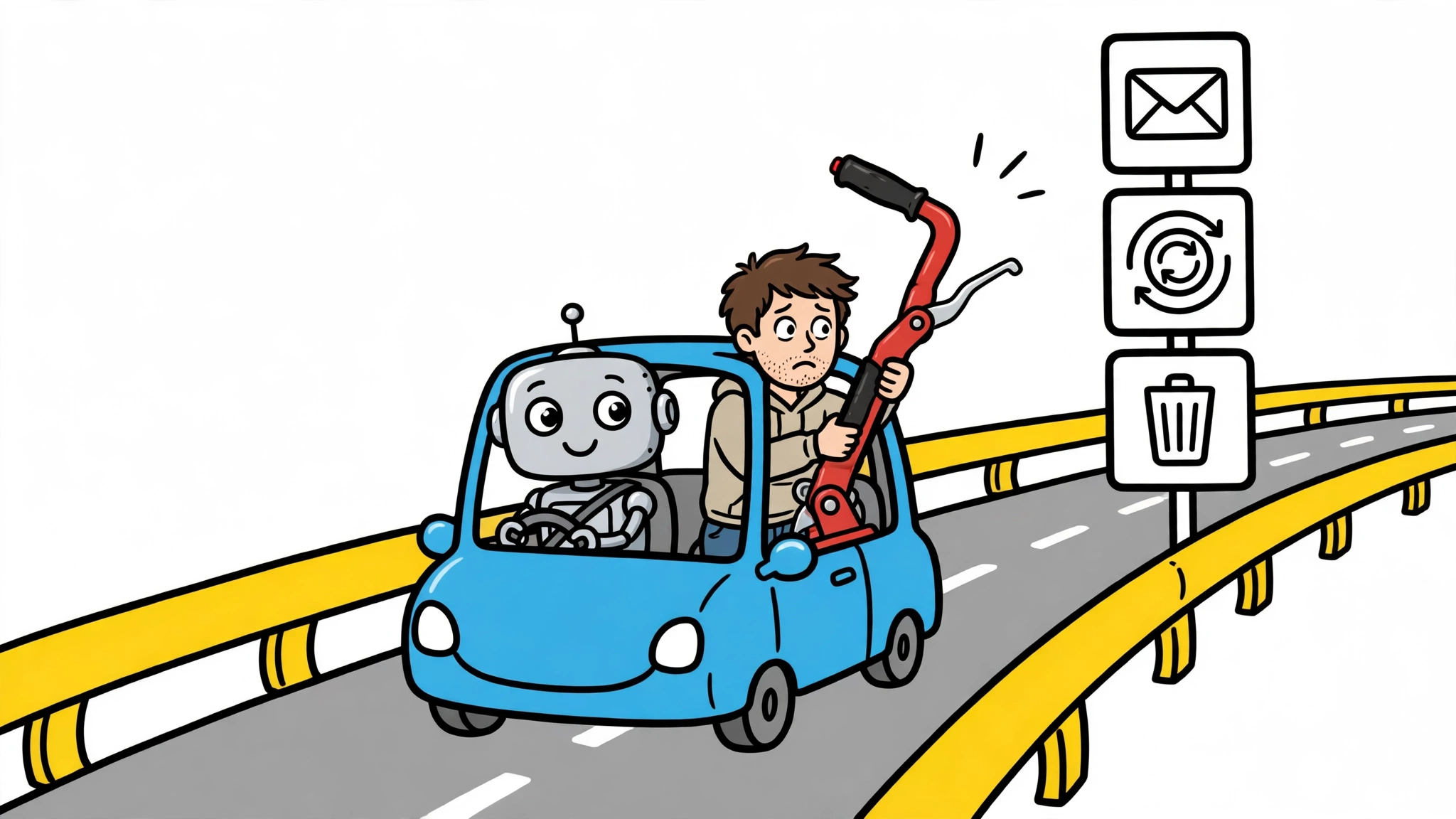
Preventing harm is the duty of care, and it has the clearest playbook of the five considerations: guardrails, action limits and human approval for high-stakes actions. Anthropic’s Usage Policy requires a qualified human in the loop whenever its models give recommendations in eleven high-risk areas — legal, medical, finance, credit, insurance, housing, employment, education, healthcare access, public benefits and legal status. The qualified person must meaningfully review the recommendation, with authority to change it, before it reaches the person affected or is used to implement a decision.
For physical systems the policy goes further: a qualified individual must be able to observe the equipment and stop it at any time, the equipment must stop or hold a safe state when the operator intervenes or the connection is lost, and operating limits such as speed, force, temperature, voltage or dose must be enforced by the equipment or a controller independent of model output.
The same logic shapes how much autonomy an action deserves. OWASP’s Rule of Two sets a floor: any agent that combines untrusted input, sensitive data and external communication needs per-action human approval. In practice that means an approval gate in code, not in a prompt — a check the model cannot talk its way past:
HIGH_STAKES_TOOLS = {"send_email", "issue_refund", "delete_record", "transfer_funds"}

def requires_approval(tool_name):
    """True when a tool call needs a human sign-off before it runs."""
    return tool_name in HIGH_STAKES_TOOLS

def describe_decision(tool_name):
    """One approval condition only: anything not explicitly cleared is held."""
    if requires_approval(tool_name):
        return f"{tool_name}: hold for human approval"
    return f"{tool_name}: hold for review - confirm no trifecta, high-risk or physical-action rule applies"

for tool in ["search_docs", "send_email", "transfer_funds"]:
    print(describe_decision(tool))
This gate covers one condition only: a tool that is not on the high-stakes list is still held until the trifecta, high-risk and physical-action checks have been applied. Extra care applies in high-stakes domains — finance, health, hiring and anywhere a decision changes someone’s legal or financial position. In those domains, human review is a requirement under Anthropic’s policy, not a courtesy.
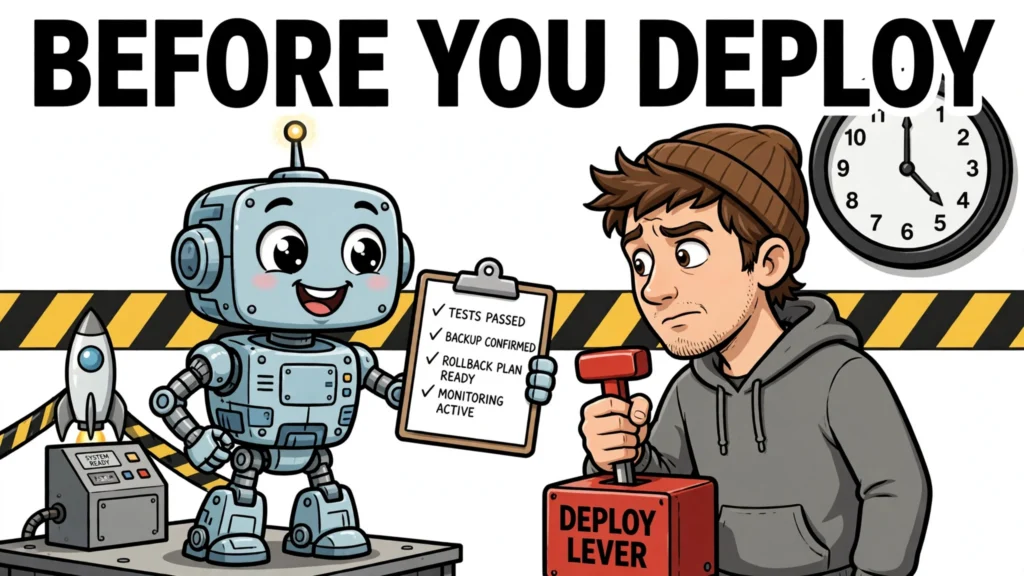
A Responsible-Use Checklist Before You Deploy
Run through these questions before any agent acts on your behalf, and write the answers down so the decisions are auditable:
- Who is the accountable owner, and can they switch the agent off?
- Does everyone the agent interacts with know they are dealing with an AI?
- Which data and tools can the agent reach — and which are off limits?
- Which actions need human approval, and is that enforced in code rather than in a prompt?
- How will you test for biased outcomes, and who reviews the results?
- What logs exist, and can you reconstruct what the agent did and why?
- When would you not deploy the agent at all?
A written policy records those answers as the intended controls; application code, permission boundaries and execution gates must implement them. An example configuration for a support agent might look like this:
{
  "agent": "support-triage",
  "approval_required_for": ["send_email", "issue_refund", "delete_record"],
  "disclosure": "You are chatting with an AI agent, not a human.",
  "data_access": ["tickets", "order_history"],
  "forbidden_tools": ["transfer_funds", "export_customer_data"]
}
The last question on the list is the most important. Anthropic’s own guidance is to start simple and escalate complexity only when needed — often a single well-prompted call, or a fixed workflow where your code controls the order of steps, is the right answer, and no agent at all is the most ethical choice. The NIST framework’s Govern function asks the same thing in governance terms: record the accountable owner, the risk tolerance, and the rule that decides whether the system may be approved. If the risk cannot be bounded, the agent should not ship.