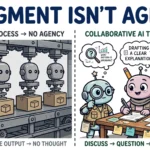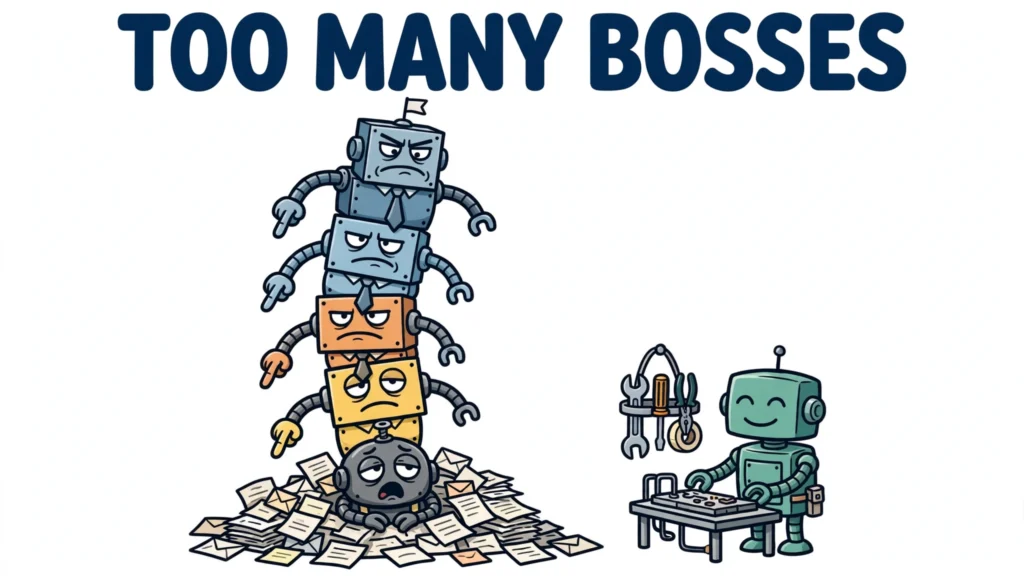


The decision to build hierarchical multi-agent systems instead of a single monolithic agent is a decision about delegation, not ambition. A hierarchy adds a supervisor that assigns work, workers that execute within bounded contracts, and synthesis by the supervisor that turns separate results into one answer. It earns its place only when the work genuinely decomposes into supervised layers, and it should stay out of the design when one reasoning loop can hold the task, the tools, and the context it needs. Building on a companion guide’s general decision rule, this guide gives that choice a testable form: when the split should be layered, how deep it should go, and when to flatten it back.
Hierarchical multi-agent systems: the decision in short
Choose a hierarchy when the work decomposes into subtasks that need separate context windows, different instructions, tools, or models, and the benefit measurably outweighs the delegation cost. The benefit must be concrete — for example, independent subtasks that can run in parallel, information that exceeds a single context window, failure in one part that must be isolated from the rest, or subtasks that need genuinely different tools or instructions and perform measurably better separated than in an improved single-agent baseline. The cost is equally concrete: coordination rounds, substantially higher token use, and — in handoff designs that condense results at each level — context summarised at each handoff, with detail that can be lost in summarisation. Reference-based handoffs, where an intact artifact is stored externally and only a lightweight reference passes upward, can avoid repeated condensation. Stay with a single monolithic agent when one reasoning loop can hold the task, the tools, and the context, especially for sequential work where each step needs the same shared context.
Deciding to split and deciding how deep to go are separate decisions. One supervisor layer is the default hierarchy. A second layer needs its own justification: a distinct delegation boundary with its own contracts, not merely more agents under the same supervisor. That default follows Anthropic’s guidance: “When building applications with LLMs, we recommend finding the simplest solution possible, and only increasing complexity when needed.”
What makes a system hierarchical — and what does not
Hierarchy means directed delegation. A supervisor assigns work, workers execute within bounded contracts, and results are synthesised upward. OpenAI describes the manager pattern in those terms: a central manager agent coordinates multiple specialised agents through tool calls, each handling a specific task or domain, and the pattern is ideal where only one agent should control workflow execution and have access to the user. Anthropic describes the related orchestrator-workers workflow, in which a central LLM dynamically breaks down tasks, delegates them to worker LLMs, and synthesises their results. In both, the supervisor decides, the workers execute, and one place is responsible for the combined result.
Agent count alone is not hierarchy. OpenAI contrasts the manager pattern with a decentralised pattern in which peer agents hand tasks to one another based on their specialisations, with no single agent maintaining central control or synthesis. A system with many agents passing work peer to peer is therefore not hierarchical, while a two-agent manager and worker system is. A single agent with many tools is also not a hierarchy: OpenAI notes that a single agent can handle many tasks by incrementally adding tools, keeping complexity manageable and simplifying evaluation and maintenance. Hierarchy is about the direction of delegation and who synthesises the result.
Layers are the unit of analysis: each adds a delegation boundary, a context handoff, and a place where detail can be lost when a result is condensed. CrewAI’s hierarchical process uses a manager agent that coordinates, delegates, and validates outcomes, set explicitly because the default is sequential. LangGraph’s supervisor pattern uses a central supervisor to orchestrate workers through tool-based handoffs, and complex hierarchies are built by nesting supervisors.
The conditions that justify a hierarchy
The first condition is independent work that benefits from separate contexts. Anthropic’s Research system illustrates the shape: a lead agent plans a research process, then creates parallel subagents that search simultaneously, each with its own context window, condensing the most important tokens for the lead agent. Each subagent provides separation of concerns through distinct tools, prompts, and trajectories. On Anthropic’s internal research evaluation, that system — a Claude Opus 4 lead with Claude Sonnet 4 subagents — outperformed a single-agent Claude Opus 4 by 90.2% for breadth-first research queries. That scope matters: the figure does not show hierarchy improves each workload.
The second condition is genuine difference between subtasks: different instructions, tools, or models, so keeping them in one prompt forces compromises. Model specialisation is a consideration to test: different tasks may benefit from a variety of models, and that difference should be measured rather than assumed. The third condition is failure isolation: a fault in one subtask must not silently corrupt the shared reasoning of the whole job. Anthropic’s account of stateful agents shows why: errors compound across many tool calls, minor failures can cascade into large behavioural changes, and a system that cannot resume from where the agent was must restart expensive work. A hierarchy helps only if the boundary actually contains a failure, with the supervisor able to retry, reassign, or escalate.
A fourth condition is a distinct ownership or scaling boundary, such as different teams or evaluation regimes per layer — a test to apply, not a vendor finding. State the conditions as measurements before building, so the decision can be revisited against evidence.
When a single monolithic agent stays the better call
Sequential work with shared context is the clearest case for staying single. Anthropic states that domains requiring all agents to share the same context, or involving many dependencies between agents, are not a good fit for multi-agent systems today. When each step needs the same record or documents, splitting copies that context into several windows and gains no parallelism. A small, coherent tool set points the same way. OpenAI advises considering a split as the number of required tools increases, and using multiple agents if improving tool clarity — descriptive names, clear parameters, and detailed descriptions — does not improve performance. Until then, adding tools to one agent keeps state, prompting, and debugging in one place.
Latency and cost budgets also favour the single loop. Anthropic reports that agents typically use about four times more tokens than chat interactions, and multi-agent systems about fifteen times more, and states that multi-agent systems require tasks whose value is high enough to pay for the increased performance. Hierarchy adds coordination rounds: in Anthropic’s Research system, lead agents execute subagents synchronously, so the whole system can be blocked waiting for a single subagent. For sequential work, that cost is paid on each run with no parallelism to offset it.
How deep should the hierarchy go?
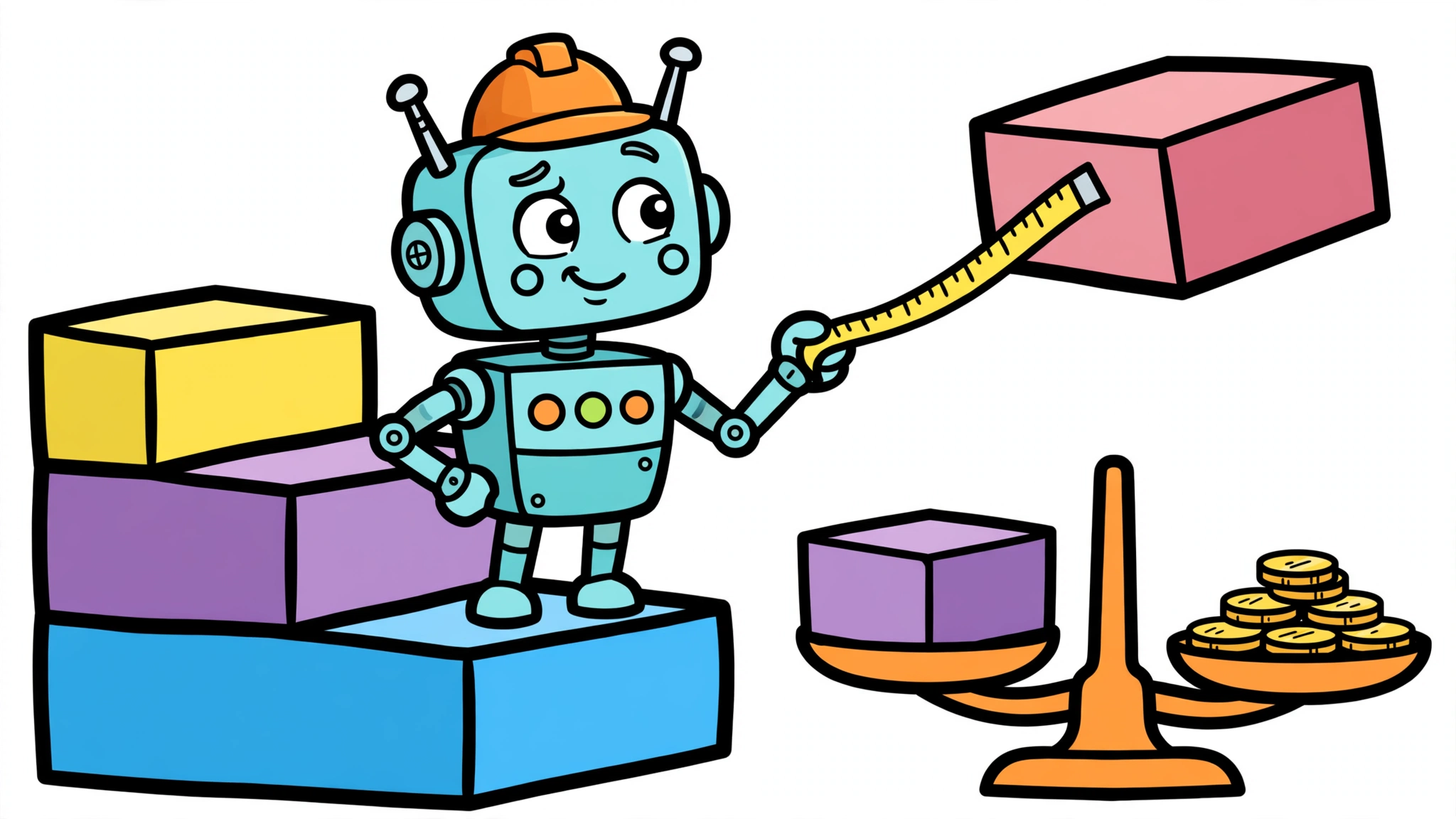
One supervisor layer is the default hierarchy because it adds a single delegation level, with synthesis responsibility held by that supervisor — not a fixed count of delegation or synthesis operations at run time, since a supervisor may delegate and synthesise repeatedly. A second layer — a supervisor managing other supervisors, as LangGraph’s nesting allows — should be added only for a distinct delegation boundary, such as a sub-supervisor owning a whole workstream with its own contracts and evaluation. If the proposed layer cannot name the boundary it owns, the contract it enforces, and the measurement that would show it earning its cost, it should not be added. No vendor-stated maximum hierarchy depth was found in the sources consulted for this article, so this guide gives a depth test rather than a numeric cap.
Costs grow with depth. Depending on the handoff design, a worker’s result may be condensed before it reaches the next supervisor, and detail can be lost in summarisation — although reference-based handoffs, where an artifact is stored externally and only a reference passes upward, avoid copying the full result through each layer. Anthropic addresses the same risk by letting subagent outputs bypass the lead coordinator for certain results: agents write outputs to an external system and pass lightweight references back, preventing information loss and reducing token overhead. With more layers, there are more points where loss can occur in designs that condense at each level, more serial rounds, and more places where an error propagates upward. Evaluation also gets harder, because agents may take different valid paths to the same outcome, so the check must judge outcomes and reasonable process rather than a prescribed path.
Apply the depth test before adding a layer, and reapply it after the system runs. The test is this article’s synthesis of the costs above, not a vendor rule: each layer must own a boundary, enforce a contract, and carry a measurement. If the supervisor above could absorb a layer without losing a distinct context, tool set, or failure boundary, flatten it.
Designing a hierarchy that can be operated
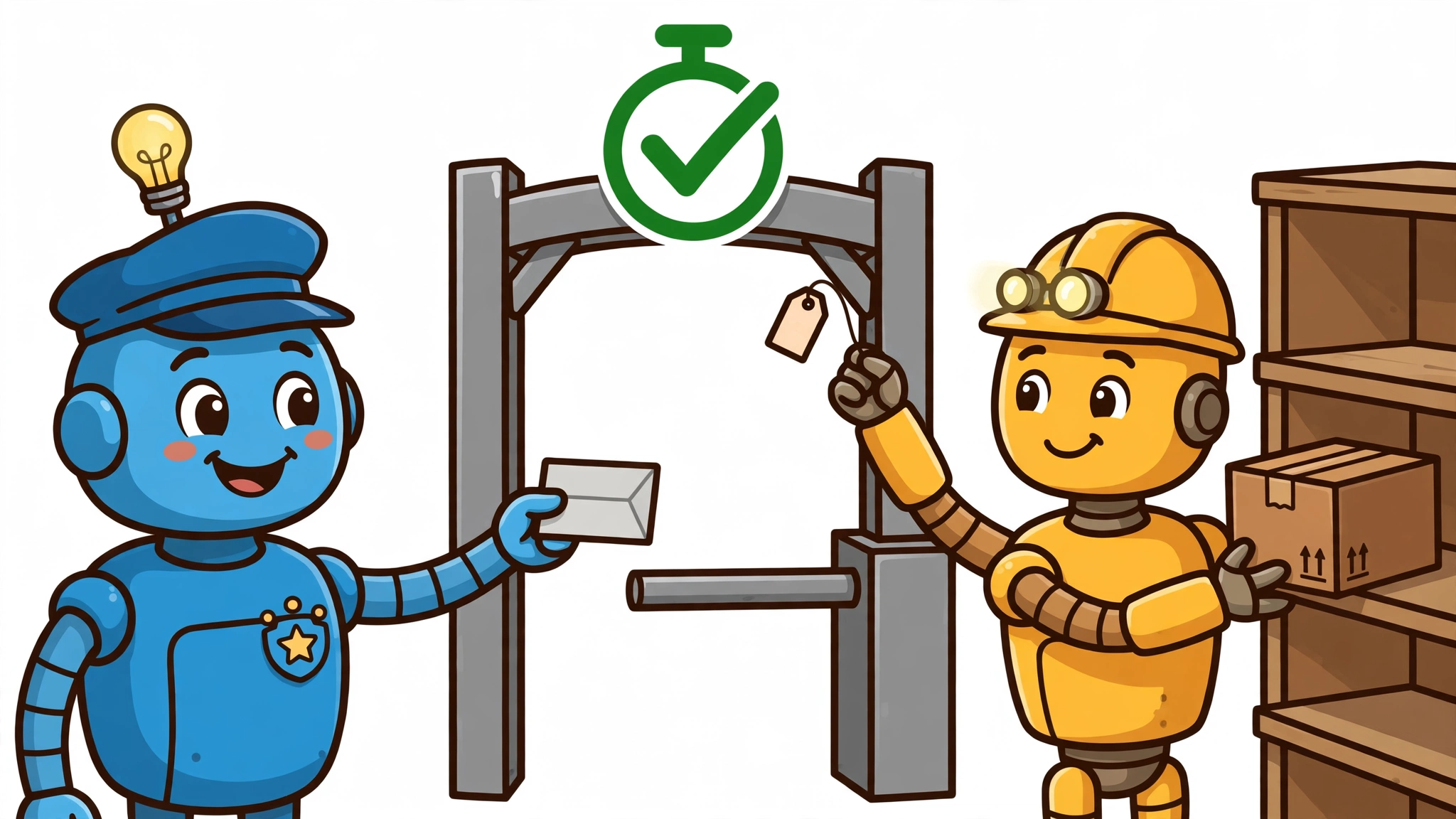
Decompose first. Name the subtasks, their dependencies, and which ones are genuinely independent before assigning any agent to a layer. Anthropic’s orchestrator-workers workflow suits complex tasks where the subtasks needed cannot be predicted in advance, because the orchestrator determines them from the specific input rather than following a pre-defined division.
Next, write a delegation contract for each worker. Anthropic states the requirement directly: “Each subagent needs an objective, an output format, guidance on the tools and sources to use, and clear task boundaries.” Without detailed descriptions, agents duplicate work, leave gaps, or fail to find necessary information. Anthropic’s example shows the failure: vague semiconductor-shortage instructions caused subagents to misinterpret the task or duplicate searches. A contract should state the objective, output format, tools and sources allowed, boundaries, and what must be returned verbatim. Where a result must survive intact, write the artifact to an external store and pass a lightweight reference upward.
Then define handoff and synthesis rules, and failure handling per layer. The supervisor must know what to check when results return, how to reconcile conflicting results, and when to retry or escalate instead of synthesising silently. Build the system so it can resume from where the agent was when an error occurred, combining the model’s adaptability with deterministic safeguards such as retry logic and regular checkpoints, as Anthropic describes. Add full production tracing: Anthropic reports tracing and monitoring of decision patterns let its team diagnose failures and fix issues systematically.
Common mistakes, limits, and when to flatten back
The most expensive mistake is building a hierarchy for anticipated scale that has not yet arrived. Anthropic’s early system shows the run-time version: agents spawned 50 subagents for simple queries, scoured the web endlessly for sources that did not exist, and distracted each other with excessive updates. The fix was to scale effort to query complexity: simple fact-finding with one agent and three to ten tool calls, direct comparisons with two to four subagents, and complex research with more than ten. A hierarchy designed for a workload the system may not see pays coordination, token, and debugging costs from the first run, without the single-agent version being measured against it. The other mistakes are vague delegation, described above, and copying another team’s hierarchy without matching its task shape.
Hierarchy also has limits that careful contracting does not remove. Work requiring shared context at each step, work with many dependencies between subtasks, and work where a supervisor would become a bottleneck for each decision will not be fixed by adding layers. When shared context starts dominating, when delegation overhead exceeds the parallelism gain, or when failures concentrate at handoffs, flatten the layer back: merge the subtask into the supervisor’s loop behind a stable contract, and re-measure latency, cost, and failure rate. If the merged version performs as well, the layer was not earning its cost.
Keep a written decision record for each architecture choice, so a later team can see what was measured rather than what was assumed. The record below is an example format, not a required schema. Its value is that the revisit trigger is written down before the architecture is debated again.
{
  "decision": "hierarchical",
  "reviewed": "2026-11-26",
  "task": "Weekly supplier research briefing",
  "decomposition": "independent supplier checks in separate context windows",
  "hierarchy_layers": 1,
  "revisit_trigger": "supplier checks stop being independent"
}
The decision rule is a measurement discipline. Start with one agent, and let the system’s signals — context exceeding one window, independent work waiting on a sequential loop, distinct tools or failure boundaries — justify evaluating a hierarchy. When evaluation shows a layered split earns its cost, draw the boundary around the measured benefit — independent work, subtasks needing genuinely different tools or instructions, or a failure boundary that must be isolated — and weigh shared-context dependencies as a cost against it; add a second layer only for a distinct boundary, and keep it as small as the task allows. Choosing hierarchical multi-agent systems means refusing to pay for layers before the work has shown it needs them.