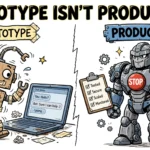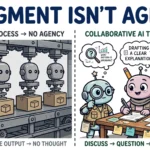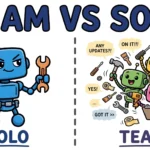

The single-agent vs multi-agent decision is not a choice between a weak system and a powerful one. It is a choice about where coordination lives: in one reasoning loop that sees everything, or across several loops that must pass context to one another. OpenAI recommends maximising a single agent’s capabilities first; Anthropic recommends the simplest solution possible, increasing complexity only when needed. The question is not whether multi-agent systems can work — they demonstrably can, for the right work — but what measurable condition in your own system justifies paying their coordination cost.
This article gives that decision a testable form. It defines both architectures, weighs complexity, latency, and reliability on Anthropic’s and OpenAI’s published evidence, applies the rule to three illustrative scenarios, and sets out a path that starts with one agent and evaluates a split only when the signals appear. The scenarios are worked examples, not reported case studies: the primary vendor sources consulted contain no documented production migration from a single agent to multiple agents with its triggering measurements, so none is claimed here.
The single-agent vs multi-agent decision rule in one place
Choose a single-agent architecture when one reasoning loop can hold the task, the tools, and the context it needs. That is the default, and it stays the right call while three conditions hold: the steps are mostly sequential and depend on shared context; the tool set is coherent enough that the agent reliably picks the right tool; and the prompt stays maintainable without branching into many conditional paths.
Evaluate a split into a multi-agent system when at least one of three conditions is present, and split only if the measured benefit outweighs the coordination cost. First, the work decomposes into independent subtasks that can genuinely run in parallel or need separate context windows. Second, subtasks need genuinely different instructions, tools, models, or permissions, so keeping them in one prompt forces compromises. Third, failure in one part must be isolated from the rest, so a fault in one subtask cannot silently corrupt the shared reasoning of the whole job. A fourth signal is prompt growth into many if-then-else branches that are hard to scale — OpenAI’s complex-logic signal, a maintainability argument in its own right.
Revisit the decision when the system changes materially: task scope grows, a new independent stream of work appears, the latency budget tightens, or one failure mode starts to dominate incidents. Record the reason for the current choice and the trigger that would reopen it, so the revisit is a measurement, not a debate.
What single-agent and multi-agent architectures actually mean
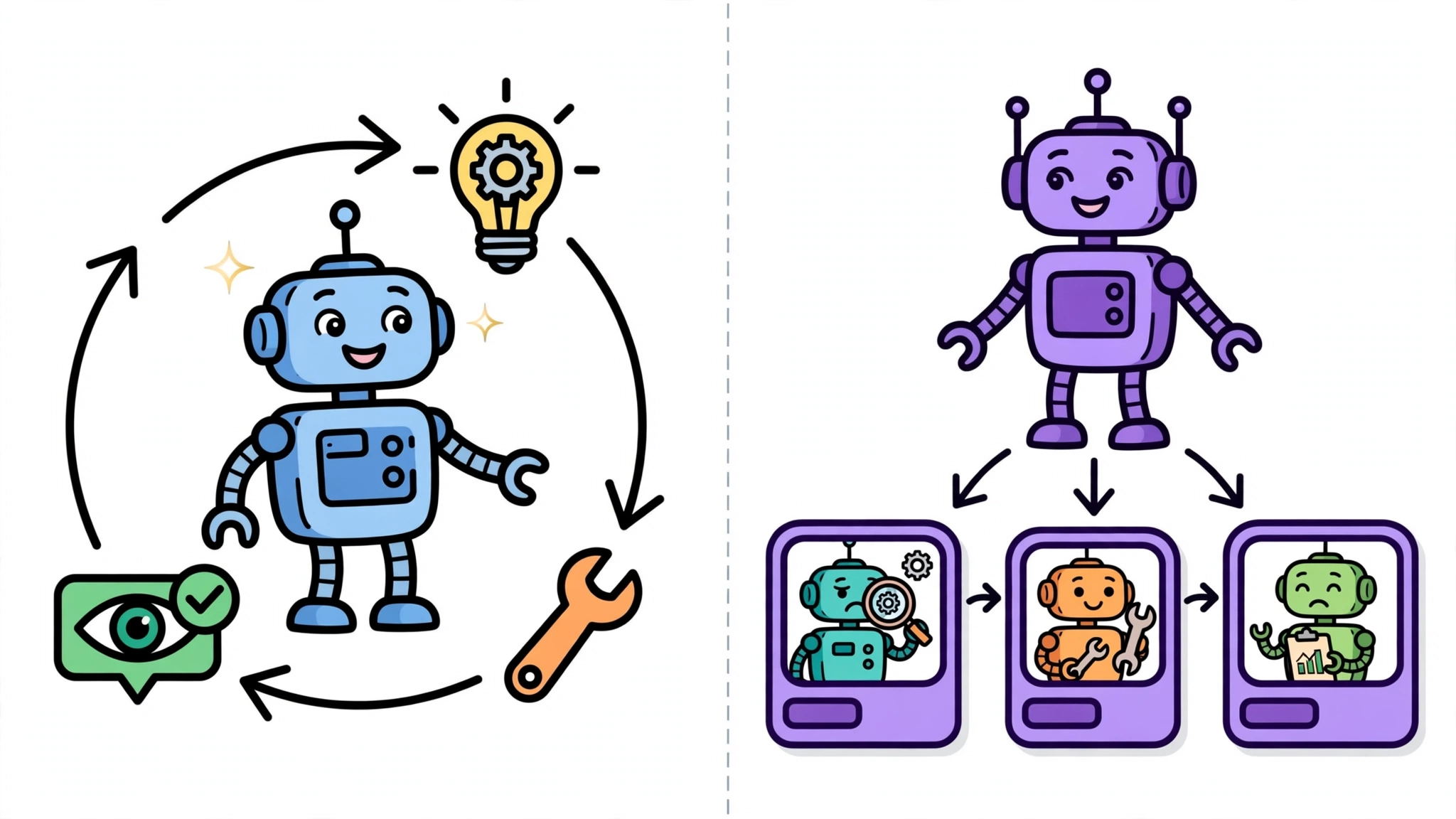
A single-agent system, in OpenAI’s definition, is a single model equipped with appropriate tools and instructions that executes a workflow in a loop. It can handle many tasks by incrementally adding tools, which keeps complexity manageable and simplifies evaluation and maintenance. It works in a loop: reason, call a tool, observe, continue until an exit condition is met.
A multi-agent system distributes workflow execution across multiple coordinated agents. OpenAI describes two broadly applicable forms. In the manager pattern, a central manager agent coordinates specialized agents through tool calls and synthesizes their results. In the decentralized pattern, peer agents hand tasks to one another based on their specializations. Anthropic’s Research feature is an orchestrator-worker variant of the manager pattern: a lead agent plans, spawns subagents that search in parallel with their own context windows, and combines what they return.
Two distinctions prevent the most common confusion. A single-agent architecture is not a single model call: an agent loops, uses tools, and retains context, while a single call answers once. Nor is it a weak system: a single agent can handle many tasks by incrementally adding tools, keeping complexity manageable and simplifying evaluation and maintenance, as OpenAI puts it. A hybrid design is also possible: one agent calling helper agents for isolated sub-jobs, offered here as an illustration.
Complexity: what each architecture costs to build and change
A single agent keeps state, prompting, and debugging in one place. That simplicity is why Anthropic’s 2024 guidance recommends the simplest solution possible, adding complexity only when it demonstrably improves outcomes.
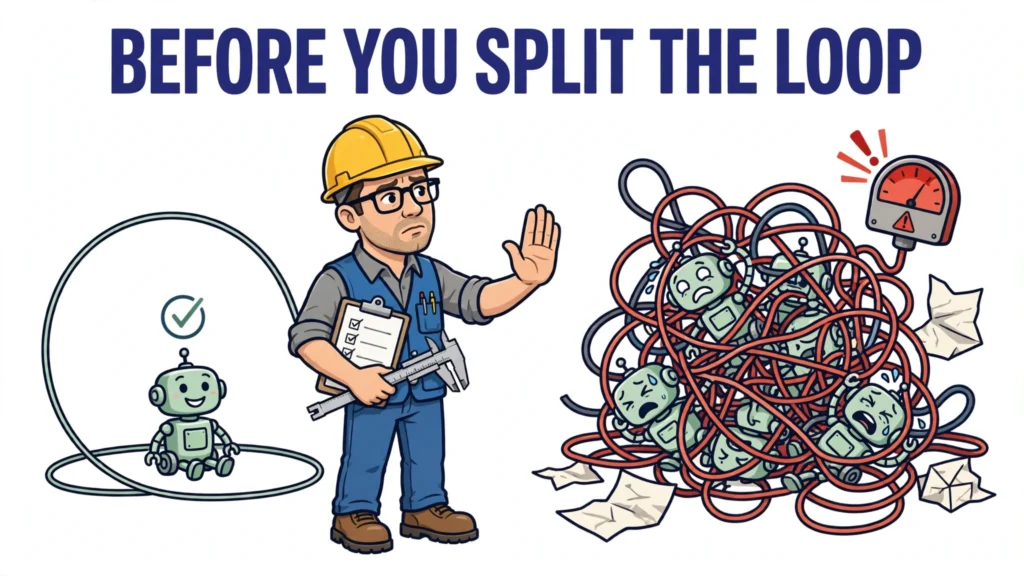
Multiple agents add a second system on top of the first: contracts between agents, message formats, orchestration logic, and cross-agent debugging. Anthropic reports that multi-agent systems introduce new challenges in coordination, evaluation, and reliability, and that coordination complexity grows rapidly. Delegation itself becomes work: the lead agent must give each subagent an objective, an output format, guidance on tools and sources, and clear task boundaries. When those descriptions are vague, Anthropic found, subagents duplicate work, leave gaps, or misinterpret the task.
Coordination cost grows with handoffs and shared-state dependencies, not just with agent count. Every boundary is a place where context must be passed or summarized, and every summary can lose a detail that mattered. Cognition’s 2025 warning about multi-agent coding work makes the same point from the opposite direction: when subagents make decisions on context the others cannot see, their work can silently conflict, and the conflict surfaces only at integration, when it is most expensive. For tightly coupled work, that context-passing cost is paid on every run, not just at build time.
Latency and reliability: how the trade-offs show up in production
Latency in a single-agent system is bounded by one chain of model and tool calls. A multi-agent system adds coordination rounds: a manager delegates, workers run, results return, and the manager synthesizes. Parallelism is the counterweight. Anthropic reports that spinning up three to five subagents in parallel, with subagents using three or more tools in parallel, cut research time by up to 90% for complex queries in its research system — a gain that belongs to breadth-first, independent work, not to sequential work forced into parallel form.
Cost follows the same shape. In Anthropic’s data, agents typically use about four times more tokens than chat interactions, and multi-agent systems use about 15 times more tokens than chats. Read against the same chat baseline, a multi-agent run costs roughly three to four times a single-agent run in tokens. Anthropic is explicit that the economics only work when the task’s value pays for the extra performance, and that multi-agent systems work mainly because they help spend enough tokens: in its BrowseComp analysis, token usage alone explained 80% of the performance variance.
Reliability cuts both ways. A single loop fails as one unit, which makes failures visible and the trace readable, but a single failure can stall the whole task. A multi-agent system can isolate failures, but it creates new ones: duplicated work, gaps between subtasks, agents distracting each other with excessive updates, and, in Anthropic’s early versions, spawning 50 subagents for simple queries. Evaluation gets harder too, because different valid paths can reach the same outcome. Anthropic’s fit test is blunt: multi-agent systems excel at tasks with heavy parallelization, information that exceeds a single context window, and numerous complex tools, while domains that require shared context or many dependencies between agents are a poor fit today.
Worked decisions: three scenarios and the call each one earns
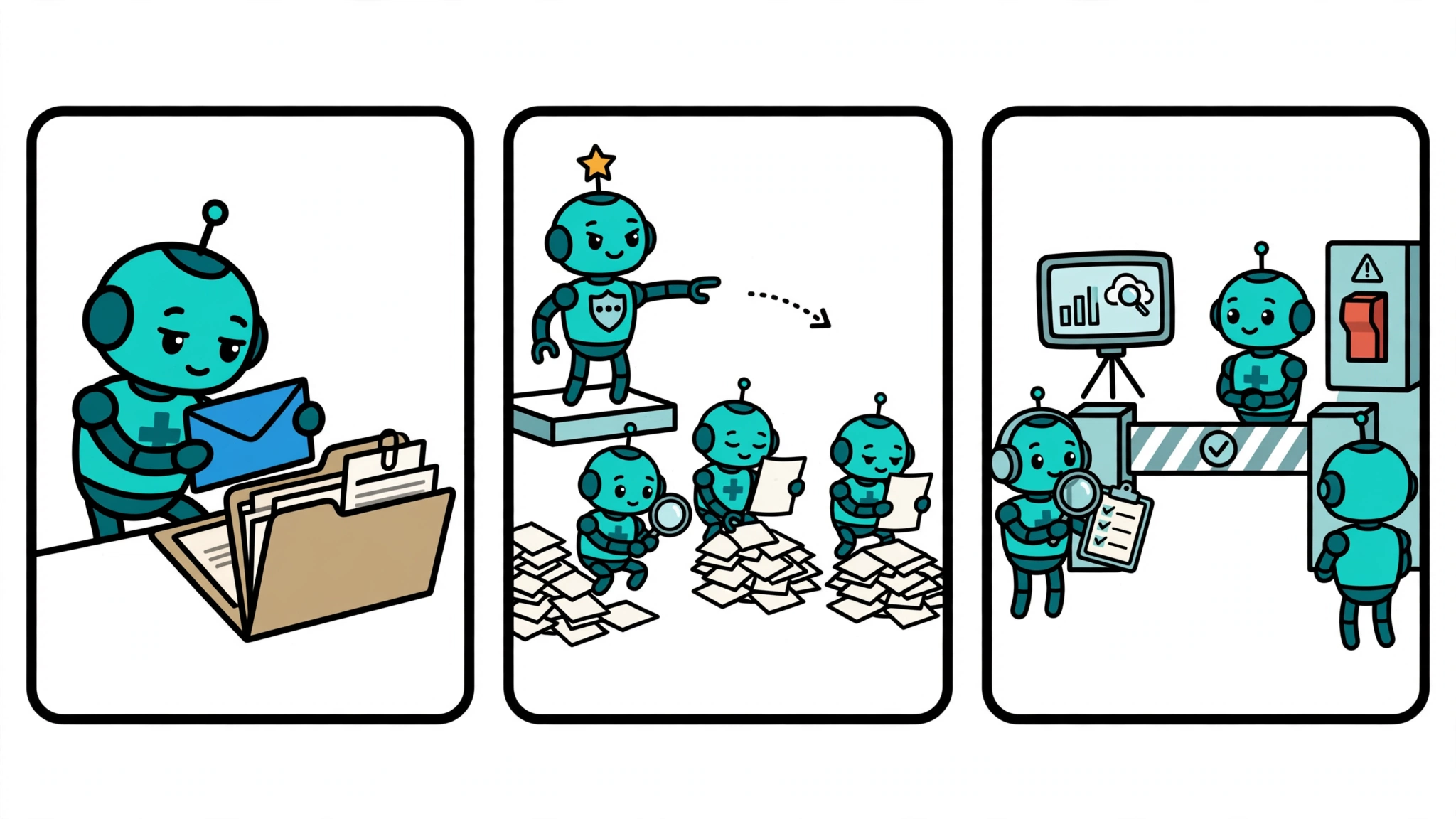
Consider a narrow, sequential support workflow: triaging refund requests for one product line, where every step needs the same customer record, order history, and policy document. The work is sequential, the context is shared, and the tool set is small and coherent. The call is a single agent. Splitting it would copy the same record into several windows, add handoffs between agents that must agree on the same facts, and gain no parallelism.
Consider a research pipeline that must survey dozens of independent sources, compare suppliers, and synthesize a briefing. The subtasks are independent, can run in parallel, and each fits in its own context window, returning a short summary to a lead agent. The call is a multi-agent system, in the orchestrator-worker pattern Anthropic uses for its own research feature, which outperformed a single agent by 90.2% on Anthropic’s internal research evaluation when a Claude Opus 4 lead directed Claude Sonnet 4 subagents. That evidence directly supports splitting for this kind of breadth-first research workload; it does not establish results for other workloads. The other fit criteria Anthropic names — information exceeding a single context window and numerous complex tools — remain reasons to evaluate a split on their own evidence, not conclusions from this evaluation.
Consider a long-running operations workflow that reads monitoring data, drafts remediation actions, and applies changes to production systems. Speed is not the binding constraint; failure isolation is. The read-only investigation and the write action need different permissions, and a bad inference in the investigation must not become a bad change in production. The call is to separate permissions and verification rather than to chase speed: a gathering agent with read-only tools, and a separate acting agent whose write tools sit behind approval checks. Separation alone does not prevent a bad inference from becoming a production change; the approval check must be enforced independently of either agent, and it is that enforcement, not the agent count, that contains the error.
Starting single-agent and migrating when the signals appear
Prototype with a single agent and measure before splitting. Anthropic’s scaling rules for its research system give the shape of the measurement, simple fact-finding needed one agent with three to ten tool calls, direct comparisons needed two to four subagents with ten to fifteen calls each, and only complex research needed more than ten subagents. A team should set its own equivalents — tool-call counts, context size, latency, and failure modes — and watch three conditions drawn from the fit criteria in the published guidance: context dilution, where accumulated output crowds out specifics; specialization, where distinct tasks genuinely need different instructions, tools, or context; and parallelization, where independent work can run concurrently. This three-condition check is the article’s own synthesis of those criteria, not a framework Anthropic names.
OpenAI’s two signals belong on the same list: prompt branches that are hard to scale, and tool overload that clearer names and descriptions no longer fix. When a signal fires, evaluate a split by extracting one subtask behind a stable contract — one agent, one job, one output format — and keep the rest on the single loop. Re-measure after the split. If latency, cost, or failure rate did not improve, merge the subtask back rather than adding more agents to compensate.
Keep a written decision record for each architecture choice, so a later team can see what was measured rather than what was assumed. A minimal record names the decision, the decomposition of the task, the counts that support it, and the trigger that reopens it:
{
  "decision": "single-agent",
  "reviewed": "2026-11-25",
  "task": "Refund triage for one product line",
  "decomposition": "sequential, shared customer record",
  "parallel_subtasks": 0,
  "tool_count": 6,
  "revisit_trigger": "a second, independent lookup stream appears"
}
The record is an example format, not a required schema. Its value is that the revisit trigger is written down before the architecture is debated again.
Common mistakes when choosing
The most expensive mistake is splitting for anticipated scale that never arrives. A multi-agent design built for a workload the system never sees pays coordination, token, and debugging costs from day one, and the single-agent version is never measured. Anthropic’s early failure — spawning 50 subagents for simple queries — is the same mistake at run time: effort scaled to the architecture’s capacity rather than to the query’s complexity.
The second mistake is treating agent count as a proxy for capability. More agents do not by themselves make a system smarter; they let it spend more tokens in parallel and keep more separate contexts. For sequential, context-bound work, extra agents add boundaries where context can be lost, and the added coordination can make the system more fragile rather than more capable — a task-dependent risk, not a universal outcome. The third mistake is copying another team’s architecture without matching its task shape. Anthropic’s research system and Cognition’s coding agent reach opposite defaults because their workloads differ, and copying either without that classification copies the answer to a different question.
The decision rule, in the end, is a measurement discipline. Start with one agent, build it well, and let the system’s own signals — context dilution, unmanageable prompt branches, tool-selection failures that clearer tools do not fix, and independent work waiting on a sequential loop — justify evaluating a second agent. When evaluation shows a split earns its coordination cost, draw the boundary where the work is genuinely independent, the tools and permissions genuinely differ, or failure genuinely must be contained, and keep the boundary as small as the task allows. That is what choosing a single-agent architecture means: not refusing multi-agent systems, but refusing to pay for them before the work has shown it needs them.