



What are AI agents?
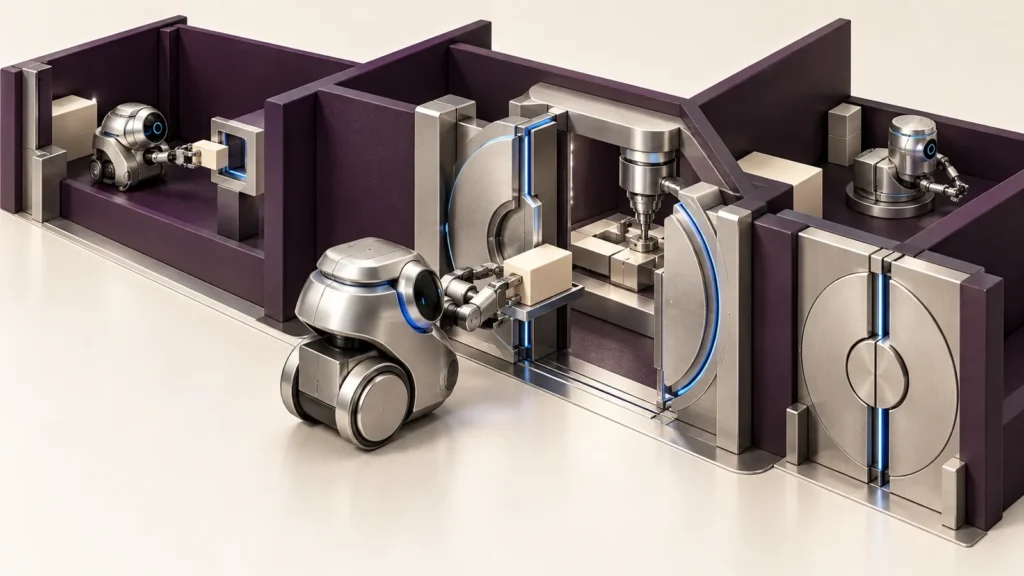
AI agents are software systems that can access information, make decisions, and take actions across business systems. They can use tools to carry out work beyond producing a text response. In a business setting, their authority is delegated: the organization determines which systems they may access and which actions they may perform. Microsoft’s governance guidance emphasizes that this ability to affect multiple systems creates organizational risks.
The practical question is what work the agent should be allowed to complete. An agent that retrieves information and prepares a recommendation has a different scope from one authorized to act on that recommendation. Evaluating an agent therefore means examining both its capabilities and its boundaries.
The following comparison separates three task designs. It is a way to clarify requirements, rather than a claim that all products bearing these labels have the same capabilities.
| Task design | How the work is framed | Main question for the buyer or builder |
|---|---|---|
| Traditional automation with a fixed workflow | The designer specifies the sequence of actions in advance. | Can the task be expressed as a predefined sequence? |
| A chatbot limited to text responses | The system produces a response for a person to use. | Is a text answer sufficient to complete the task? |
| An AI agent using tools | The system makes decisions and takes permitted actions through connected tools. | Which decisions and actions should be delegated? |
Use the task boundary to guide the choice. The supplied evidence supports agents performing work through tools; it does not establish that greater autonomy produces better results than a fixed workflow.
Core components of AI agents
Databricks describes an agent as a model plus a harness. The harness is the surrounding software that provides tools, memory, orchestration, and guardrails. This description makes the deployment question more concrete: selecting a model is only part of assembling the system. Databricks’ explanation of agent harnesses also identifies APIs, databases, and internal systems as tools agents can use.
The components have distinct roles:
- Model: the AI component used in the agent’s reasoning and decision process.
- Instructions: the description of the goal and rules the agent should follow. Neoteric’s architecture discussion identifies receiving goals, breaking work into steps, and applying rules as architectural concerns.
- Tools: connections through which the agent accesses information or performs permitted operations.
- Memory: short-term context and longer-term storage used to retain information.
- Orchestration: coordination of the steps involved in pursuing the goal.
- Guardrails: operational boundaries governing access and actions.
A component diagram captures the model-and-harness relationship without prescribing a particular implementation:
AI agent
├── Model
└── Harness
    ├── Tools
    ├── Memory
    ├── Orchestration
    └── Guardrails
Diagram description: the AI agent comprises a model and a harness; the harness contains tools, memory, orchestration, and guardrails. Instructions supply the goal and rules the architecture must apply, as described in Neoteric’s architecture overview.
How AI agents work: the ReAct loop
Many agents use a cycle called ReAct: reason, act, observe. The harness discussion from Databricks presents this as a foundational pattern for completing tasks. It describes an operating cycle, not a guarantee that the agent’s decisions will be correct.

At a practical level, the steps are:
- Reason: use the goal and available context to determine the next step.
- Act: perform that step through an available tool, within the permitted scope.
- Observe: examine the tool’s result and use it as context for the next decision.
The cycle lets subsequent decisions take account of what an action returned. For instance, retrieving information supplies context for preparing a response. The article’s proposed workflows below show where a human checkpoint can limit the actions that follow.
AI agent architecture: orchestration, tools, and memory
Architecture determines how an agent receives goals, divides work into steps, and applies rules. For a business team, those are operational choices: which task enters the system, which tools support it, and how far the workflow may proceed.
Orchestration connects the task’s steps. When evaluating a proposed architecture, ask the provider to explain the path from the initial goal to the final output, including where approval is required. A description that names a model without explaining that path leaves the workflow unclear.
Tool access should be specified as permitted operations, rather than simply a list of connected systems. Access to an internal system and permission to change its contents are different decisions. Because the evidence establishes that agents act with delegated authority, this distinction belongs in the deployment specification.
Memory management needs to distinguish short-term context from long-term storage. Databricks identifies both as part of a structured approach to agent memory. A useful design review should establish what information the current task needs and what, if anything, should be retained for later work. The supplied evidence does not prescribe a storage technology or retention period.
Together, these decisions turn a broad request to “deploy an agent” into a bounded workflow that can be reviewed.
Governance and security for AI agents
Microsoft calls for an organizational governance and security baseline because agents can exercise delegated authority across systems. Google Cloud’s AI-assisted vulnerability-management guidance supports operational guardrails to restrict sensitive-data access and enforce security policies.
For a deployment review, translate those principles into a checklist. These are design questions derived from the supplied guidance, rather than a complete compliance standard:
- [ ] Define the task and the authority being delegated.
- [ ] Specify the data and systems the agent may access, including sensitive information it must not access.
- [ ] Identify permitted tool operations and actions outside the agent’s scope.
- [ ] State which actions require human approval.
- [ ] Establish how the organization’s security policies apply to the workflow.
- [ ] Review short-term context and long-term storage against the permitted data boundary.
- [ ] Test that the implemented boundaries hold before authorizing the workflow.
Approval deserves particular attention when a workflow moves from preparing an output to affecting another system. The proposed support workflow below makes that boundary explicit: preparing a response and sending it are separately authorized steps.
Practical use cases for AI agents
The research identifies capabilities and architecture principles, but supplies no detailed deployment case studies or performance metrics. The following are proposed workflow specifications based on its example plan, not reports of verified implementations or business results.

Customer support: retrieve policy information and prepare a response
Input: a customer’s question. Tools: access to approved policy information and a response-drafting step. Permissions: retrieve the relevant policy and prepare a draft. Output: a proposed response. Human checkpoint: approval before sending.
This design delegates information gathering and preparation while keeping the outgoing communication behind a review step. It makes the difference between drafting authority and sending authority visible.
Research assistance: gather information with citations
Input: a research question and an approved source boundary. Tools: retrieval from those approved sources. Permissions: gather information within that boundary and prepare a cited output. Output: findings with citations and uncertainty flagged. Human checkpoint: review the findings and unresolved questions before relying on them.
The review should examine whether the cited material supports the findings. The supplied evidence does not establish an accuracy rate for this workflow.
Scheduling: propose times before booking
Input: a scheduling request and its constraints. Tools: access to the permitted scheduling information and a booking operation gated by confirmation. Permissions: check constraints and propose times; make a booking only after confirmation. Output: proposed times, followed by a booking if approved. Human checkpoint: confirmation before the booking action.
For a buyer, the useful specification is the permission boundary around booking. The research does not substantiate any named scheduling integration or measured time savings.
Evaluating AI agents: ensuring reliability and compliance
Andrii Furmanets’ practical architecture discussion argues for evaluating agents as software through structured evaluation. Combined with the governance evidence, that suggests reviewing both task completion and adherence to the authorized workflow.
For the proposed support agent, a concrete evaluation would check whether the draft uses the retrieved policy and whether sending remains blocked until approval. For the research assistant, it would check citations and the treatment of uncertainty. For the scheduling agent, it would check the stated constraints and the confirmation boundary. These are recommended checks for the proposed designs, not supplied benchmark results.
The central distinction is between an acceptable output and acceptable conduct. A useful response does not by itself establish that the agent accessed only permitted information or respected required approvals. Review those boundaries separately.
The research provides no benchmark scores, deployment success rates, or jurisdiction-specific compliance requirements. It supports structured evaluation and policy controls, but does not establish that any particular implementation is reliable or legally compliant.
Conclusion: when to use AI agents
Consider an agent when the task calls for decisions informed by retrieved information and actions through tools. Before choosing one, describe the expected output, the operations it may perform, and the points where a person must approve further action.
If those requirements are still unclear, define the workflow first. That specification gives the team something concrete to compare with a text-only assistant or fixed automation, and something testable before delegating authority.
Explore more AI Agents coverage.








