


Nordic AI infrastructure is expanding around shared supercomputers, commercial clouds and specialized applications built with NVIDIA technology. NVIDIA projects about 1 gigawatt of AI cloud capacity across the region by the end of 2027, while Sweden’s Sferical One consortium has already launched a shared GPU system. Alongside that infrastructure, companies are adapting models for patent analysis, multilingual retrieval, meeting assistance and industrial simulation.
The development matters because it connects computing capacity with specific business workloads and initiatives to widen access. But the evidence describes several stages of maturity: deployed software, a launched supercomputer, an enterprise assistant entering beta, a space-computing prototype and facilities planned for 2027. Performance figures largely come from participating companies, rather than independent evaluations. NVIDIA’s regional overview provides the central account; Blockchain.News also attributes much of its reporting to NVIDIA.
Shared computing and commercial clouds expand together
NVIDIA names Bitdeer, CoreWeave, Crusoe, Hyperstack, Nscale, Verda and Volta among cloud providers expanding in the Nordics. Its approximately 1-gigawatt figure is a regional projection through the end of 2027. It should not be read as capacity already deployed or as a measure of application performance.
Sferical One offers a more concrete example of shared infrastructure. According to NVIDIA, the Swedish consortium is anchored by Ericsson, AstraZeneca, Saab, SEB and Wallenberg Investments, with SKF as a strategic partner. Its supercomputer runs on two NVIDIA DGX SuperPODs, with 16 racks of NVIDIA DGX GB300 systems and 1,152 GPUs.
The consortium plans to build services using NVIDIA Nemotron open models, allowing researchers to customize and deploy models in a secure environment. That links the hardware investment to model development and services, although a launch and a service roadmap establish different things. The evidence does not establish general customer availability, pricing or workload performance for those planned services.
NVIDIA cites renewable energy, data governance and connections between academia and industry as regional advantages. Those are the company’s explanation for the buildout, rather than a quantified comparison of Nordic operating costs or deployment conditions. Source: NVIDIA.
Enterprise applications give the infrastructure a purpose
Spotify illustrates the use of accelerated computing in an existing service. NVIDIA says Spotify uses TensorRT-LLM inference software for AI-powered podcast recommendations, framing the deployment as a way to serve recommendations faster and at a lower cost per query. The evidence provides no numerical cost reduction, so it supports the direction of the claimed improvement rather than a transferable savings estimate.
Elisa’s Moontalk AIRI addresses a different workload. The Finnish telecom company is launching a beta of a real-time enterprise agentic assistant built on Nemotron open models and distributed infrastructure. NVIDIA describes it as retrieving information, capturing insights and documenting decisions during meetings and calls, using company data and low-latency networking.
For technical decision-makers, that description makes the application more tangible than the broad label of an AI agent. It also leaves a clear maturity boundary: Moontalk AIRI is entering beta. The supplied evidence does not establish general availability or measured reliability in customer deployments. Source: NVIDIA.
Startups adapt models to specific languages and workflows
NVIDIA reports that Sweden’s startup ecosystem raised $2.8 billion in the first half of 2026 and projects $5 billion for the full year. The latter remains a forecast. More revealing for builders is the range of model adaptation described alongside that funding.
Stockholm-based Stilta is post-training Nemotron open models to extend patent analysis from individual patents to portfolios. ConfidentialMind’s SampoTron uses NVIDIA Nemotron-3-Embed for retrieval across English, Finnish and Swedish. Agaton routes knowledge retrieval to NVIDIA Nemotron 3.5 Lightning to reduce response latency in its Revenue Mining solution during live sales calls.
Klang’s work focuses on Swedish speech. The company fine-tuned NVIDIA Parakeet v3 using the open source NVIDIA NeMo framework to create Pianissimo. NVIDIA says the model was built on more than 50,000 hours of Swedish speech and is freely available on Hugging Face.
These examples show distinct uses of the model ecosystem: adapting analysis to a professional domain, improving multilingual retrieval, accelerating conversational assistance and specializing transcription for one language. Their reported results measure different tasks and should be assessed separately.
| Application | Reported performance claim | Qualification |
|---|---|---|
| ConfidentialMind SampoTron | More than 20% improvement in cross-lingual retrieval accuracy | Company claim covering English, Finnish and Swedish |
| Klang Pianissimo | 75% fewer errors and 64x faster than the most accurate alternative | Company claim; the supplied evidence does not identify the comparator |
| ABB RobotStudio HyperReality | Up to 99% simulation accuracy and up to 80% less commissioning time | ABB Robotics’ claim; the figures are upper bounds |
The supplied evidence does not provide enough benchmark methodology to reproduce these comparisons. The figures identify potential benefits to investigate, rather than establish expected results for another organization’s workload. Sources: NVIDIA, Blockchain.News.
Simulation and onboard computing extend the scope
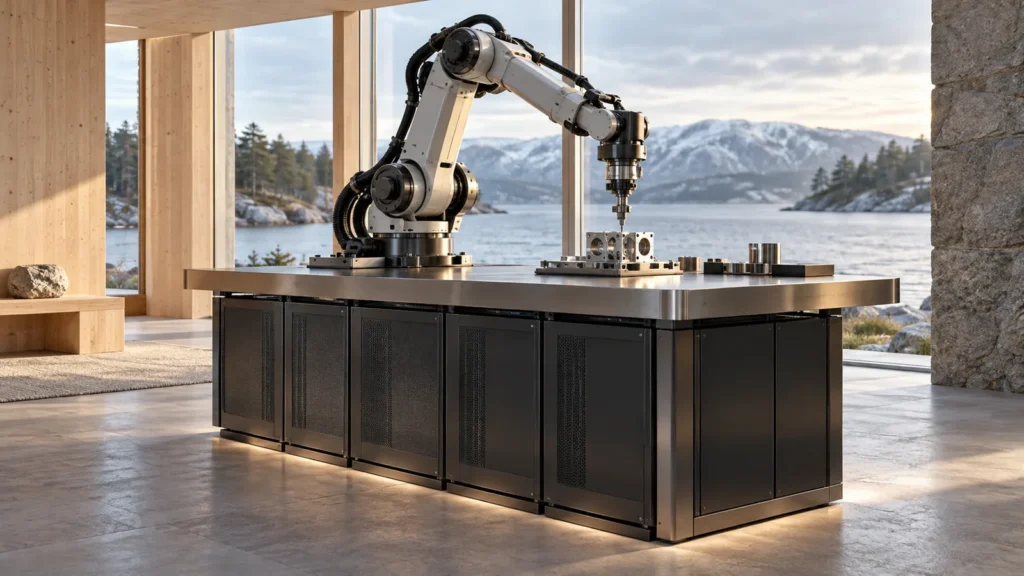
ABB Robotics developed RobotStudio HyperReality with NVIDIA Omniverse libraries. NVIDIA describes a system combining simulation with ABB’s virtual controller, which runs the same firmware as its physical robots. Engineers can train, test and validate robots virtually, while real-world data helps improve the digital model. That mechanism explains the commissioning use case behind ABB’s performance claims.
Toyota Material Handling Europe is also adopting a simulation-first approach to autonomous material handling through a collaboration with NVIDIA and SoftServe. NVIDIA reports deployment-time reductions of up to 50%. Separately, Einride is building its next-generation Einride Driver on NVIDIA Hyperion for autonomous freight trucks, using NVIDIA Halos and NVIDIA Cosmos open world models. These are development and deployment accounts, not evidence of universal autonomous capability.
Embedl and Space Cargo Unlimited provide another example at prototype stage. Their onboard system monitors protein crystallization, flags anomalies and recommends actions on a single NVIDIA Jetson Orin NX module without continuous ground connectivity. Its relevance is the documented ability to perform those functions onboard; the announcement does not establish routine operational deployment. Source: NVIDIA.
Access initiatives are the next practical test
Sweden AI Factory has announced a collaboration with NVIDIA to open infrastructure and expertise to NVIDIA Inception startups and small and medium-sized enterprises, including companies in life and material sciences, autonomous systems and gaming. Norrsken Foundation and NVIDIA also plan to open the Stockholm AI Lab in 2027 as a physical hub for AI-native founders working on global challenges.
Those initiatives address the connection between infrastructure and the companies that might use it. For prospective users, the practical questions are when access becomes available, what support accompanies it and how well the available systems serve their workloads. The regional announcements establish substantial activity across hardware, models and applications. Their value to an individual organization will depend on the access terms and measured outcomes that these accounts do not yet establish. Source: NVIDIA.