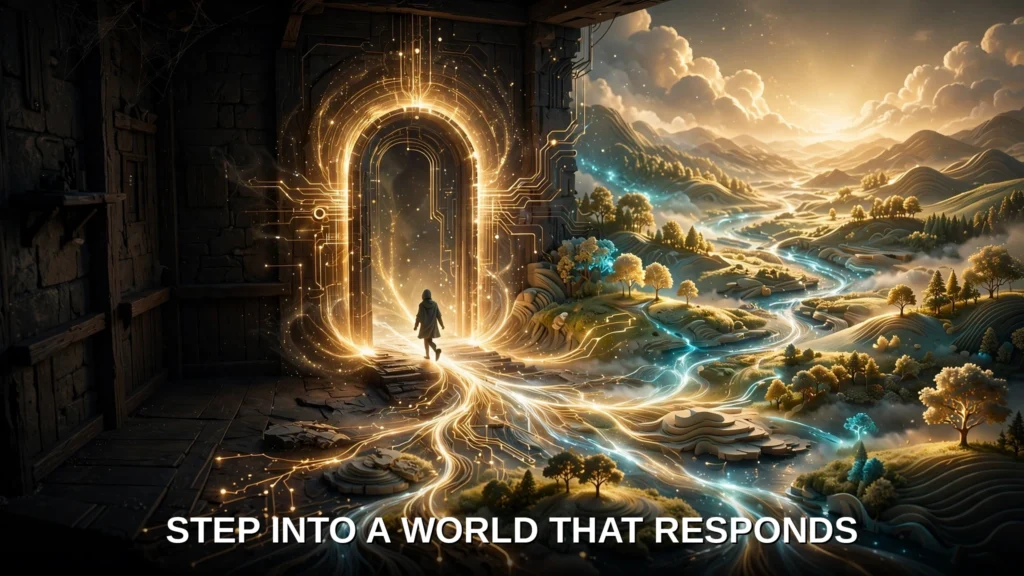



Google DeepMind has announced the Genie 4 world model, a system that does not just generate a picture or a video clip but simulates an interactive world in real time, complete with sound. Announced on 27 October 2026, Genie 4 lets a user set an event in motion and then watch — and steer — what happens next: how the world responds, how it sounds, and how the people inside it move, react and speak.
A world model is a useful way to think about what is new here. Most generative models produce a finished artefact: an image, a paragraph, a short video. Genie 4 instead produces a place that keeps running. You can move through it, change it as it runs, and talk to the characters inside it. DeepMind presents it as a step towards systems that understand and simulate the world, which it describes as a crucial aspect of building AGI — while stressing that this is still an early, experimental research preview.
What the Genie 4 world model is
Genie 4 is DeepMind’s new world model, and its headline claim is improved real-time interactive simulation with what the company calls unprecedented realism. It is natively multimodal, which means the audio is not added afterwards: music, ambient noises and interactive dialogue are generated simultaneously with the world itself. Ambient noises can be generated simultaneously with the world, and the characters in it can converse and react to your inputs or to events in the world, in real time.
That combination — a world that looks, moves and sounds coherent while you interact with it — is what separates Genie 4 from a video generator. A video plays the same way every time. A Genie 4 world responds: change something, and the simulation adapts. DeepMind describes the interactions as real-time, with users steering scenes as they evolve.
How Genie 4 builds a world

Genie 4 incorporates and builds on capabilities from the Gemini family of models. Gemini Omni anchors the simulations in real-world appearance and behaviour, while other Gemini models provide the complex reasoning needed to help maintain a simulation’s coherence and continuity. In practice, that division of labour is the whole trick: one part of the system grounds what the world looks like and how things in it should behave, and another part keeps the story of the world consistent as it unfolds.
The result, in DeepMind’s description, is that you can set an event in motion and Genie 4 simulates what happens next. That includes the physical response of the world, its sound, and the movement, reactions and speech of the people in it. The company also describes a move towards hybrid world models, combining the reasoning strengths of Gemini models with Genie’s sensory simulation.
That hybrid idea matters most for complex, multi-step events. Bringing Gemini and Genie 4 together adds a layer of reasoning to world simulation, allowing the system to model events that unfold over several steps and to test how AI systems navigate different environments before they are brought into the real world. In the announcement, Gemini 3.8 Flash serves as a guiding agent in the loop: as Genie 4 generates a world in real time, Gemini continuously observes the scene, breaks a goal down into a sequence of steps, and reviews incoming frames to track progress and verify that each step succeeded. When the world shifts or the user intervenes, Gemini adapts its plan in the moment, which DeepMind says unlocks worlds with multi-step reasoning.
DeepMind has also experimented with combining Gemini 4 Argon and Genie 4, including simulating Apptronik’s Apollo humanoid playing a game of checkers, with the task broken down into real-time steps interleaved as text captions as the simulation renders. Because Genie 4 can be steered in real time with text captions using Gemini, the simulation can adapt as it progresses towards completing the task.
Steering a simulation in real time
The most immediately graspable part of Genie 4 is how you control it. Users navigate with standard keyboard controls for movement and camera control, and use text prompts to steer the scene as it evolves. With natural language, you can modify a simulation in real time — changing the weather, moving the camera, or introducing a new person or object — and Gemini contextually adapts your prompt to match the surrounding scene. Between your inputs, Gemini also monitors and steers the scene to keep the world progressing cohesively, so the world does not simply freeze while you type.
DeepMind groups the advances into four capability areas. The first is that real-time shaping just described. The second is realism for physics and human action: Genie 4 simulates physics scenarios and its characters can be steered interactively in real time.
The third area is sound. Genie 4 generates audio natively, including interactive dialogue that adapts on the fly, with characters conversing and reacting to inputs or events in the world as they happen. The fourth area is the complex-event modelling with Gemini models described above.
What Genie 4 could be used for
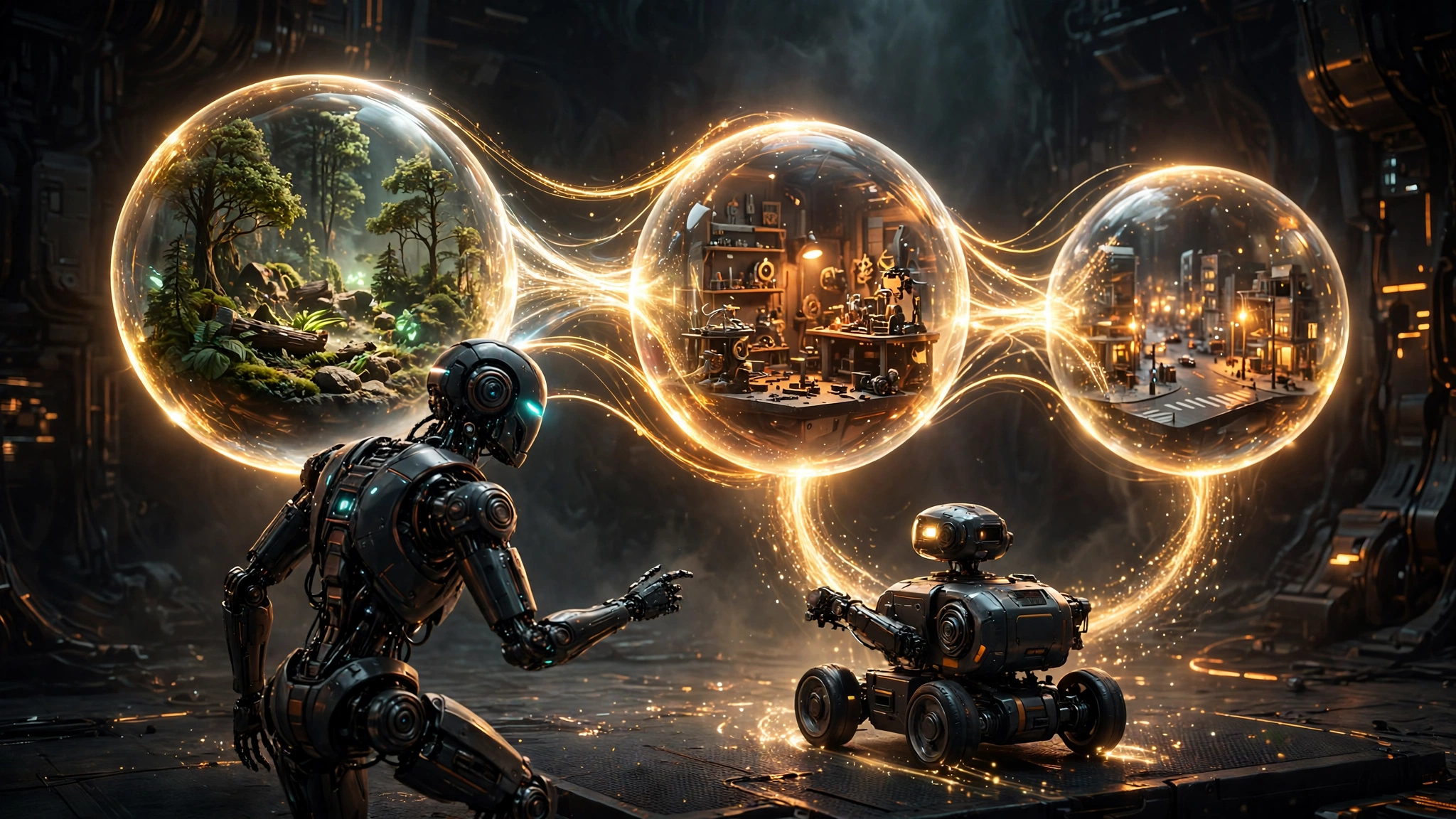
DeepMind’s stated uses fall into two broad groups: training environments and new interactive experiences. On the training side, Genie 4 advances the ability to create infinitely variable simulations that could help with developing training environments for robots and agents. The logic is straightforward: an agent that has to cope with the real world benefits from practising in many simulated ones, and a world model that can generate new scenarios on demand — and adapt them mid-run — is a powerful way to produce that variety. The Apollo checkers experiment is a small illustration of the same idea: a task broken into steps, simulated, and adapted as it progresses.
The second group is creative and experiential. Trusted testers across creative industries, journalism, education, gaming and engineering have been trying Genie 4 out, and DeepMind reports several patterns. Filmmakers and other creatives are testing it as a rapid draft mode for pre-visualisation and ideation. Photojournalists are exploring how a single two-dimensional archival photograph can become a grounded simulation of that environment. Game developers and creative technologists are testing it to go from an initial idea to an explorable prototype.
What unites those uses is speed of iteration: a world you can step into, change and re-run beats a rendering pipeline you have to wait for. Whether that speed survives contact with production workflows — where consistency, control and repeatability matter more than novelty — remains an open question for users.
Availability and access
Genie 4 has started rolling out as a research preview for trusted testers, with DeepMind gathering feedback before releasing it more broadly to consumers and developers. The wider release starts with Google AI Ultra subscribers in Project Genie and early access partners of the Gemini API and Google AI Studio. A waitlist for Genie 4 in Project Genie is open.
That staged rollout is deliberate. DeepMind says Genie 4 includes strict safety guardrails consistent with its safety policies across other models, and that before launching the preview it evaluated the model through internal rigorous safety evaluations to prevent the generation of harmful or malicious content. It deployed first to trusted tester partners specifically to get early feedback before a broader release. For transparency, all video and audio generated by Genie 4 will include SynthID watermarking.
What Genie 4 does not yet settle
DeepMind is unusually candid about Genie 4’s limits, and readers should take them seriously. The model remains an early, evolving area of research. While it can maintain coherent environments over short sessions, visual details and object permanence can still shift or drift over time — especially as a simulation runs longer, after multiple complex prompt edits, or when navigating throughout the scene. Complex physical interactions, real-time audio accuracy, rendering legible text, spatial accuracy and long-term consistency are all active areas of ongoing research.
That frames the right expectations. Genie 4 is not, on the evidence of its own announcement, a finished product for building production worlds; it is a research preview whose most interesting claims — long, coherent, multi-step simulations that stay consistent while a user intervenes — still have to be proven outside curated demonstrations. Public availability beyond the stated first groups, pricing and usage limits are also not confirmed in the announcement, so anyone planning around Genie 4 should treat the waitlist and the trusted-tester feedback as the current state of play, not a launch date.
Still, the direction is clear. A world model that combines real-time visuals and native audio with a reasoning model that plans and checks multi-step events is a different kind of tool from either a video generator or a chatbot. If the coherence holds up over longer sessions, Genie 4 will matter less as a demo and more as infrastructure: a place where agents can be trained, ideas can be prototyped, and scenarios can be explored before they ever touch the real world. Whether that coherence holds up over longer sessions will decide how far these uses go in practice — and the preview is how DeepMind intends to find out.