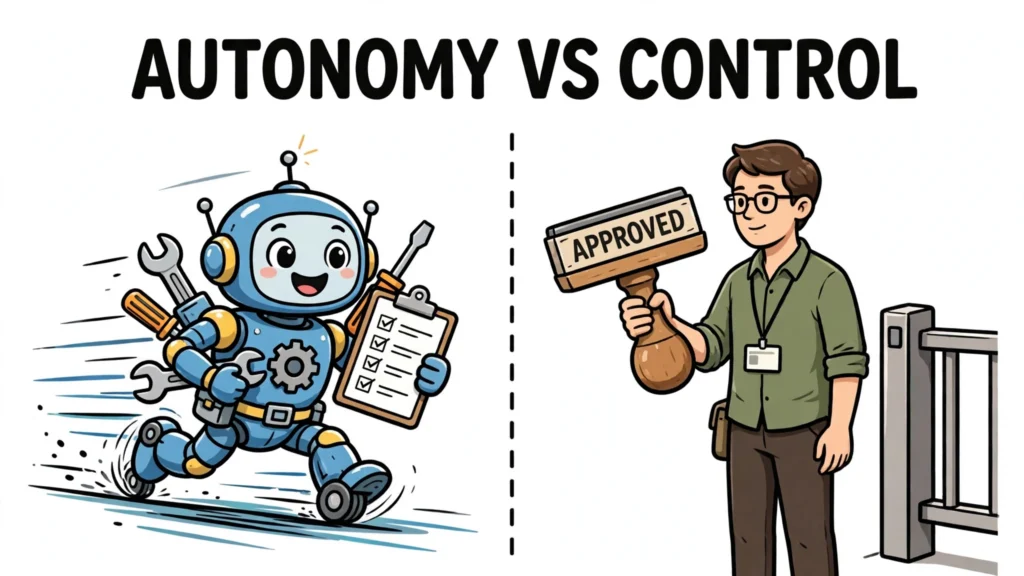

The difference between autonomous vs semiautonomous agents is not how clever the underlying model is. It is how much freedom the system is given to act on its own, and where a human is allowed — or required — to step in. Two agents can run the same model, use the same tools, and pursue the same goal, yet behave very differently depending on that one design decision. This article explains both designs, compares them side by side, and gives you a practical way to choose between them.
Autonomous agents, defined
An autonomous agent pursues a goal through a perceive-plan-act loop with minimal human intervention. It takes a goal, breaks it into steps, chooses the tools it needs, acts, observes the result, and then replans until the goal is done or it hits a boundary it cannot cross. The human’s role is typically limited to setting the goal at the start and reviewing the outcome at the end.
That independence is the whole point. An autonomous agent is useful precisely because it can handle long, multi-step work without a person babysitting every decision. This is why autonomous designs suit recurring, well-bounded work: the goal is clear, success is checkable, and the cost of a wrong step is low.
But independence has a price. Once an agent is free to act, its mistakes can compound before anyone notices. A misunderstood goal at step one becomes a wrong plan at step two and an irreversible action at step five.
Semiautonomous agents, defined
A semiautonomous agent works independently within limits set by a human, and pauses for approval, confirmation, or correction at defined checkpoints. The difference is that it does not get to finish the job unsupervised: at certain moments, chosen in advance, it must stop and wait for a human decision.
Those checkpoints are the defining feature. A semiautonomous agent might draft an email but wait before sending it, prepare a refund but wait before processing it, or propose a plan and wait before executing it. The human stays in the loop for high-stakes, irreversible, or ambiguous decisions — decisions where an error would be consequential or where uncertainty is material. Those checkpoints target impact and uncertainty; they are not a claim that errors are most likely at exactly those moments.
There are three common positions a human can take, and they are worth distinguishing. In the loop, the agent proposes and a person approves before anything happens. On the loop, the agent acts while a person monitors and can intervene or undo. Out of the loop, the agent acts and nobody checks. This article uses a terminology convention worth stating plainly, because frameworks name and number these levels differently: it calls execution with approval gates semiautonomous and execution without approval gates autonomous, while treating monitoring and review as a separate dimension. Monitoring-only operation — human-on-the-loop — can therefore accompany either design, and does not by itself make an execution semiautonomous. The distinction that matters for classification is execution autonomy: whether the agent may act without a human approval gate.
Autonomous vs semiautonomous agents at a glance
Put side by side, the two designs differ on every dimension that matters for deployment, not just on who clicks the final button.
| Dimension | Autonomous agent | Semiautonomous agent |
|---|---|---|
| Goal-setting | Human sets the goal; the agent decides how to reach it | Human sets the goal and the boundaries the agent must stay inside |
| Execution | The agent sequences its own steps and acts without approval pauses | The agent sequences its own steps but pauses at approval checkpoints |
| Checkpoints | No approval gates during the task; monitoring, exception review and stopping conditions may still apply | Defined in advance, at high-stakes or irreversible moments |
| Error handling | The agent retries or replans within its authorized limits, or escalates when it hits a blocker, a stopping condition, or a case outside its authorized scope | A checkpoint gives a human the opportunity to correct the course before damage is done, when they have the information, time and authority to intervene |
| Tool access | Broad, within the permissions and guardrails granted up front | Broad for low-risk tools; gated for high-impact tools according to consequence, reversibility, permissions and uncertainty — not externality alone |
| Reversibility | Actions may be hard to undo by the time they are reviewed | Risky actions within a gate’s scope can be caught before they happen; detection is not guaranteed and depends on reviewer attention and the quality of information at the checkpoint |
Two things are easy to get wrong about this comparison. The first is treating autonomy as a strict binary. In practice it is a spectrum: systems range from assistance, where the human decides and acts, through supervised execution, where the human approves a specific action, to genuine autonomy, where the human sets policy boundaries in advance and reviews outcomes afterwards. Most real products do not sit at a single point on that spectrum — they vary by task, granting more freedom where the work is safe and less where it is not.
The second mistake is confusing capability with autonomy. A very capable agent can still be built to ask first. Autonomy is a deliberate design decision, separate from how powerful the model is. That is why frameworks that rank autonomy describe it by the role left for the human — operator, collaborator, consultant, approver, observer — rather than by the model’s intelligence.
How the control loop differs in practice
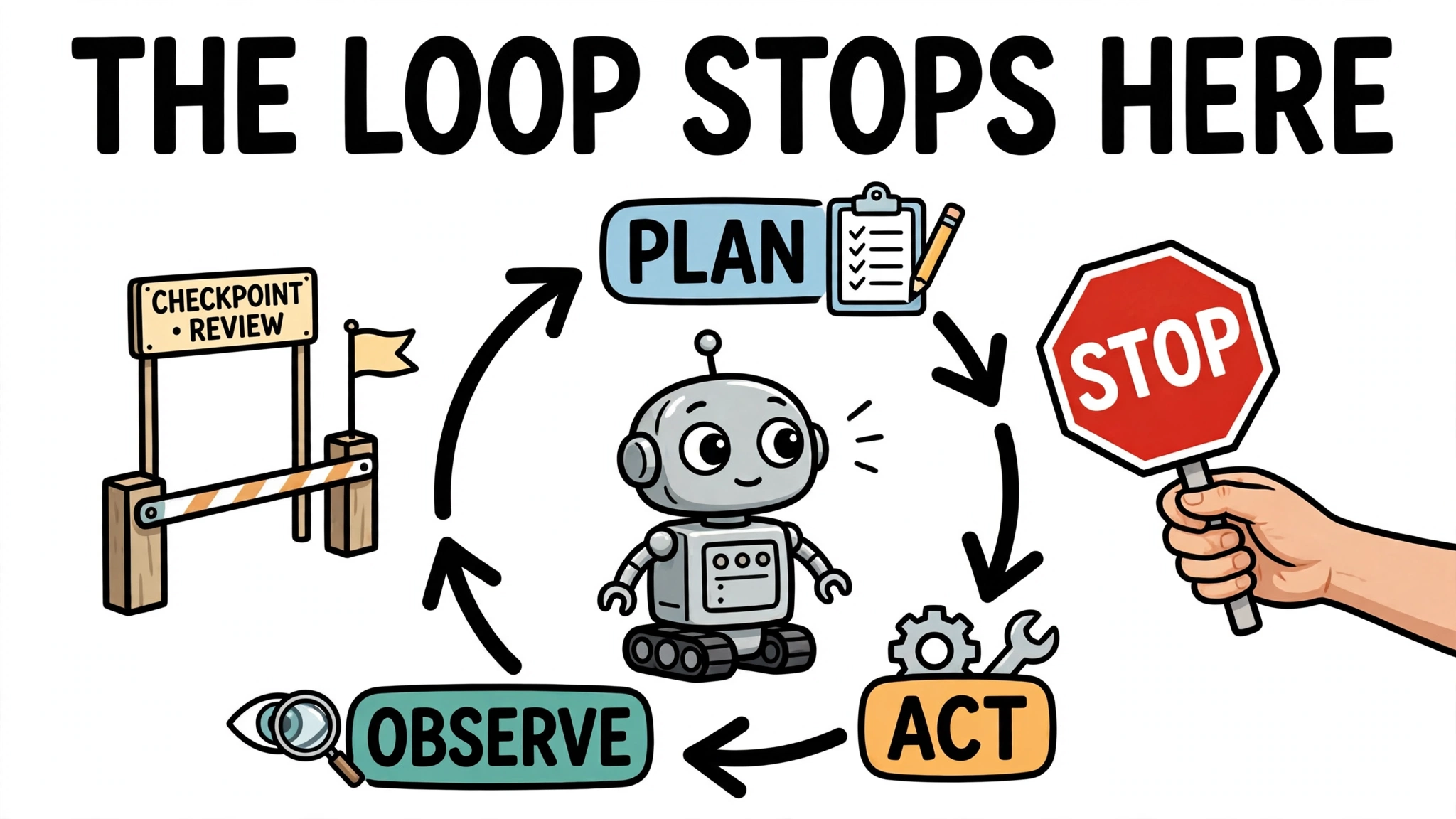
Underneath, both designs run the same loop: perceive, plan, act, observe, replan. What differs is where the human interrupts it.
The autonomous loop runs end to end. The agent receives a goal, forms a plan, acts, observes the result, and replans until the goal is complete. Within its authorized limits, it may resolve ambiguity itself — by gathering more information, choosing the most likely interpretation, or trying an approach and watching what happens — and it may retry after a failure. But blockers, uncertain cases outside those limits, failures, and stopping conditions can halt or escalate the task instead, depending on the configured intervention policy; autonomous execution does not require guessing through ambiguity or deferring escalation until the end. The loop is fast and uninterrupted by approval gates, which is its strength and its risk.
The semiautonomous loop is the same loop with gates built in. The agent plans and acts, but at defined points it stops: it presents a draft, a proposed action, or a summary of what it intends to do next, and waits. The human approves, amends, or rejects. On approval, the loop resumes. On rejection, the agent replans with the correction in mind. The human can also override mid-task, taking control back when something looks wrong.
Watch what happens when each design meets ambiguity. An autonomous agent may fill in the blank itself and act, within its authorized limits, or escalate when the case falls outside them. A semiautonomous agent asks at its configured gates — not whenever ambiguity occurs, but at the points its design has chosen. The same logic applies to failure: an autonomous agent may retry a failing approach several times before giving up, while a semiautonomous agent surfaces the failure at a checkpoint, where a human can spot that the plan itself is wrong rather than the execution.
The standard pattern for getting this right is graduated autonomy. Low-risk decisions pass through automatically, medium-risk decisions are logged for review, and high-consequence actions always require explicit human approval. The design challenge is not whether to have humans involved, but finding the right granularity of oversight — the specific moments where human judgement adds the most value.
Choosing the right level of autonomy
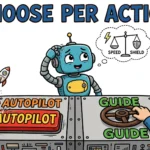
Five factors should decide the level of autonomy for any given task: the stakes of a mistake, whether the action can be reversed, the cost of an error, how fast the work needs to happen, and how much you trust the system based on evidence, not hope.
Full autonomy earns its keep when the cost of an error is low enough to accept. Running tests, formatting code, and searching documentation are the classic examples: if the agent gets one wrong, the damage is small and easily fixed. Semiautonomy is the right default for high-impact actions — a large money movement, a live deployment, sending a message to a customer, or publishing something publicly. Gates should be based on consequence, reversibility, permissions, and uncertainty, not on externality alone: leaving the system does not by itself make an action irreversible, and a bounded, low-risk external action within a pre-approved policy may run without a gate, while a large or irreversible one should not.
Consider the same task — handling a customer refund request — at three levels. A supervised design drafts the refund and waits for a human to approve every case. A semiautonomous design checks the policy itself, prepares refunds under a set amount on its own, and pauses for approval above that amount or when the case looks unusual. A fully autonomous design processes every refund that matches policy and reports the results in aggregate. They differ only in where the human sits.
Volume matters as much as stakes. Human review works well when stakes are high and volume is low — a doctor reviewing a diagnosis, a lawyer checking a contract. It breaks down when an agent makes many decisions per minute and expects a human to evaluate each one meaningfully. If your checkpoints fire so often that reviewers cannot give them real attention, that is a reason to investigate review quality — reviewer attention, time, error detection, and workload — together with whether the gates are placed well. Frequent firing alone does not prove the gates are badly placed, and it does not change the system’s autonomy classification.
Trust, finally, should be earned incrementally. Evidence from real deployments supports this: in one telemetry study of coding-agent usage, newer users used full auto-approve about 20% of the time, rising to over 40% after hundreds of sessions — and experienced users also interrupted the agent more often, not less. Comfort with autonomy, in other words, came with a sharper sense of exactly when to step back in. Start with tight checkpoints, measure where they actually catch problems, and loosen them only where the evidence says it is safe.
Common mistakes and failure modes
The first failure mode is over-autonomy: granting an agent freedom over a task whose goal is ambiguous or whose actions are irreversible. The agent fills in the blanks, acts confidently on a misunderstood goal, and the mistake is discovered only after the damage is done.
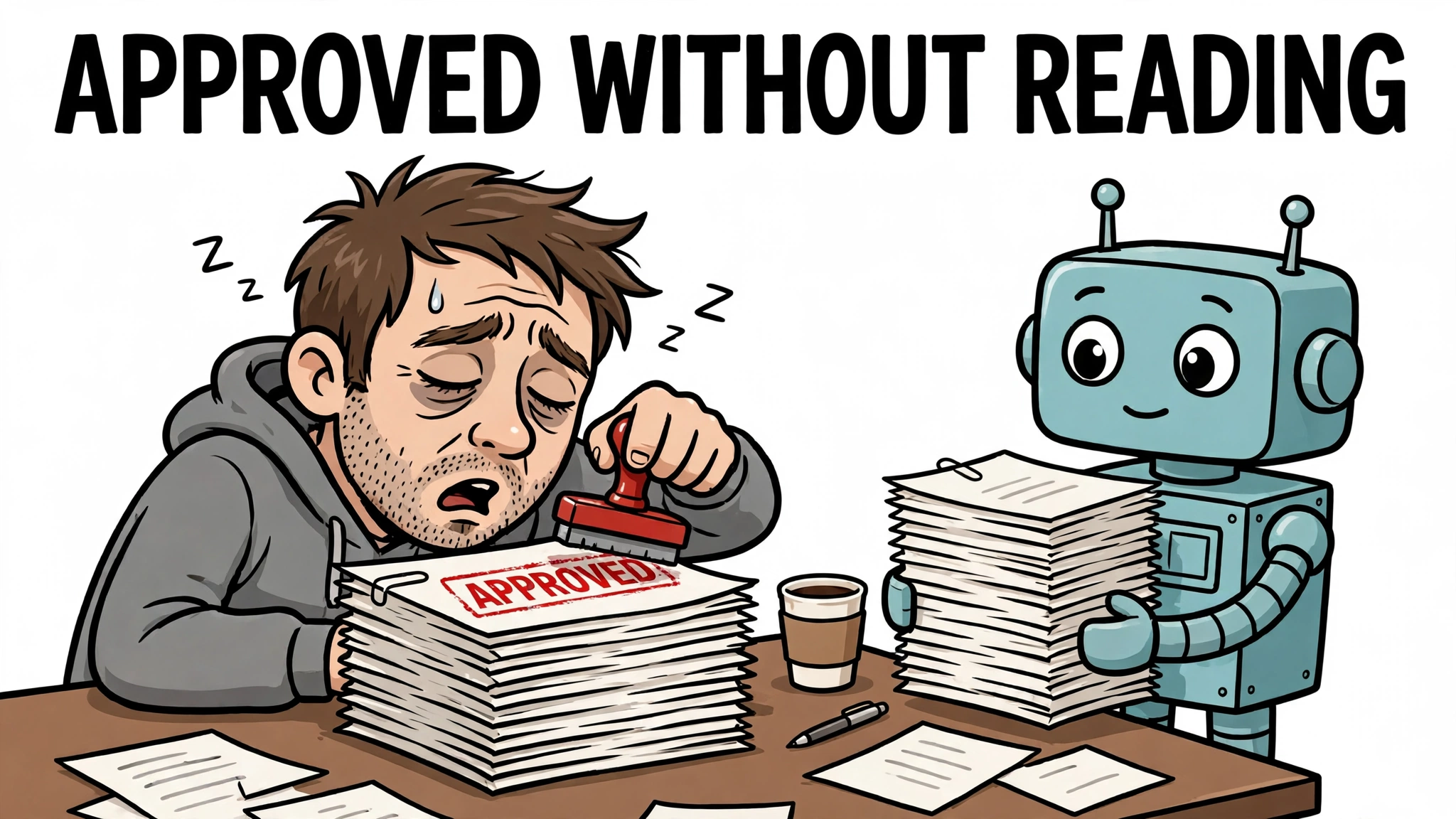
The second is approval fatigue. Checkpoints that fire too often, or on decisions too trivial to matter, train reviewers to approve without reading. Nominal approval can create false assurance — a record of oversight without real review. A high approval rate alone does not establish rubber-stamping or badly placed gates, since the proposed actions may be appropriate; it is a reason to investigate review quality, not a diagnosis by itself.
The third is under-autonomy: throttling a capable agent into a glorified suggestion engine. Unnecessary or excessive approvals can add latency and limit the value an agent adds, depending on task volume and stakes. The agent still contributes its reasoning and preparation; what it loses is authorization to act, not its capability — and whether the human becomes a bottleneck depends on the workflow, not on approval alone. The remedy is graduated autonomy: automate the routine, gate the consequential.
Two subtler failure modes deserve attention. Drift and compounding errors occur when small mistakes early in a long autonomous run go unnoticed and shape everything that follows; a checkpoint midway through a long task, even a light one, can interrupt this chain — if it surfaces the drift with enough information for the reviewer to act on. A checkpoint is an opportunity to detect drift, not a guarantee of detection. Unclear responsibility is the other: when no one owns a decision, everyone assumes someone else reviewed it. For human approval gates, name who approves and what they are approving. For monitoring, escalation, and automated controls, describe accountability according to their function — who monitors, who can intervene, and what triggers escalation — rather than requiring a named approver for every control.
The governance risk is real enough to show up in industry forecasts. One research note predicted that by 2027, 40% of enterprises would demote or decommission autonomous agents because of governance failures — not because the models were incapable, but because the governance wrapped around them did not match how much freedom the agents actually had. Treating agent governance as binary — either locked down or fully trusted — was named as the root cause.
A practical checklist for your own agent
Before you grant an agent autonomy, answer five questions. What can go wrong, and how bad is it? What can be undone, and what cannot? Who reviews what, and at which step? How often will checkpoints fire, and can a reviewer give each one real attention? And what evidence would make you trust this system more — or less — over time?
Place checkpoints where they catch real risk without killing speed. Gate actions that are high-consequence, hard to reverse, or highly uncertain; let routine, reversible, low-stakes work run free; log the middle ground for review in aggregate.
Finally, move systems up or down the spectrum as they prove themselves. A new agent should start semiautonomous, with tight checkpoints and close review. As it demonstrates reliability on a task — measured by outcomes, not by vibes — loosen the checkpoints on the safe parts and keep them on the consequential ones. Autonomy is not a setting you choose once. It is a dial you adjust as evidence accumulates, task by task, until the level of freedom matches the level of trust the system has actually earned.