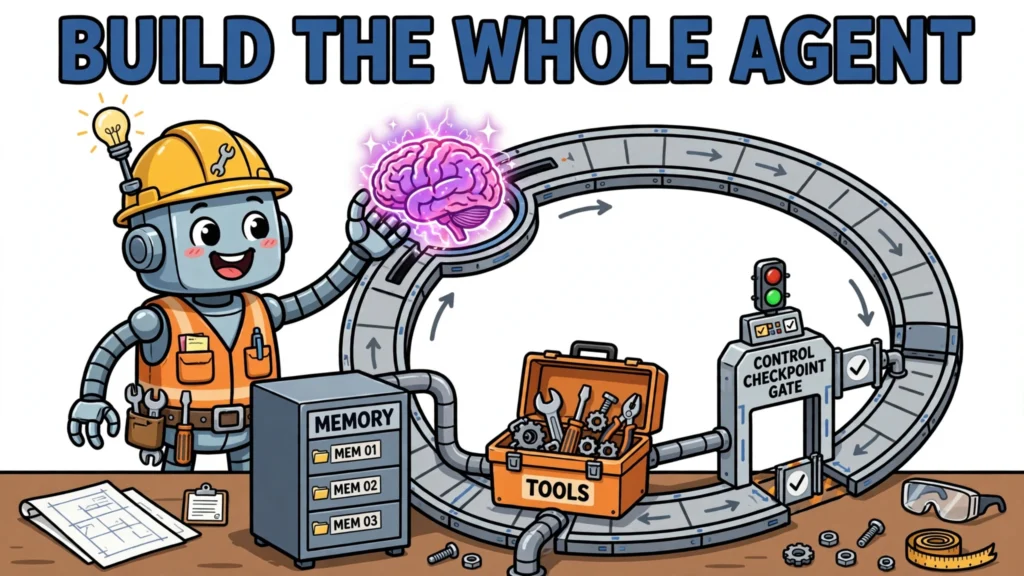


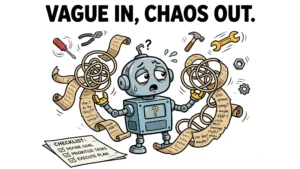
An AI agent architecture is the structure that turns a language model into something that can actually get work done. A bare model only responds to prompts; an agent perceives input, reasons about a goal, remembers what happened, calls tools, and keeps going until the job is finished or a stopping rule fires. Understanding the components — perception, reasoning, memory, tools, and orchestration — is what separates someone who can prompt a model from someone who can build or evaluate an agent system.
What an AI agent architecture actually is
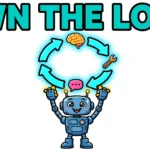
Think of an agent as a loop, not a single call. The loop runs in four repeating steps: perceive what is happening, reason about what to do next, act through a tool, and observe the result. The result feeds back into the next round of reasoning, so the agent can correct course, retry failures, and build on partial progress. The loop ends when the agent produces a final answer, declares the task complete, or hits a stopping condition such as a step limit.
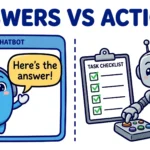
This is the fundamental difference between an agent and a chatbot. A chatbot typically answers one prompt at a time, without a goal that persists across steps. An agent maintains a goal across many steps, accumulates evidence from its own actions, and can change its plan when the world pushes back. The language model is the reasoning engine at the centre, but on its own it cannot see files, remember yesterday, or send an email. The surrounding components supply all of that.
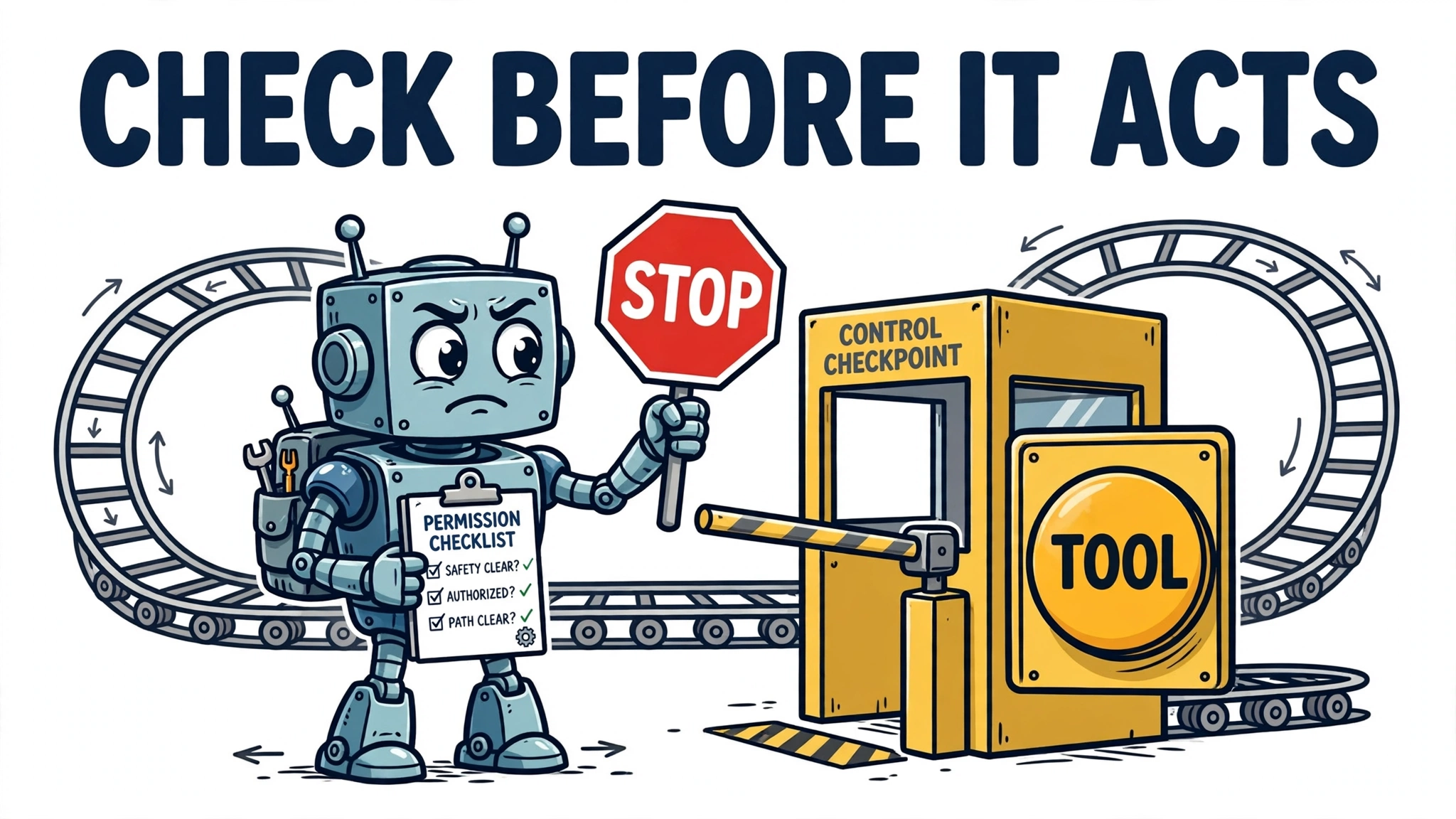
A component diagram should also describe control — the rules that decide when to stop, when to ask a human, and what the agent is allowed to touch. Controls matter because without them a looping agent has no principled way to finish safely.
Perception: how the agent takes in the world
Perception is everything the agent sees before it decides. It has three main channels: the user’s request, the system instructions that define the agent’s role and constraints, and environment signals such as tool results, retrieved documents, and messages from other systems.
Raw input is rarely usable as-is. A perception layer assembles context: it builds the prompt from the conversation, injects retrieved documents or relevant memories, and appends previous tool results in structured form. It also validates input, because a malformed payload or a hostile instruction slipped into retrieved content can derail the whole run.
Perception quality sets a ceiling on everything downstream. If the agent’s view of the task is incomplete or wrong, its reasoning will compound the error rather than catch it. Two practical limits matter most: the context window, which bounds how much the agent can hold in view at once, and the quality of retrieval, which determines whether the right facts are in view at all.
The reasoning core: the model and its planning
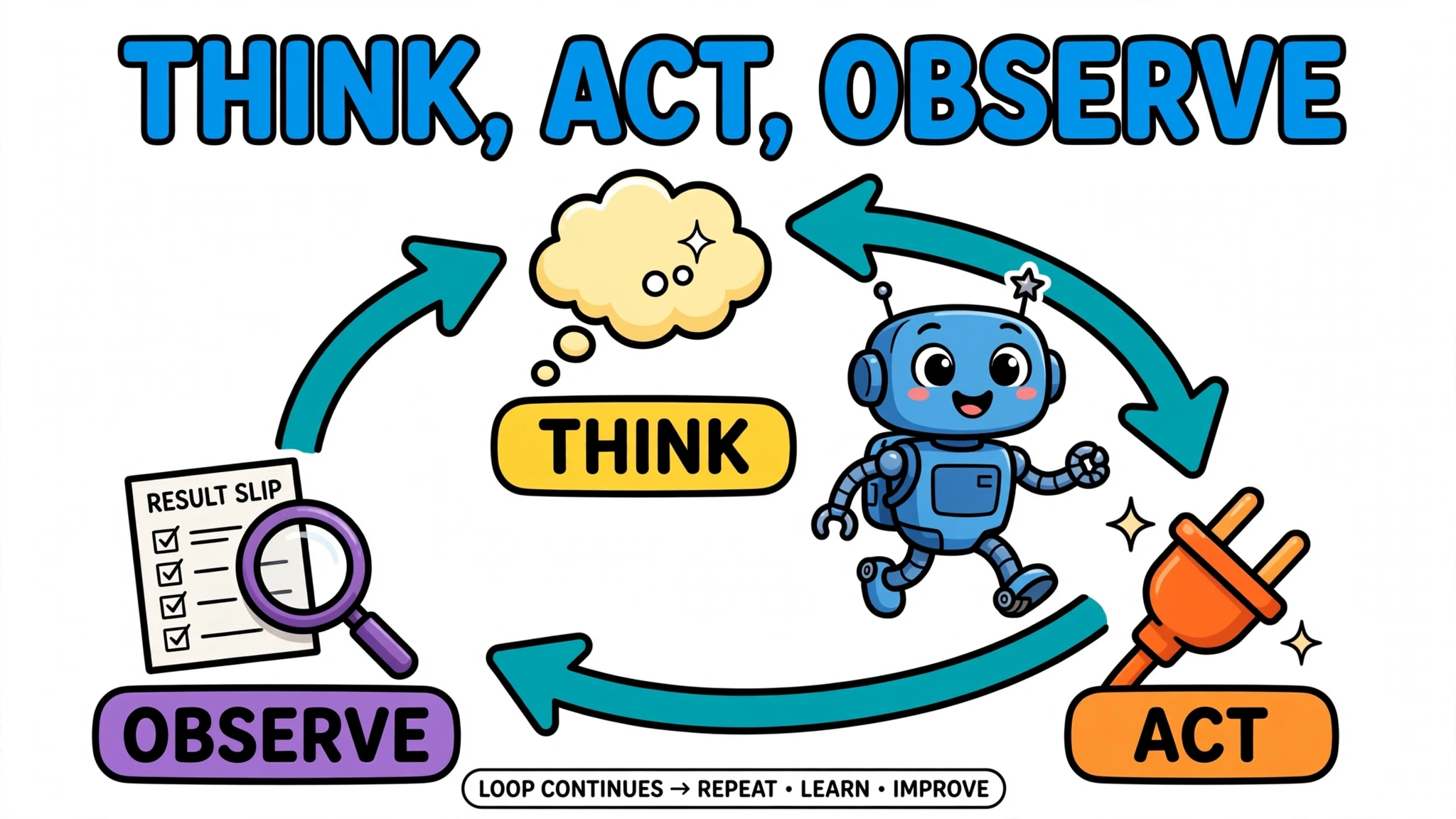
This article focuses on LLM-based agents, where at the centre sits a reasoning engine — in practice, a large language model. It interprets the perceived inputs, breaks the goal into subtasks, decides which tool to call, and determines when the task is done. It does not execute anything itself; it proposes, and the runtime disposes.
The best-known planning pattern is ReAct, short for Reasoning and Acting. Introduced by Yao and colleagues in 2022, ReAct interleaves reasoning traces with actions in a Thought, Action, Observation cycle: the model reasons about what information it needs, calls a tool, reads the result, and reasons again with that new fact in hand. The loop repeats until the model produces a final answer or reaches a step limit. The paper reported that interleaving reasoning and acting outperformed imitation and reinforcement learning methods on interactive benchmarks by an absolute success rate of 34% on ALFWorld and 10% on WebShop.
A typical ReAct trace looks like this:
Thought: I need the current price before I can compare the two options.
Action: search[product price comparison]
Observation: Option A costs 49, option B costs 65.
Thought: Option A is cheaper, but I should check whether it includes shipping.
Action: lookup[option A shipping terms]
Observation: Shipping is included for option A.
Thought: I have what I need.
Action: finish[Option A is the cheaper choice at 49 including shipping.]
ReAct is not the only pattern. Plan-and-execute suits predictable workflows: the agent writes a full plan up front as an illustrative design choice, then works through it, revising the plan when feedback, exceptions, or new information call for it. Single-pass reasoning suits trivial tasks where a tool call would cost more than it saves. The choice is a trade-off between adaptability and cost: looping with feedback handles surprises but burns more tokens and more time.
Memory: what the agent remembers between steps
Language models are stateless: they remember nothing between calls unless the system hands them the past. Memory is the component that fills that gap, and it comes in two forms.
Short-term memory is the active context of the current run — the conversation so far, the tool results already collected, the plan in progress. It lives inside the model’s token window, which means it is immediate but bounded: stuff too much in and the earliest context gets squeezed out, or the model starts attending to the wrong parts.
Long-term memory persists across sessions. It can be stored facts, past interactions, user preferences, or learned procedures. The usual implementation is a vector store: interactions and documents are embedded and indexed, and when a new query arrives, the most relevant entries are retrieved and injected into the reasoning step. Graph databases serve a similar role when relationships between facts matter more than similarity. The retrieval step is the weak point — retrieving the wrong memory is often worse than retrieving none, because the model treats retrieved content as evidence.
A useful rule: short-term memory answers “what are we doing right now”, long-term memory answers “what do we already know”. Both must be written deliberately. Every tool result worth reusing should be recorded; every recorded fact should carry enough context to be interpreted correctly when it is retrieved weeks later.
Tools and actions: how the agent touches the world
Tools are what turn reasoning into real-world effect. A tool can be an API call, a database query, a code execution environment, a search engine, or a message sent to another system. In the SDK definition tools are optional, but in practice they are what let an LLM-based agent act on the world rather than only describe it.
Tools are exposed to the model as typed function interfaces: a name, a description of when to use it, and a schema for its arguments. The model does not run the tool — it returns a structured request naming the tool and its arguments, the runtime executes it, and the result comes back as an observation for the next reasoning step. The schema is the contract: a clear name, descriptive parameters, and type annotations are what let the model choose correctly.
A minimal tool definition, as the model would see it, looks like this:
{
  "name": "get_weather",
  "description": "Get the current weather for a city.",
  "parameters": {
    "type": "object",
    "properties": {
      "city": {"type": "string"}
    },
    "required": ["city"]
  }
}
Structured output is the sibling mechanism: instead of deciding which tool to call, the model is asked to return data in an exact shape, such as a JSON object matching a schema. Tool calling says “here are actions you can take, decide which ones to use”; structured output says “give me data in this shape, now”. Both rely on the same idea — structured contracts help software validate and consume tool requests and structured results reliably.
Tools also need bounds. A tool that can send email, move money, or delete records should carry permission checks, and applications commonly add a human approval gate before irreversible actions, governed by their own approval policy. The blast radius of an agent is defined by its tools, not by its model.
Orchestration and control: keeping the loop on track
Orchestration is the component that sequences everything: which step runs next, how failures are retried, how state is passed between steps, and how multiple agents hand work to each other. In simple agents, the orchestrator is a small loop in the framework’s runner — call the model, run any requested tool, feed the result back, repeat. In complex systems, orchestration is an explicit graph of nodes and edges, where edges can loop back on failure and checkpoints let a run pause and resume exactly where it stopped.
Control mechanisms are what keep the loop safe and finite. Stopping rules and iteration caps prevent infinite retries — an agent that keeps failing the same step must eventually give up and report, not burn budget forever. Guardrails validate inputs and outputs and can terminate a run early when a check fails. Human-in-the-loop checkpoints can pause the run before sensitive or irreversible actions, when the application’s approval policy calls for them, and the run resumes from the saved state once a person approves. Observability — logs of every reasoning step, tool call, and outcome — is what makes a non-deterministic system diagnosable in practice.
Multi-agent designs add a coordination layer on top: a supervisor or router agent decides which specialist handles the next step. This pays off when work is genuinely decomposable or parallel, such as a research sweep across many sources. But coordination is not free. Every agent needs its own copy of shared context, every handoff is a place where information is summarised lossily and errors compound, and every additional agent multiplies token cost. One benchmark of agent teams against single agents found teams costing 1.8 to 5.1 times more per completed application, with a significant quality gain in only one of four comparison conditions — while parallel research decomposition improved performance by 90.2% over a single agent on an internal research evaluation. Multi-agent systems are a tool for specific shapes of work, not a default.
A reference architecture, end to end
Put the components together and a typical agent run looks like this. A user asks for a weekly competitor report. Perception assembles the request, the agent’s instructions, and last week’s report retrieved from long-term memory. Reasoning breaks the job into steps: gather news, check pricing, draft sections. Tools execute each step — an RSS fetch, a pricing API call, a writing tool — and each result returns as an observation that updates the plan. Orchestration sequences the steps, retries the failed API call once, and pauses for human approval before the report is sent. Memory stores the finished report so next week’s run can build on it instead of starting from scratch.
Mapped onto a framework stack, the layers line up cleanly: the model provider supplies the reasoning engine; the framework supplies the loop, the tool registry, and the state graph; a vector store supplies long-term memory; the application supplies the tools, the guardrails, and the approval UI. Nothing in the stack is exotic — the architecture is the composition, not any single piece.
Common mistakes when designing agent architectures
Three mistakes recur across failed agent projects. First, giving the agent powerful tools without bounds or verification: an agent whose results are never checked risks acting wrongly at scale, with errors going undetected until they surface downstream. Second, treating context as infinite memory: stuffing every retrieved document into the prompt degrades reasoning and crowds out the instructions that matter. Memory must be retrieved selectively, not dumped wholesale. Third, skipping evaluation: if there is no task set with a measured success rate, no one can tell whether a prompt change, a new tool, or a model swap helped or hurt. Log structured step events from day one — success rate, steps per task, and step-limit hits — and changes can then be judged against measured evidence.
An AI agent architecture is, in the end, a discipline more than a diagram. The components are simple; the craft lies in the loop that binds them, the memory that grounds them, the tools that bound them, and the controls that keep them honest. Get those right and the model at the centre can do far more than answer a prompt — it can finish a job.