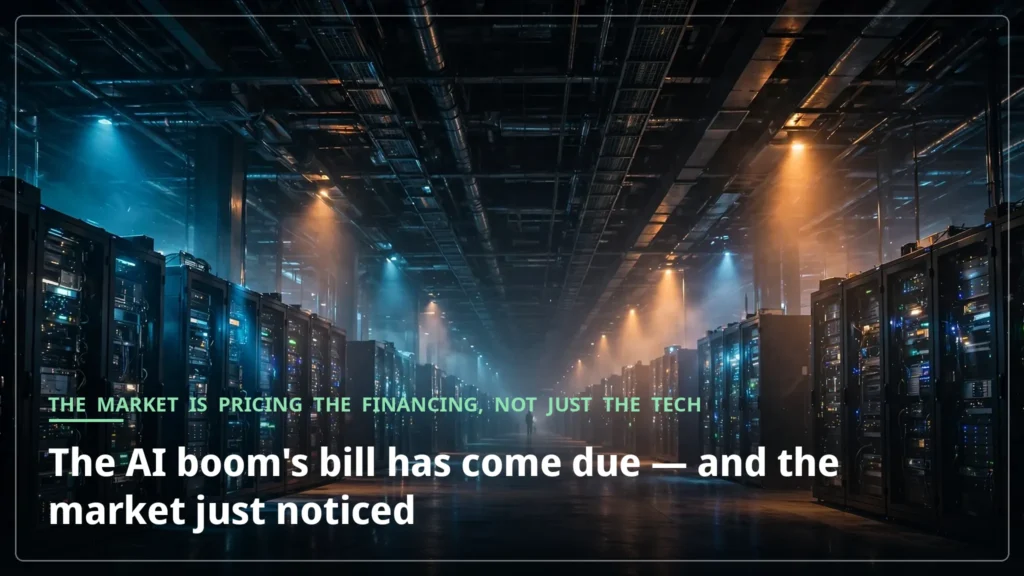



For most of the AI boom, a very large number was read as a very good sign. When a hyperscaler announced tens of billions more for data centres and chips, investors heard confidence: demand was real, the future was being bought, and the bill could wait. This week, the bill arrived in the earnings reports — and the market stopped applauding.
The demand has not faltered. That is what makes this turn interesting, and a little unnerving. Google, Amazon and Microsoft all reported gains in their cloud businesses, and TechCrunch reports that investors are spooked not by a collapse in appetite for AI compute but by the cost of meeting it. The question that has moved to the centre of the story is no longer whether anyone wants AI. It is whether the companies building it can pay for it without eroding the businesses that fund it.
The numbers that changed the mood
Start with the headline figure. Alphabet, Amazon, Meta and Microsoft have outlined plans to spend more than $740 billion on capital expenditures this year, which Wall Street reads as AI infrastructure spending, including data centres and chips. Against that, three of the four reported negative free cash flow.
Alphabet reported negative free cash flow of $9.1 billion in the third quarter, its second consecutive quarter in the red, even as quarterly capital spending grew to $51.4 billion. It expects to spend up to $205 billion this year, and expects that spending to keep rising in 2027.
Amazon reported negative free cash flow of $42.4 billion over the past 12 months, compared with $14.8 billion in positive free cash flow the year before, and expects to spend $220 billion in capital expenditures this year. Its cloud business, AWS, grew revenue by 39%, yet Amazon’s stock tumbled 7% after it reported earnings on Thursday.
Meta reported negative free cash flow of $2.1 billion in the third quarter as capital spending outpaced operating cash, and is guiding to as much as $145 billion in capital expenditures this year. Advertising revenue grew 26%, and Meta’s stock still took a 10% hit last week. The spending pressure has a human-readable cause inside Meta’s own account of it: chief executive Mark Zuckerberg has said Muse, its new free personal AI agent, is “very compute-intensive to run”.
None of this, on its own, proves a company is in distress. A single quarter — or even twelve months — of negative free cash flow does not by itself establish that for companies of this scale, and the reporting gives no cash balances against which to judge it. But as a pattern, repeated across three companies at once, it changes what the spending means. Earlier in the boom, investors largely rewarded big outlays as a sign of confidence in the technology’s growth potential. As the fourth quarter began, TechCrunch reports, that enthusiasm gave way to concerns about negative free cash flow, mounting debt, and whether the investments will ever generate enough returns.
The exception that sharpens the point
Microsoft is the exception, and it is a useful one. It recorded $18.6 billion in positive free cash flow in its latest quarter, with capital spending at $45.2 billion — less than the $50 billion it had projected. Microsoft said that was not an intentional pullback from AI spending, blaming delays in capacity from third-party providers.
The exception cuts both ways. It shows that at least one hyperscaler is still funding AI from operating cash, which is a genuine counterweight to any claim that the whole boom is unfunded. It also shows that even Microsoft, the one hyperscaler still cash-flow positive, did not spend what it planned — because suppliers, not strategy, held it back.
A credit story underneath a technology story

Underneath the earnings figures sits a financing figure that reframes the boom. According to S&P Global Market Intelligence, Microsoft, Alphabet, Amazon, Meta and Oracle raised a combined $326 billion in debt in 2026, triple the amount raised last year. TechCrunch notes the money for AI infrastructure is not just coming from Big Tech profits, but also from stock and bond sales.
That does not make the boom a fraud, and it does not mean the debt cannot be serviced. It does mean the buildout is now, in part, a credit story, alongside chip supply and engineering — and whether bond-market access or borrowing costs could constrain its pace remains an open question. When cash flow turns negative as spending rises, that distinction matters a great deal.
The market’s verdict, in one Friday
On Friday the Nasdaq fell 2.9%, and chip stocks fell with it: Nvidia dropped 4%, Broadcom more than 5% and Qualcomm 11%. Alphabet fell 12% on Thursday, which TechCrunch describes as its worst day on record, wiping out $500 billion in market value, and fell again on Friday.
A sharp selloff after earnings can be a valuation reset rather than proof that a boom is unfunded. But the breadth of Friday’s fall — an index, the chip suppliers, and the spenders together — fits the financing reading better than a story about any single company’s quarter. Investors were not punishing one miss. They were repricing a shared bet.
Google’s tightrope

Nowhere is the tension sharper than at Google. TechCrunch describes Google as walking a tightrope, spending billions on AI technology that could undermine the search business that pays for it. Google Search advertising growth slowed to 12%, its weakest pace in five quarters, while Search makes up roughly half of Google’s revenue.
Did AI Mode cause the slowdown? The reporting does not establish that. The slowdown is confirmed; its cause is an open question, and it is one of the most consequential unanswered questions in the whole story. If AI answers are displacing the clicks that fund the buildout, Alphabet’s squeeze is self-inflicted in a way a simple spending cycle is not. If the slowdown has other causes, the squeeze is still real, but the remedy is different. Either way, Alphabet is watching its core business grow at its slowest pace in more than a year while its AI spending climbs.
What would change the story
The counterarguments deserve to be kept in the open. Demand is real, not just hype: cloud businesses grew, with AWS revenue up 39%, so the spending is meeting actual demand for AI compute. The capital figures are guidance, not spent cash. Microsoft’s positive cash flow shows the model working at least somewhere. And negative free cash flow alone is not distress.
What would settle the argument is evidence the market does not yet have. Will Alphabet’s capital spending keep rising in 2027 as it expects, and will AI revenue distinct from cloud grow fast enough to restore positive free cash flow? Will Google Search advertising growth keep slowing as AI Mode spreads, or stabilise? Will the other hyperscalers revise 2026 capital guidance down, and will third-party capacity delays cap spending regardless of intent? Those are the questions to watch in the next round of earnings, because they test the financing thesis directly rather than relitigating this quarter’s sentiment.
The coda: Anthropic goes public into this weather
There is a coda that shows how far the financing question now reaches. Anthropic filed to go public earlier in the week, and its future growth depends on securing enormous amounts of compute. The Financial Times reported on Friday that Blackstone warned investors the company might not qualify for an investment-grade rating after its IPO, meaning it might end up more reliant on the hyperscalers and third parties to fund its infrastructure ambitions.
That warning is reported, not decided. But the timing is the point. A company that needs enormous compute is asking public investors for money in the same week those investors watched its would-be suppliers go cash-flow negative while pledging hundreds of billions more. The AI boom has not ended. But the market’s focus has shifted — from the technology alone to the spending behind it, the debt funding it, and whether those investments will ever generate enough returns.