


AI agent scaling is the difference between a demo that impresses five users and a system that survives five thousand. An agent that works beautifully at low volume can fall over in several distinct ways once traffic grows: it hits a provider rate limit, its costs climb faster than its user count, its tool calls start double-charging customers, or its sessions slow to a crawl as context piles up. Scaling an agent is therefore not one problem but a stack of them, and the fixes belong in a particular order.
This guide works through that stack: what agent load actually is, the bottlenecks in the order they tend to bite, and the rollout discipline that turns a design into a system you can trust at volume. Provider limits change often, so treat the figures below as a snapshot and re-check the provider documentation before budgeting against them.
AI agent scaling: what it actually means
Before changing anything, measure what kind of load you actually have. Agent load has four dimensions, and they point at different fixes. Concurrent sessions tell you how many agent runs are live at once. Tool calls per task tell you how much downstream work each run triggers. Tokens per task tell you what each run costs and how much of a provider quota it consumes. Latency budget tells you how long a user will wait before the answer stops being useful.
Agents scale differently from ordinary web requests for a simple reason: the work is long-running, stateful, and model-bound. A web request typically finishes in milliseconds and holds no state between calls. An agent run can last minutes or hours, keeps conversation and tool state across many turns, and spends most of its time waiting on model inference or downstream APIs. That means the usual scaling reflex — add more servers and watch CPU — misreads the system: an agent worker waiting on a model call burns almost no CPU, so CPU-based autoscaling sees an idle fleet while the queue of waiting tasks grows.
Start with a load profile: sessions per minute at peak, median and 95th-percentile task duration, tool calls per completed task, and tokens per completed task. Cost per completed task is the metric that ties the rest together. At fleet scale, a per-task price that looks like a rounding error on one request can become a significant variable cost once it is multiplied by loop length and then by task volume.
Where agents break first under load
The first wall most teams hit is the provider rate limit. Model APIs cap usage in requests per minute and tokens per minute, per model and per organization, and the caps rise with usage tier rather than with demand. OpenAI’s tiers, simplified from five to three on 6 October 2026, illustrate the shape: the Build tier allows 5,000 requests and 1,000,000 tokens per minute for its Astra, Sol and Terra models, while the Grow tier allows 15,000 requests and 40,000,000 tokens per minute. Requests over the limit return HTTP 429 with a retry-after header, which is the provider telling you to slow down, not a bug to retry through immediately.
The second wall is downstream: the tools your agent calls have their own limits, timeouts, and failure modes. A search API, a CRM, or a payment endpoint will not all scale at the same rate as your agent fleet, and when one of them slows down, your agents queue up behind it.
The third wall is state: sessions accumulate context and retrieval stores serve many concurrent queries. The fourth is cost: token spend growing faster than user growth, usually because conversation history is re-sent in full on every step of the loop, so each turn costs more than the last.
Scale horizontally: stateless workers, queues, and session routing
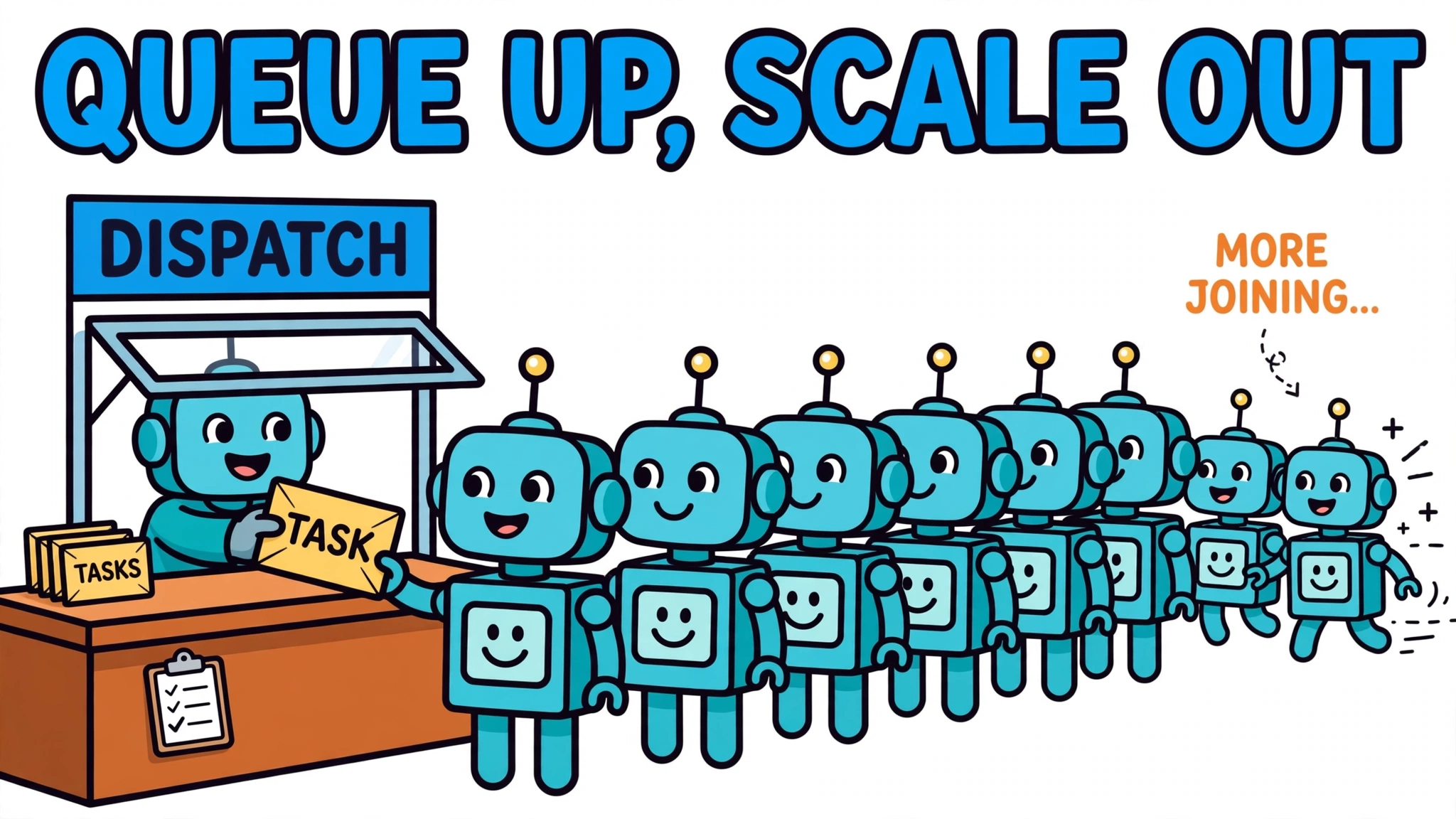
The core pattern for handling many concurrent agent runs is to separate the agent runtime from session state. Workers should be stateless processes that pull tasks from a shared queue, do the work, and write results back to a store. Any worker can then handle any task, workers can be added or removed freely, and a crashed worker’s queued tasks can be retried by another worker, but only progress actually persisted outside the worker survives; anything still in flight is lost and must be re-run, with idempotency protecting its side effects.
Queue long-running agent tasks instead of holding open requests. A user-facing request that waits minutes for an agent to finish ties up connections and times out; a queued task with a status endpoint does not. Queue depth — how many tasks are waiting — is the signal that actually reflects agent load, and autoscalers such as KEDA scale worker replicas on it, down to zero when the queue empties.
For the strongest form of this pattern, use durable execution: a framework such as Temporal records every step of a workflow, so a crash, timeout, or deployment mid-run resumes from the recorded history instead of restarting from zero. Restarting a long agent run repeats paid model calls and can repeat side effects. One production account, Grid Dynamics’ deep-research agent, migrated from a LangGraph prototype to Temporal for this reason, replacing thousands of lines of custom retry code with declarative retry policies and a custom Kafka-based queue autoscaler with identical stateless workers polling one task queue.
Session routing is the remaining piece: either route follow-up turns to the worker holding the session, or make sessions rehydratable from a store so any worker can pick up any turn. Managed runtimes take this further: Amazon Bedrock AgentCore Runtime runs each session in an isolated microVM and, according to AWS, automatically scales from zero to hundreds of thousands of concurrent sessions.
Cut cost and latency per task: routing, caching, and batching
Once the fleet can grow, the next job is making each task cheaper, because cost per task multiplied by volume is the bill. One supported lever is model routing: send every task to the smallest model that can handle it safely, and escalate to a frontier model only when the task is ambiguous, high-impact, or outside the small model’s measured competence. Production reports cited in the research claim 40–70% cost savings from smart routing in live systems, with roughly 85% of tasks handled successfully by smaller models. The router should check concrete signals — task type, measured confidence, output validation — rather than asking a model to judge itself in free-form prose. Which lever matters most depends on the measured cost breakdown of the workload.
The second lever is caching. Prompt caching reuses the processed prefix of a request, so a long system prompt or retrieved context is paid for once and then read back cheaply. Anthropic prices cache reads at about 10% of the base input rate, with a 1.25x premium to write a 5-minute cache, and reports up to 90% cost and 85% latency savings on long prompts. The catch is structural: caching only works when the prompt prefix is stable. Injecting dynamic values such as timestamps or user IDs above the static content defeats the cache, so requests must be ordered static-to-dynamic, with the longest stable prefix first.
Semantic caching adds another layer: near-duplicate questions are answered from a cache of previous answers without any provider call at all, with one vendor study reporting about 31% of redundant queries eliminated this way. And for work where nobody is waiting — nightly evaluations, bulk classification, backfills — batch APIs process asynchronously within 24 hours at a 50% discount from the major providers.
Finally, compress context. Treating the context window as the system of record is one of the most expensive mistakes in agent design: appending every message, observation, and tool result to an ever-growing array makes inference latency grow quadratically and token cost grow linearly on every call. Summarise completed turns, store durable state outside the prompt, and send the model only what the next step needs.
Keep agents reliable at scale: retries, idempotency, and guardrails
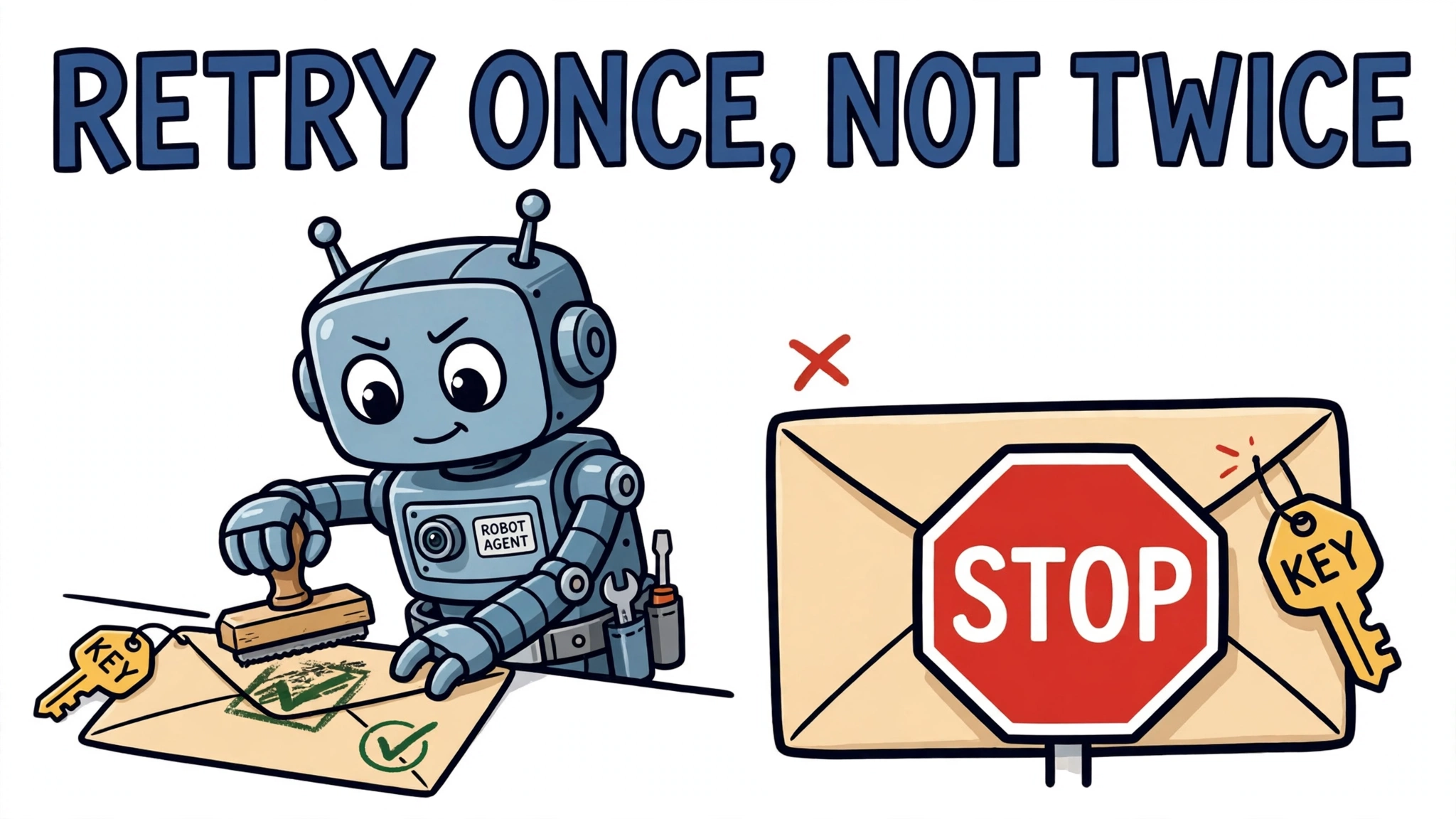
High volume multiplies failure modes, so reliability has to scale with traffic. Retries are the first tool, but they must be bounded: retry with exponential backoff and jitter, with a hard cap on attempts, and never retry a 429 before its retry-after interval. Unbounded retries turn a downstream blip into a self-inflicted denial of service.
The subtler problem is retries of side-effecting tool calls. A timeout means no response arrived — it does not mean the work did not happen. If a payment, booking, or message send succeeded on the server but the response was lost, a blind retry performs the action twice. The fix is idempotency keys: a unique token generated once per logical action and sent with every retry of that action, so the server replays the stored result instead of repeating the work. For agents, the natural anchor is the tool-call ID the model itself produced, because it is stable across retries of the same action and different across distinct actions.
The fragment below derives such a key:
import hashlib

def idempotency_key(session_id, tool_call_id, action):
    # Stable across retries of the same tool call; distinct per action.
    raw = f"{session_id}:{tool_call_id}:{action}"
    return hashlib.sha256(raw.encode()).hexdigest()
Guardrails complete the picture. Validate agent outputs before they reach users or external systems, enforce budgets on steps and tokens per task, and use circuit breakers to stop calling a tool that is failing repeatedly. Then define degradation paths in advance: a graceful partial answer, a queued follow-up, or a human handoff beats a crashed run or a confidently wrong action performed at scale.
Scaling state: memory, context, and retrieval under load
State is the half of scaling that stateless-worker advice leaves out. Split memory deliberately: short-term memory holds the current session’s conversation and working notes, while long-term memory holds facts that persist across sessions, such as user preferences or learned procedures.
Context-window management is the operational side of the same question. As sessions grow, summarise completed phases and compact the working context instead of carrying the full transcript forever. Retrieval, meanwhile, must stay fast and fresh when many agents query the same stores at once: cache hot results and bound result sizes before they reach the prompt.
When one agent’s job grows too broad, split it. A single agent that plans, retrieves, writes, and verifies can run into context and reliability limits that adding workers alone may not fix. Splitting into specialised sub-agents with narrow tools and short contexts is one option when measured context or reliability problems warrant it; whether it is cheaper per task, easier to route, or simpler to debug should be validated against end-to-end cost, latency, and task success.
Load-test, roll out, and watch it in production
None of the above is verified until it is tested under realistic load. Load-test with multi-turn, tool-using traffic, not single prompts: a fleet that handles ten thousand isolated questions may collapse on one thousand agents that each make twenty tool calls and hold state for ten minutes. Include provider rate-limit behaviour in the test — what happens at the 429 boundary is a production question, not an edge case.
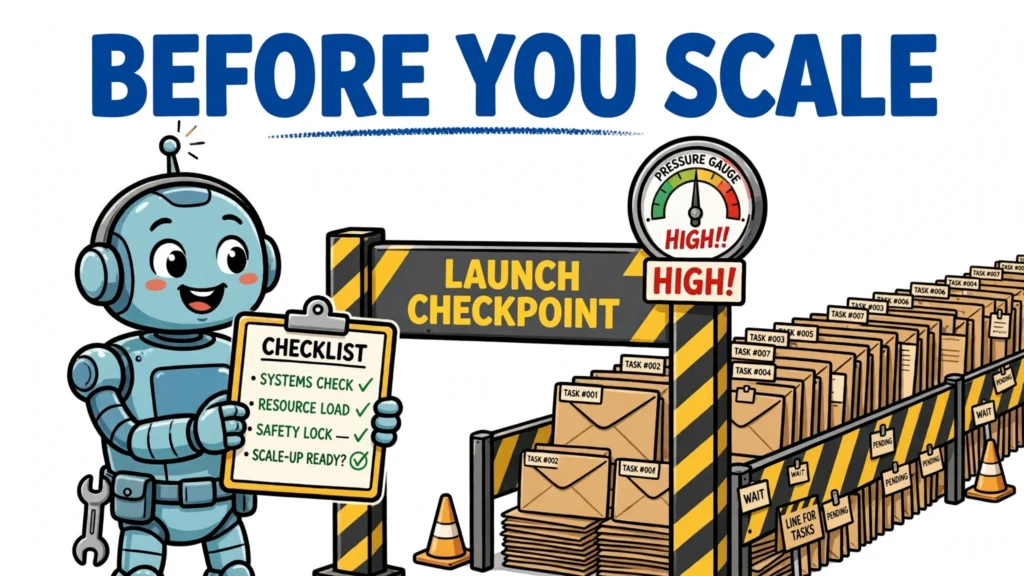
Roll out in stages. Shadow traffic first, then a percentage ramp with explicit rollback criteria: if task success rate, 95th-percentile latency, or cost per completed task breaches its threshold, roll back before the next ramp. Capacity planning belongs in the same exercise: provider quotas, token budgets, and downstream API limits are hard ceilings, and the plan should name them rather than discover them at peak.
In production, watch the metrics that actually describe an agent fleet: task success rate, 95th-percentile end-to-end latency, cost per completed task, retry rate, guardrail trigger rate, and cache hit rate. A rising retry rate is one possible sign of a downstream problem to investigate against task traces; a rising cost per task is one possible sign of context growth or a routing regression, again to be checked against workload measurements.
Common mistakes and hard limits
The most common scaling mistake is autoscaling the agent while a shared dependency stays fixed: a database connection pool, a provider quota, or a downstream API limit that no number of new workers can raise. Scale the bottleneck, not the fleet around it. The second is unbounded retries and context growth — silent leaks that look like success until the bill or the latency curve arrives.
And some limits do not yield to architecture at all. Tasks that are inherently serial cannot be parallelised; a provider outage cannot be routed around if there is no second provider; tasks that need human judgement cannot be scaled by adding workers. The honest version of scale is knowing which ceiling you are hitting, because the fix for a quota ceiling, a cost ceiling, and a judgement ceiling are three different projects. The data suggests most teams do not get there: one industry account cited in the research puts 88% of AI proofs-of-concept as never reaching wide-scale deployment. What the cited research documents is the set of scaling failure modes covered in this guide — quotas, cost, state, and reliability — not a general verdict on why deployments stall.