
The ballot that would not stay in line
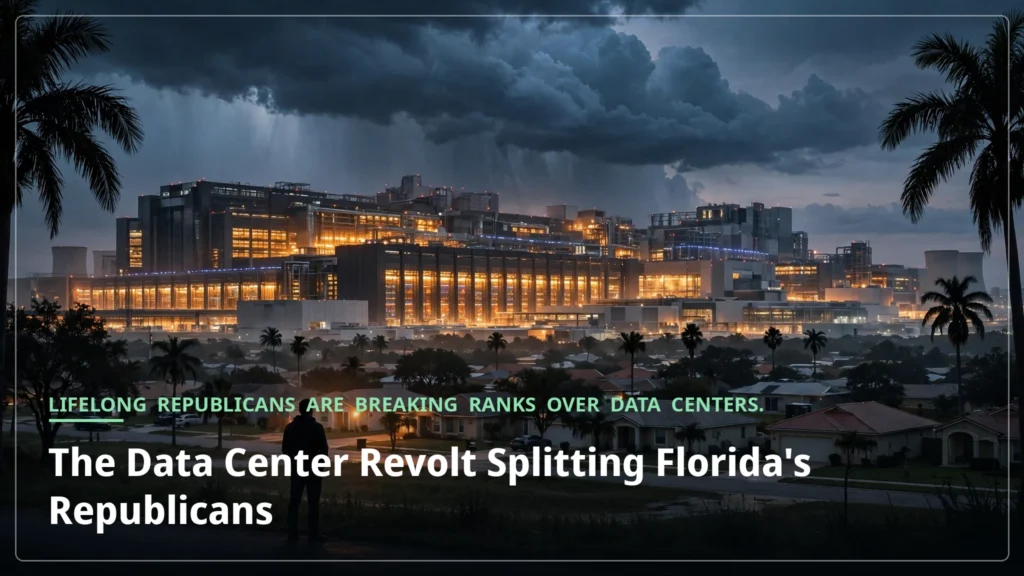
The Florida data center backlash has a face: Patti Zirhut describes herself as a lifelong Republican. She voted for Donald Trump in 2016, in 2020, and again in 2024. On one race, however, she says her mind is made up. She will not vote for Byron Donalds, the Republican nominee for governor of Florida.
Zirhut is an organizer with a group called No Data Center Hernando County, and the reason for her break with her party’s nominee is summed up in the group’s name. Donalds has been a vocal supporter of data center development in Florida, and his campaign has drawn heavily on tech-industry money. For Zirhut, that combination is disqualifying. She first told a reporter at a small protest in Spring Hill in August that she would not vote for Donalds if he won the primary. Now that he is the nominee, she is sticking to her word.
Her story matters because of the race it sits inside. Florida’s governor contest, between Donalds and the Democratic nominee, David Jolly, is close on the available polling: a University of North Florida survey put Jolly just two points behind Donalds, within the poll’s 2.8 percent margin of error. In a race that tight, a voter like Zirhut is not a curiosity. She is a variable.
An issue you can point at: the Florida data center backlash
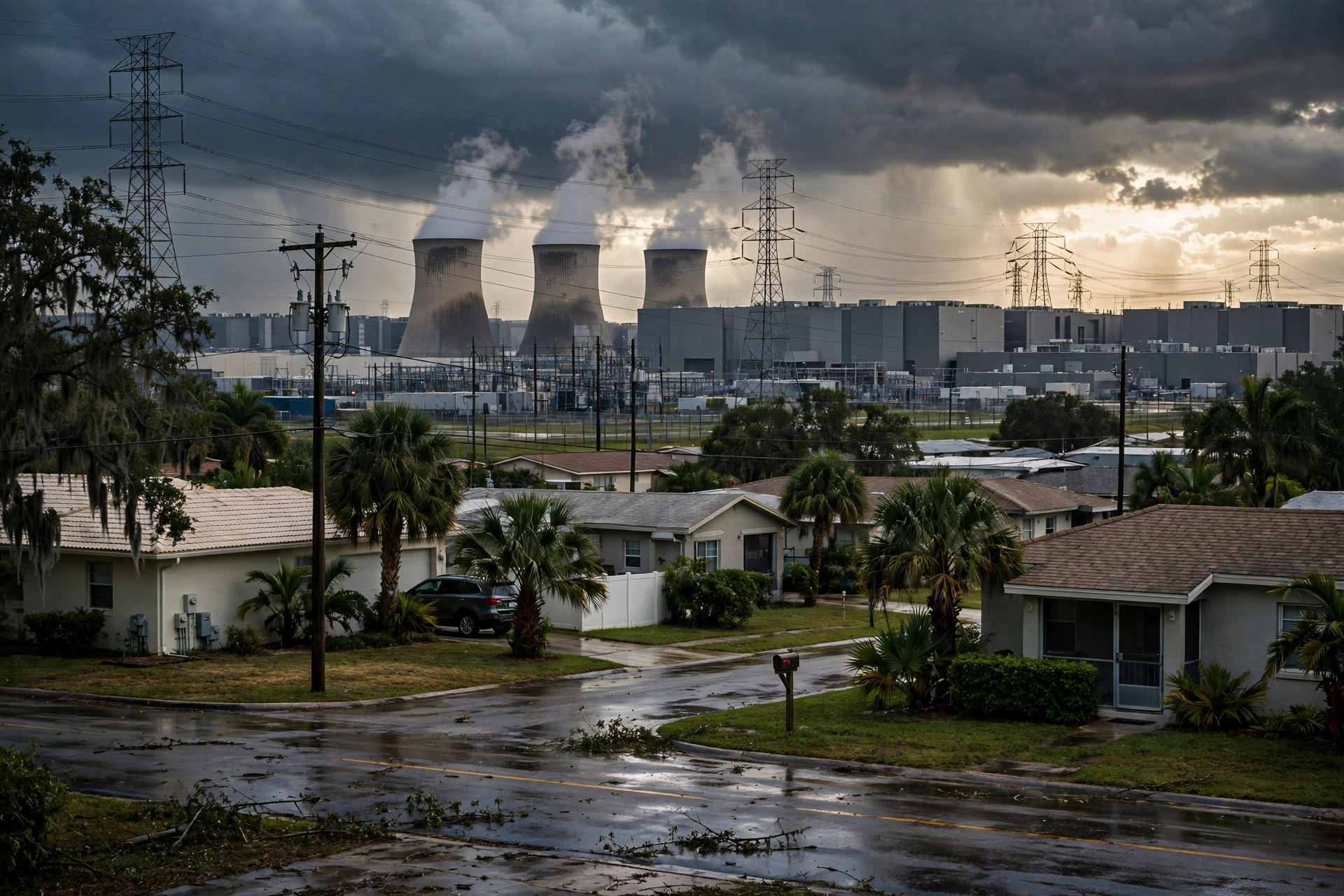
One interpretation of why this issue resonates is that data centers are physical. Voters cannot cast a ballot on artificial intelligence in the abstract, or on the future of work, or on surveillance. But they can cast a ballot on a building going up near their homes, with its noise, its water use, and its power plants. Whether that concreteness is what moves voters is an open question; what is documented is that particular voters say it moves them.
The opposition is broad in polling, and the polling behind it is striking. A July University of North Florida poll found that 68 percent of Floridians surveyed opposed data centers being built in their areas. Other state polls have put opposition anywhere from 49 percent to 79 percent. Jolly has promised a one-year moratorium on new data center developments if elected, and he has gone looking for evidence firsthand, travelling to Virginia’s Loudoun County to see what large hyperscale facilities do to a community.
Jolly himself is an unusual messenger for this revolt. He is a former Republican who left the party in 2018, and he is now hoping to win over newly disgruntled conservatives like Zirhut. He argues that opposition to data centers in Florida runs more intense among Republicans than among Democrats, because it reflects concern about the influence of Big Tech and Big Data in a world where people worry about surveillance, and about development encroaching on their land and their freedom. The cross-party element that is actually documented is narrower: individual Republican voters considering the Democratic candidate, and a Republican primary candidate endorsing him. At the local level, Hernando County’s commission voted 4-0 in June for a one-year moratorium on large-scale data centers, acting on residents’ objections.
The other side of the ledger
Donalds has not ignored the issue. He has moderated his stance as the campaign has gone on, trying to appeal to the majority of Floridians who say they oppose the developments in their communities. His defence has two parts. First, he points to his running mate, state Senator Bryan Ávila, who sponsored a bill regulating new data center projects that requires them to pay their fair share for water and electricity. Second, he argues that the governor’s office is the wrong place to fight this fight at all: local governments issue building permits, not governors, so a community that does not want a data center will not get one.
That argument has a real core, and it deserves to be stated fairly. Permits are indeed local. But it also sidesteps one of Zirhut’s documented objections: the money. Donalds has raised $148 million to Jolly’s $22 million, much of it from the tech industry, and he has received $5 million from Leading the Future, a pro-AI super PAC whose funders include executives of OpenAI, Palantir, and Andreessen Horowitz.
Nor is Zirhut the only Republican voter making this calculation. Raul Alfonso, chair of Watchdogs of Fort Meade, a community group fighting a $2.6 billion hyperscale data center development in deep-red Polk County, also voted for Trump in all three elections. He says many voters who have always voted the party line are now considering switching to a candidate who takes citizens’ concerns more seriously.
Then there is Bobby Williams, a Republican primary candidate who won 4.1 percent of the vote and has since endorsed Jolly. Williams says the party selected its nominee from the start, and that corporations are buying seats, including the governor’s role. His endorsement is his own decision; whether his voters follow him is an unanswered question.
Why it still might not be enough

For all of that, the honest version of this story includes the reasons Donalds may still win. Florida now has nearly 2 million more registered Republicans than Democrats. Republicans currently lead in early voting. And the fundraising gap is enormous. A race can be close in the polls and still break toward the candidate with the party machine, the money, and the registration advantage behind him.
There is also the question of what voters actually care about most. Poll after poll has shown that the cost of living is top of mind for voters of all political orientations in Florida and elsewhere, ahead of data centers. Jolly’s answer is that the mass opposition to data centers is a manifestation of those broader concerns: anxieties about the future of work, about wages, and about security and privacy for themselves and their children. That may be true. It is also, at this stage, an argument rather than a proven fact, and voters will settle it at the ballot box.
What is already documented is narrower. One documented voter, Zirhut, says she is considering voting for the Democratic candidate over this issue; Alfonso reports that other party-line voters are considering a switch; and a Republican primary candidate, Williams, has endorsed Jolly. Whether that becomes a movement, and whether it changes the outcome, is the question Florida will answer on November 3.