On Sunday, Jensen Huang sent a company-wide memo that apologized in plain language for an affair he admitted. The memo Nvidia’s chief executive sent to employees on 8 November said he had been unfaithful to his wife. It was direct, it named the harm, and it asked for no excuse.
It was also, in a sense, only half the document. One sentence announced the board’s investigation and handed the other half of the story to someone else: “Regarding the national security concerns raised in news reports, NVIDIA’s Board of Directors has initiated an independent investigation.” The memo’s other words on the security question were assurances of cooperation and commitment — but they contained neither a denial of the allegation nor an account of the relationship itself.
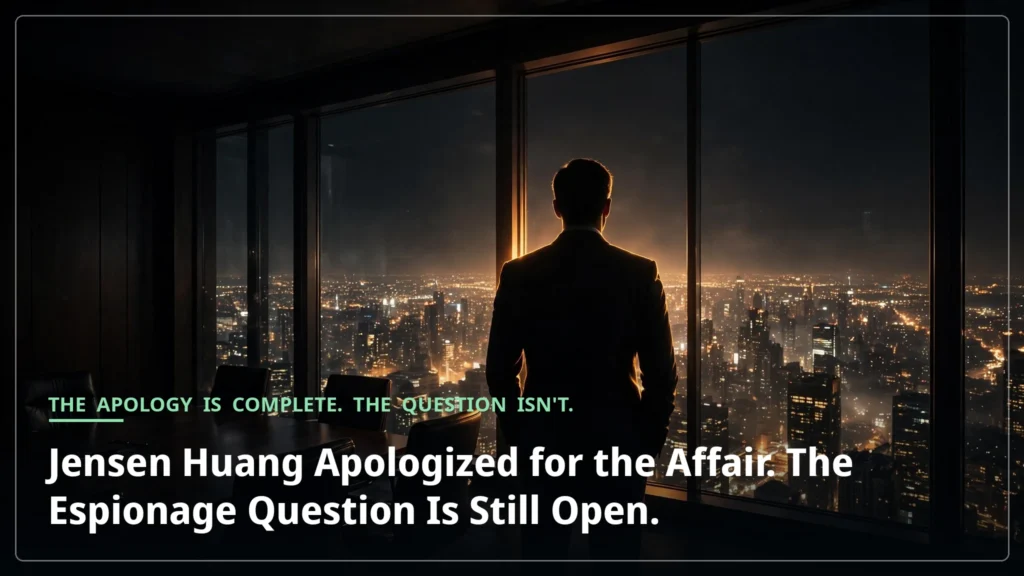
That split is the story. The apology is complete. The allegation it sits next to is not.
The memo: an apology in plain language

Huang’s memo, published in full by The Verge, is short on the personal question and shorter still on the security one. On the affair, he wrote: “I was unfaithful to my wife. My actions hurt her and our children. There is no excuse for what I did. I am deeply sorry.”
He also apologized to his family, colleagues, the board, partners and shareholders, and said he is fully committed to Nvidia. And on the question of whether he was targeted by a foreign intelligence service, the memo announced the board’s investigation and offered assurances of cooperation — but no denial of the allegation, no account of the relationship itself.
He added: “I support the investigation and will cooperate fully. I love our country and our company, and I am committed to protecting NVIDIA and supporting America’s national security.”
The board: reassurance and the investigation into Jensen Huang
The board’s statement, issued the same day, announced an independent investigation overseen by a committee of independent directors assisted by outside counsel. It said the board has “no reason to believe” national security or Nvidia secrets were compromised, that it retains confidence in Huang and his leadership team, and that Huang has committed to cooperating. It said it would provide further updates “as appropriate” and gave no timeline.
That division of labor is, on its face, how governance is supposed to work: the chief executive apologizes for the personal failing; the board, not the CEO, investigates the security question. A preliminary statement of confidence need not prejudge an inquiry that is still open — and separating a personal apology from an independent board inquiry can be entirely appropriate.
Read together, the two statements do something unusual: the board offers reassurance about the outcome — no reason to believe secrets were compromised — at the same moment it opens an investigation meant to establish the facts. The reassurance is preliminary. The investigation has no findings yet, no stated scope beyond examining “all available information,” and no date for an update.
The allegation: reported, unconfirmed, uncharged
The allegation itself remains where the reporting left it. The New York Times and the Financial Times reported that US intelligence officials concluded Alice Huang was recruited by China’s Ministry of State Security; the Wall Street Journal reported she was sharing information with the Chinese government while working with Nvidia to build data centers in Asia. NBC News said it had not independently confirmed either outlet’s reporting. Alice Huang has not been charged, and no intelligence memo has been made public.
Alice Huang, also known as Huang Le, is a Chinese citizen and a senior executive at Megaspeed, a Singapore-based data-center company and Nvidia customer. She and Jensen Huang are not related.
The commercial tie is large and, on the reporting, under scrutiny. Coinotag reported that Megaspeed purchased more than $4.8 billion in Nvidia chips over the past two years and is under US regulatory scrutiny on suspicion of diverting advanced AI processors to China. The US Commerce Department began looking into Megaspeed in late 2024, according to Digital Trends, suspecting the company helped China circumvent export controls on Nvidia chips. The purchase figure and the suspicion are reported, not established.
The earliest reported sightings of the two together date to June 2024, photographed at a bar in Taipei around Computex, with another outing in the same city in 2025.
The oversight: Congress and the Rubio memo
The story has already moved from press reporting into formal oversight. Three House Republican committee chairs have asked Huang to appear for a closed-door briefing on his relationship with Alice Huang, and Senator Chris Coons has said Congress will investigate the situation.
The New York Times also reported that Secretary of State Marco Rubio drafted a memo last spring warning top Trump administration officials about Huang’s close relationship with Alice Huang. What the memo said, and what the administration did with it, is not public.
Nvidia had previously described the contacts in question as “not unusual,” and reporting says the company’s account of the relationship was revised once — a detail that matters less for what it proves than for what it leaves unexplained.
The question the two statements leave open
None of this makes the espionage allegation true. It also does not make it false. What the two Sunday statements do is frame the question with unusual clarity: a chief executive can apologize for the failing he admits, in language nobody has to parse, while the question that matters — whether the head of the company at the center of the AI boom was targeted by a foreign intelligence service — stays open, pending findings that do not yet exist.
The test of the investigation is not whether it clears Huang or condemns him. It is whether an inquiry announced alongside a preliminary assurance can still judge the allegation on its own terms — whether “no reason to believe” is a finding the evidence supports, or a sentence the board wrote before the evidence was in.
Until the board says more, the honest summary of the Nvidia story is the split itself: an apology that is complete, and a question that is not.