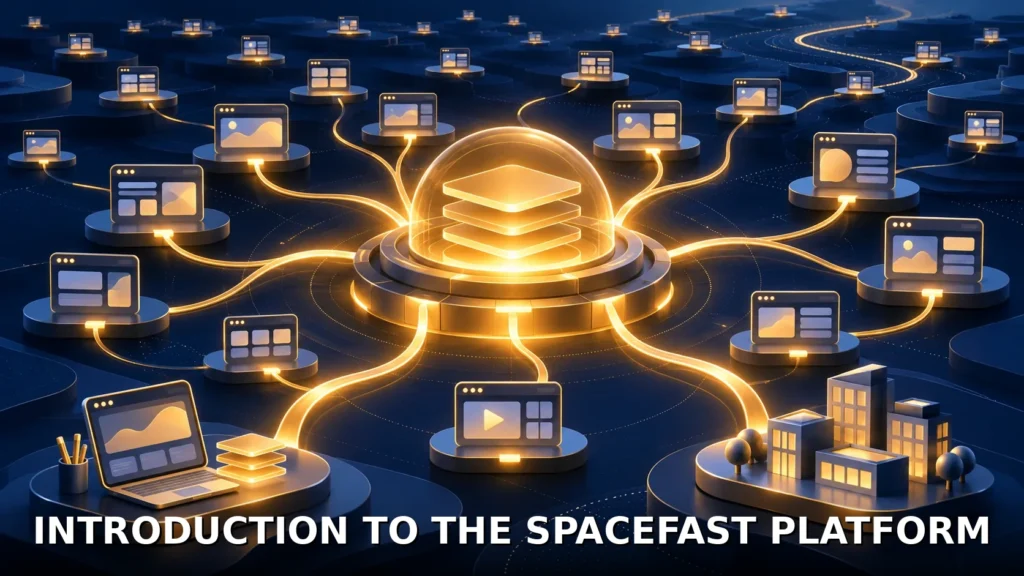



Introduction to the Spacefast platform
Automattic has launched the Spacefast platform for deploying websites and applications built through vibe coding. Its central proposition is to supply the infrastructure that turns generated projects into functional services, while letting users choose the AI tools they work with. For Automattic, the owner of WordPress.com, the launch extends its web publishing business toward projects that may begin in a chatbot rather than a content management system.
According to TechCrunch’s launch report, Spacefast provides databases, authentication, file uploads, email, and analytics. Users can connect it to a range of agents and chatbots or start by connecting a Git repository. Those entry points define the product’s positioning: Spacefast supplies a deployment destination and supporting services around work that can originate in other tools.
The platform was soft-launched in September before its November 9, 2026 launch. Automattic has seen people and organizations use it for internal mockups, slideshows, and offer-related websites. These reported uses illustrate a scope that includes temporary or narrowly focused projects as well as applications. The report does not establish how widely Spacefast is used or how many experimental projects become ongoing services.
The immediate question is whether freedom to choose an agent, combined with Automattic’s infrastructure, makes deployment sufficiently easier to attract and retain users. The launch establishes the approach and its intended audience. It does not establish a performance advantage, lower costs, or durable adoption. Assessing Spacefast requires separating its documented capabilities from the competitive benefits its team hopes those capabilities will deliver.
Features and Infrastructure

Spacefast’s infrastructure offering covers several practical requirements of a functional application. Databases provide a place for application data; authentication concerns user access; file uploads support user-supplied files; email and analytics address communication and measurement. These are the service categories identified in the launch report, rather than a detailed technical specification of how each capability works.
The significance is the connection between producing an application and operating it. Generating a project does not, by itself, explain where its data will live or how users will access it. By bringing those functions into its offering, Spacefast aims to simplify the work surrounding deployment. That is the practical meaning of its infrastructure pitch, although the report supplies no measured comparison of setup effort.
Connecting a Git repository provides another starting point alongside the named AI tools. This broadens the described workflow beyond a single conversational interface. However, repository connectivity alone does not establish which frameworks, runtimes, build processes, or repository providers are supported. Nor does the report describe how updates reach a deployed application. Developers should treat those as implementation questions rather than infer a particular deployment model.
Automattic’s existing infrastructure is also part of the product’s origin story. Spacefast head Batuhan İçöz pointed to the company’s content delivery network when explaining why he began building the service. His argument was that infrastructure already available inside Automattic could serve projects outside the company’s traditional association with WordPress. That explains the rationale for reusing those resources; it does not independently demonstrate equivalence with another provider’s network.
The report leaves important operating details unspecified, including pricing, usage limits, service commitments, and data portability. It also does not provide the security design behind authentication or the behavior of the database service. They limit what can be concluded from the launch announcement, especially for projects whose deployment decisions depend on requirements beyond getting an initial version online.
Integration with AI Agents

Spacefast’s stated compatibility spans ChatGPT, Claude, Hermes, OpenClaw, Grokbot, Muse, Pi, Cursor, Opencode, and Amp. TechCrunch reports that users can connect those agents and chatbots to the platform. The breadth of that list is central to Spacefast’s positioning: the company wants users to bring a preferred tool rather than make their tool choice a consequence of choosing a deployment service.
İçöz presents that choice as an advantage over a product such as Lovable. The underlying proposition is straightforward: a person who already works with a particular agent could use Spacefast as the infrastructure around that workflow. This is a potential benefit of the model, not evidence that every listed integration has identical capabilities or that moving among agents is seamless.
The launch report does not specify the integration mechanism. It supplies no API syntax, configuration examples, permission model, or description of what each agent can do after connection. Accordingly, the compatibility list should not be read as proof that agents can independently provision every service, manage all application settings, or carry out unrestricted deployment operations. The documented claim is connectivity, with the operational details left open.
Choice also creates a product trade-off. As TechCrunch observes, some users may prefer a service that decides more of the workflow for them. Spacefast’s flexibility could appeal to people who have already chosen an agent, while a more integrated experience could suit people seeking fewer decisions. Neither preference establishes a universal advantage. The usefulness of agent choice depends on how much control a user wants and how clearly the connections work in practice.
For someone evaluating Spacefast, the relevant distinction is therefore between a named integration and a demonstrated workflow. The report supports the former. It does not compare the experience across the listed tools. A meaningful evaluation would need to establish what a preferred agent can actually accomplish through the connection, where manual work remains, and whether the resulting deployment process fits the project.
Motivation Behind Development
Spacefast began during an Automattic hackathon sprint earlier in the year. İçöz was working on Beeper, the company’s cross-platform messaging application, and said nontechnical friends exploring vibe coding frequently sent him Vercel links. That experience prompted him to look for an easier way for people to set up and deploy their projects using infrastructure Automattic already had.
The project was initially called Stattic before becoming Spacefast. İçöz shared it with friends and added features to make it more dynamic. Automattic then used the September soft launch to gather feedback ahead of the public launch. The reported sequence describes a product shaped by early use, though it provides no quantitative evidence of how that feedback changed completion rates, deployment time, or reliability.
The origin matters because it frames Spacefast around the work following code generation. The problem İçöz identified was not simply how to generate another interface. It was how people could set up and publish what they had made. Databases, authentication, uploads, email, and analytics follow logically from that goal: the platform’s offering addresses supporting functions alongside the act of deployment.
There is a broader strategic implication for Automattic. İçöz acknowledged that people now build websites with ChatGPT or Claude and argued that some sites will not need a content management system as the web expands. Spacefast can be understood as a response to that shift: an attempt to serve projects whose starting point and requirements differ from a conventional WordPress workflow. That interpretation follows the product’s positioning rather than establishing a forecast for WordPress usage.
Enterprise consolidation supplies another motivation. İçöz described marketing teams producing landing pages across services such as Lovable, creating a proliferation of tools that organizations may want to consolidate. He pointed to Automattic’s experience serving enterprise customers as an asset. This is the company’s account of the opportunity. The report does not identify enterprise Spacefast deployments or document the administration, procurement, and governance capabilities needed to substantiate the consolidation pitch.
Competitive Advantages
Spacefast’s competitive case rests on two main ideas: freedom to choose an agent and access to Automattic’s existing products and infrastructure. TechCrunch places it alongside Lovable and Emergent, which offer interfaces and supporting infrastructure for vibe-coded applications. Spacefast’s proposed distinction is a more open workflow built around connecting outside tools. The report does not provide a feature-by-feature comparison that would establish which platform best serves a particular project.
Automattic’s product portfolio could provide another route to differentiation. Spacefast says its position within the company makes it easier to introduce web analytics, WordPress integration, and e-commerce features through WooCommerce. Those connections could make the platform relevant to work spanning generated applications, publishing, and commerce. The critical qualification is that the report presents organizational access as an advantage; it does not establish the availability or depth of every integration mentioned.
The competitive field also extends beyond application builders. TechCrunch identifies Figma, Canva, and Notion as offering products where vibe coding, mockups, and presentations overlap. That context matters for Spacefast’s reported slideshow and internal mockup use cases. The platform may be evaluated against tools chosen for the finished artifact or collaborative workflow, not solely against services marketed around application deployment.
Retention is a more immediate test than the breadth of the competitive field. İçöz acknowledged that users may try Spacefast and leave, including people who discover they are not interested in making applications. His stated objective is to make building with the platform easier and the results better than working without it. That is an ambition, not a reported outcome: the launch evidence contains no retention figures or independent assessment of application quality.
The strongest supported case for Spacefast is therefore its combination of deployment services, multiple agent connections, a Git entry point, and an infrastructure base inside Automattic. For users, the unresolved issue is whether that combination delivers a simpler workflow for their actual projects. For Automattic, it is whether projects begun as experiments become services people continue to maintain. The launch explains how Spacefast intends to compete; sustained use and documented operating results will determine how persuasive that proposition becomes.