

Agent knowledge bases are the external memory an AI agent reads from while it works. A language model on its own can only answer from what it learned during training; a knowledge base gives it the organisation’s own facts — its documents, policies, product data and procedures — retrievable at the moment they are needed. This article explains what a knowledge base is inside an agent system, how retrieval works, what it adds, and where the pattern breaks down.
What a knowledge base is in an agent system
A knowledge base is a curated, queryable store of information that an agent can consult at run time. It holds the material an organisation already has: support documents, product data, internal policies, runbooks, wikis and structured records. The defining property is not the format but the relationship: the base belongs to the organisation, it can be updated independently of the model, and the agent can search it on demand.
Under the hood, a knowledge base usually takes one of a few forms. A document collection is the simplest: files an agent can search by keyword or meaning. A vector store goes further, turning each passage into an embedding — a list of numbers capturing its meaning — so the agent can find passages that are semantically close to its question even when they share no keywords. Structured databases and knowledge graphs suit facts with fixed relationships, such as which product version a feature belongs to.
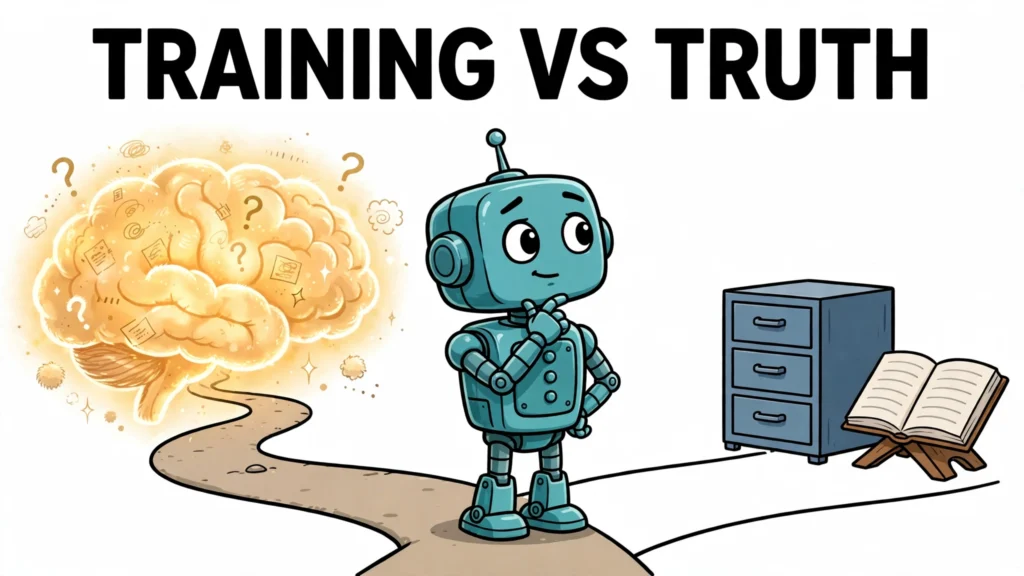
What matters is what a knowledge base is not. It is not the model’s training data: training data is fixed when training ends, while a knowledge base can be edited without retraining — though the change only reaches the agent once the updated content has been ingested and indexed, and only if the retrieval surfaces it. It is not the agent’s working memory either: working memory is the conversation and scratchpad of the current task, short-lived and task-specific, while a knowledge base persists across sessions and is available to the agents whose roles permit access to it.
How agents retrieve from a knowledge base
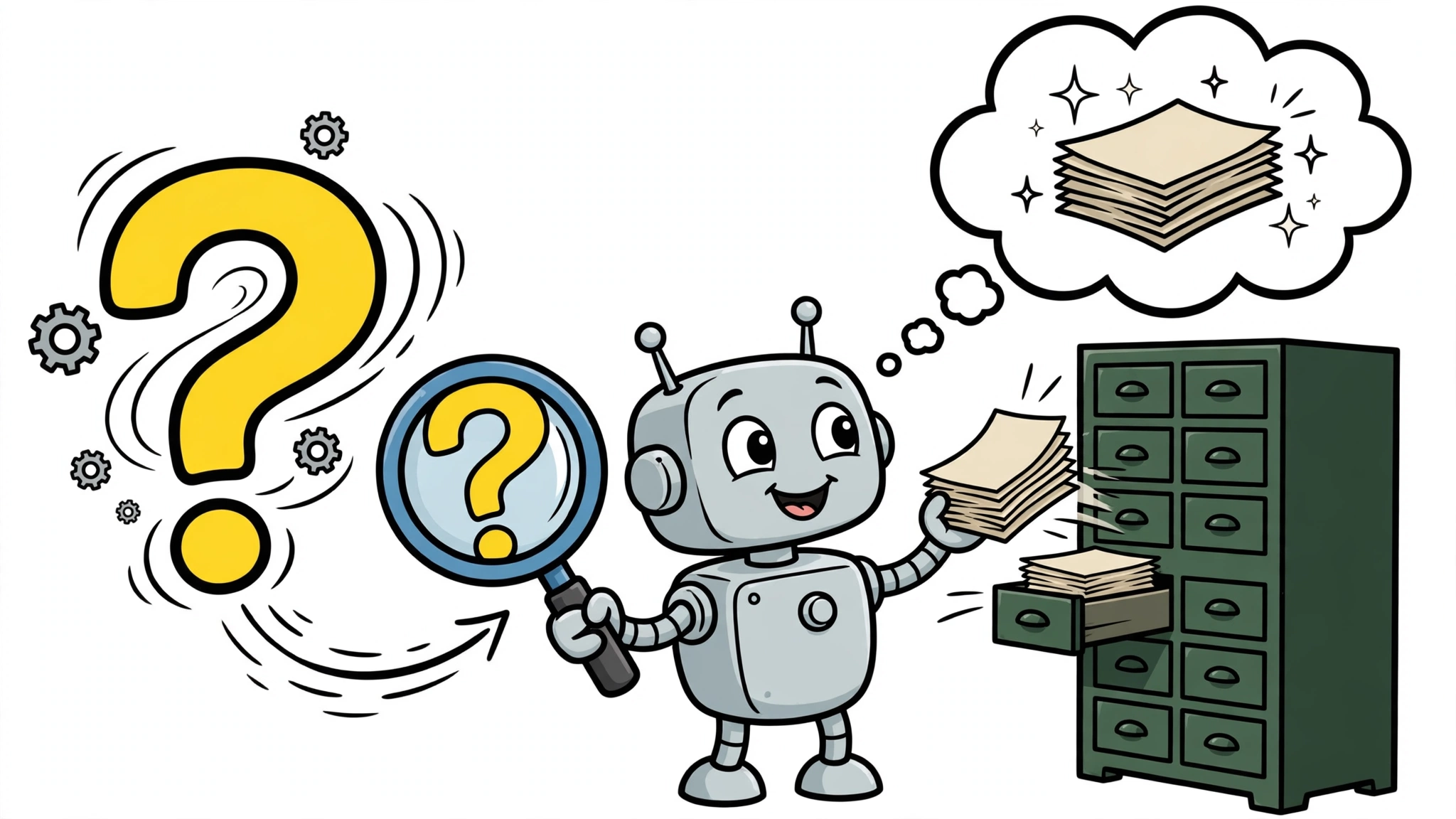
Retrieval is the mechanism that connects the agent to the base, and it follows a pattern called retrieval-augmented generation, or RAG. Introduced by Lewis and colleagues in 2020, it combines a model’s parametric memory — what is baked into its weights — with non-parametric memory, an external index it can search. In an agent system, that search becomes a tool call the agent makes for itself.
The loop runs like this. First, the agent recognises that its current step needs a fact it does not have — a support agent handling a refund request needs the current refund policy. Second, it turns that need into a query and searches the base, usually by embedding the query with the same embedding model that embedded the stored passages and returning the closest matches. Third, the retrieved passages go into the model’s context, alongside the question. Fourth, the model generates its answer or next action from that supplied evidence rather than from memory alone.
Anthropic’s framing helps here: an agent is an augmented language model, built from three capabilities — retrieval, tools and memory — and retrieval is the slot that pulls relevant context into the prompt at query time. Anthropic also describes a shift in how retrieval is used: instead of pre-processing all relevant data up front, agents increasingly keep lightweight identifiers, such as file paths or stored queries, and load the data dynamically at run time.
OpenAI’s file search is a hosted tool in the Responses API: you upload files to a vector store once, and the model decides at run time when to search it. The sketch below is conceptual pseudocode illustrating the shape of that flow, not a verbatim SDK contract.
from openai import OpenAI

client = OpenAI()

store = client.vector_stores.create(name="support-docs")
with open("refund-policy.pdf", "rb") as f:
    client.vector_stores.files.upload_and_poll(
        vector_store_id=store.id,
        file=f,
    )

response = client.responses.create(
    model="gpt-4o",
    input="What is the refund window for orders placed in December 2025?",
    tools=[{"type": "file_search", "vector_store_ids": [store.id]}],
)
print(response.output_text)
When the model chooses to search, it issues a file_search call against the vector store and receives ranked passages back. The transcript below is a conceptual illustration of that retrieval step — the identifiers are stand-ins and the structure is illustrative rather than the API’s actual response schema. Note that the vector store IDs are configured by the developer when the tool is offered; the model decides whether to call the tool and what to ask, but it does not invent the store to search.
{
  "tool_call": "file_search",
  "arguments": {
    "query": "refund window for orders placed in December 2025",
    "vector_store_ids": ["vs_abc123"]
  },
  "result": {
    "results": [
      {
        "file_id": "file_xyz",
        "filename": "refund-policy-v3.pdf",
        "text": "The refund window was extended from 30 to 60 days starting Q1 2026."
      }
    ]
  }
}
What knowledge bases let agents do that they cannot do alone
The first thing a knowledge base adds is grounding. A model’s general training does not give it dependable access to your private policies, your current product catalogue, or your latest procedures; retrieval supplies the relevant evidence at request time, and the model answers from text you supplied rather than from memory. That is the whole point of the RAG pattern: instead of hoping the model memorised the right fact, you give it a search step.
The second is currency. Facts change after training ends — prices, policies, product versions — and a knowledge base can be updated without retraining the model. The original RAG paper demonstrated this directly: the researchers built a second index from an older Wikipedia dump and asked about world leaders who had changed between the two dumps. With the matching index the model got roughly 70% right; with the mismatched one, only 4–12%.
The third is access to proprietary knowledge the model never saw. Internal runbooks, customer records, domain procedures and pricing rules are not in any public training set, and they are often exactly what an agent needs to do useful work.
The fourth is consistency: a shared source of truth supports more consistent answers across agents and sessions, subject to retrieval quality and generation errors.
The evidence for the pattern is strong on the tasks it was measured on. In the original paper, the RAG model reached 44.5 exact match on Natural Questions, ahead of the parametric-only T5-11B at 34.5, and set the state of the art on three open-domain question-answering tasks. For generation tasks, the authors found their models produced more specific, diverse and factual language than a parametric-only baseline.
Knowledge base vs model memory vs live tools
Three sources of knowledge are easy to confuse. They differ in what changes, how fast, and who owns the update.
| Source | What it holds | When it changes | Who updates it |
|---|---|---|---|
| Model memory (training weights) | General knowledge baked in during training | Only when the model is retrained or fine-tuned | The model provider, or a fine-tuning run |
| Working memory (context, conversation state) | The current task: what has been said and done in this session | Every turn | The agent itself, as it works |
| Knowledge base | Reference knowledge: documents, policies, product data | Whenever the organisation edits it | The organisation, through its normal content processes |
| Live tools | Current state in systems of record: an order status, a balance, a booking | Continuously, as the system changes | The system of record itself |
The decision rule follows from the table. If a fact is stable, owned by the organisation and reused across many tasks, it belongs in the knowledge base. If it changes by the minute or lives in a system of record — an order status, an account balance — it belongs behind a live tool call, fetched fresh each time. If the fact is general knowledge that does not change, the model’s training may suffice for low-risk questions — public or stable material can still warrant retrieval when coverage, grounding or verification matter. And if the behaviour, rather than the facts, is what needs changing, that is a matter of prompts or fine-tuning. One qualification matters: weights are fixed during ordinary inference, but organisation-specific fine-tuning can update them — changing weights requires a separate training process, whereas external knowledge can be updated independently.
Building agent knowledge bases your agents can actually use
Content hygiene comes first. The base should hold authoritative sources, with duplicates removed and ownership clear: one canonical page per policy, per product, per procedure. Every stale page left in the base is a wrong answer waiting to be retrieved.
Chunking is where most retrieval pipelines succeed or fail. Documents must be cut into passages the retriever can match precisely: too large, and the model wastes context on irrelevant text; too small, and the passage loses the meaning that makes it match. A practical baseline is chunks that each cover roughly one idea, with overlap at the boundaries. The embedding step then turns each chunk into a vector, stored alongside its original text and metadata in a vector store — and the query must be embedded with the same model that embedded the chunks, or the vectors are not comparable.
Metadata is what makes retrieval trustworthy. Each chunk should carry its title, its source, and its date, so the agent can cite where a fact came from and judge how old it is. Similarity alone does not reliably identify the authoritative or applicable version: two policies may differ in wording or dates in their text, and dates, source tags and explicit version-selection rules help the agent choose. That also sets the freshness requirement: the base needs an update cadence and change tracking.
Access control is the last piece to design. A knowledge base is a permission boundary, not a dump: the agent should see only what its role is allowed to see. Anthropic’s guidance on tools applies here too: tools define the contract between agents and their information space, and they should return information that is token-efficient. Permission scoping is a separate requirement — the agent should see only what its role is allowed to see.
Common mistakes and limits
The most dangerous failure is also the quietest: stale or contradictory content retrieved confidently. Retrieval does not verify truth. If the base holds two versions of a policy, the retriever may return the version that matches the query best, and the agent may present it as fact without validation.
Retrieval misses are the second failure. The right fact can exist in the base while the query never surfaces it — the wording differs, the chunk boundary cut the answer in half, or the ranking preferred a plausible but irrelevant passage. When that happens the agent may proceed without the fact it needed, and the gap may go unnoticed unless the system checks whether the retrieved evidence is sufficient or handles missing results.
Hallucination persists. A knowledge base reduces invention, but it does not eliminate it: the agent can still misread a passage, over-generalise from it, or fill a gap the retrieval left. The published evidence comes from generation tasks, where RAG models produced more factual language than parametric-only baselines — the research supplied for this article did not identify a citable agent-specific quantitative evaluation, so the claimed benefit stays qualitative. Treat any precise number with suspicion.
Security and leakage are the final limit. Sensitive content in the base can surface in agent outputs if access is not scoped: a pricing exception, an internal memo, a customer’s details. The retrieval step does not know what is confidential unless the access control says so.
When a knowledge base is the right answer — and when it is not
A knowledge base is the right answer when the facts are stable, owned and reused. Support documentation, product knowledge, policies, procedures and domain reference material all fit: they change slowly, they belong to the organisation, and many different tasks need the same facts.
It is the wrong answer in two cases, and a conditional choice in a third. When the fact changes by the minute, fetch it live through a tool instead — an order status has no business sitting in a document. When the information is public and general, the model’s training may cover it for low-risk questions — but retrieval is still worth considering when coverage, grounding or verification matter. And when the problem is behaviour rather than facts — the agent’s tone, its judgement about when to escalate — that is a prompt or fine-tuning problem, not a retrieval problem.
Run through the checklist before building one: is the knowledge stable or volatile? Owned by you or public? Reused across tasks or needed once? Sensitive or open? Stable, owned, reused and open is the knowledge base’s home ground — and knowing which is the difference between an agent that answers from your facts and an agent that merely sounds as if it does.