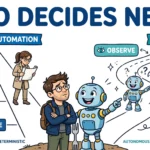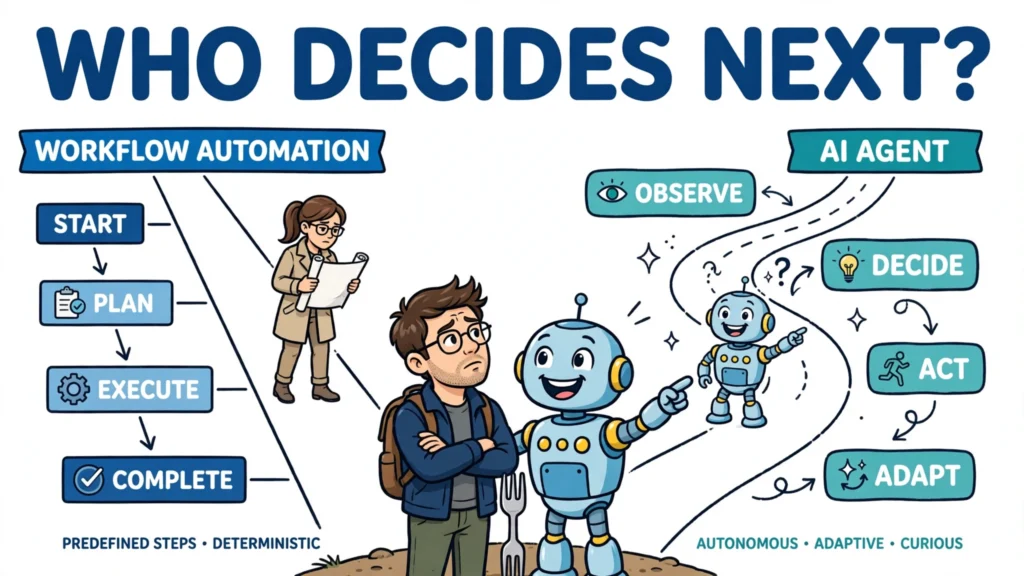
The debate over ai agents vs automation usually starts with the wrong question. People ask which one is better, as if an agent were simply a smarter workflow. It is not. The real question behind ai agents vs automation is who decides the next step: a flowchart a human wrote in advance, or a language model reasoning at run time. Once you see that, the rest of the comparison — cost, reliability, failure modes, oversight — falls into place.
This article defines both sides, traces one task through each approach, and ends with a decision checklist. Every claim comes from the research: Anthropic’s guidance, the Zapier and OpenAI Agents SDK documentation, and the NIST description of agentic AI.
What traditional workflow automation actually is
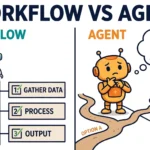
Traditional workflow automation is a fixed sequence of steps that a human defines in advance. A trigger starts the process, conditions route it, and actions carry it out. The same input always produces the same path, because the path was drawn before the workflow ever ran.
Zapier’s documentation describes the model plainly: each Zap starts with a trigger — something that happens in one app — and then one or more actions, something that happens in another app. A new form submission creates a CRM record and sends a Slack message. A new email with an invoice attached gets filed and forwarded to accounting. Filters and conditions decide whether a step runs, but the steps themselves never change.
The tools are familiar: Zapier, Microsoft Power Automate, Make, and RPA scripts, connecting more than 7,000 apps in Zapier’s case. The tasks are the repetitive, well-understood ones: moving data between systems, approvals, notifications, filing, and syncing. The defining property is determinism: you can read the flowchart, replay any run, and predict the path it will take for a given input. That is not a limitation — it is the point.
What an autonomous AI agent actually is
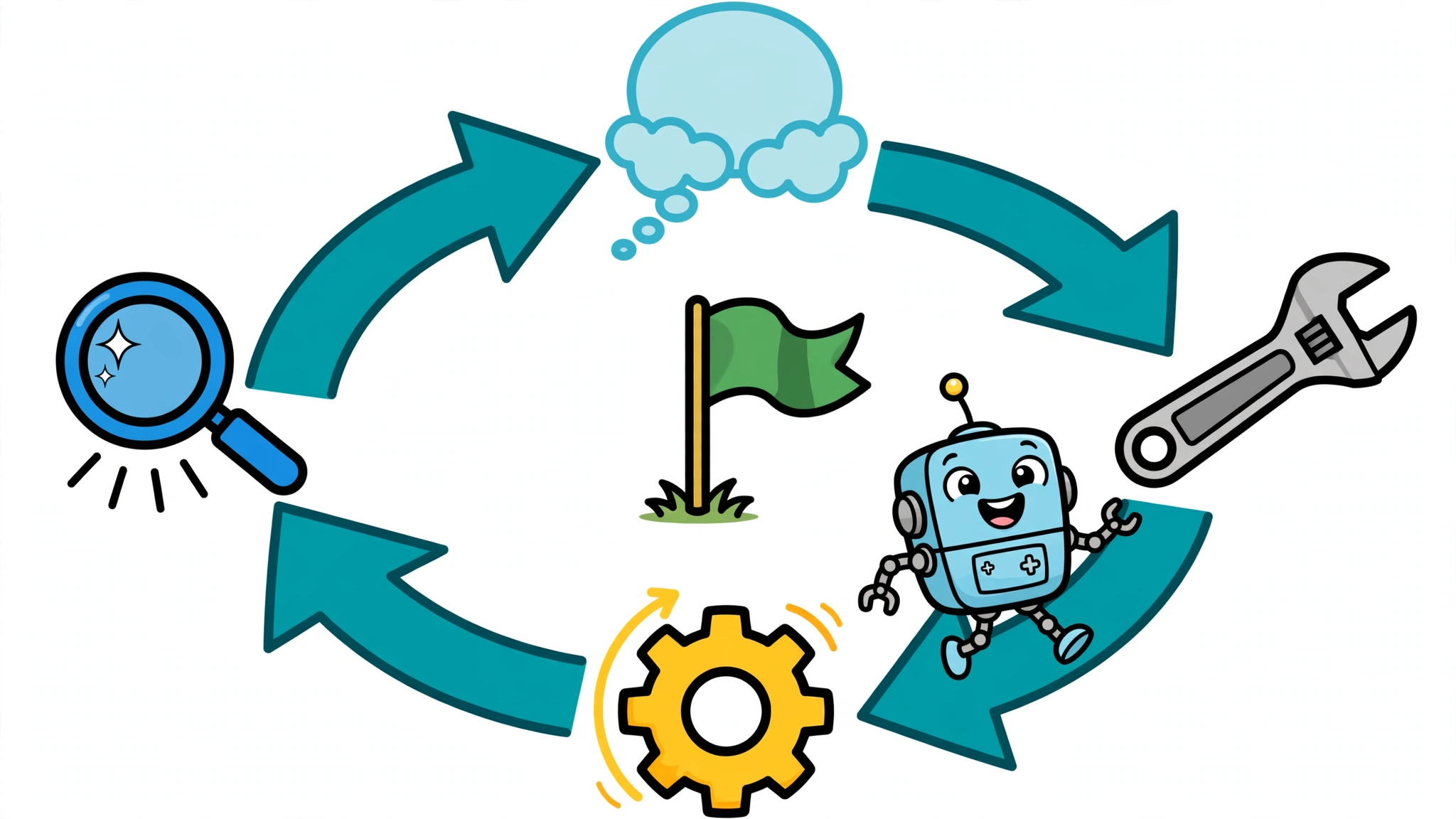
An autonomous AI agent is a system that receives a goal, plans its own steps, calls tools, and adapts as results come back. There is no predefined path. The agent decides the next step from the state of the task, not from a flowchart.
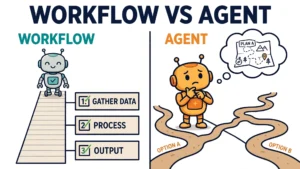
Anthropic’s engineering guidance, “Building effective agents”, draws the line cleanly: workflows are systems where LLMs and tools are orchestrated through predefined code paths, while agents are systems where LLMs dynamically direct their own processes and tool usage, maintaining control over how they accomplish tasks. The difference is one axis — who decides what happens next.
Under the hood, most agents run a loop. The model reasons about the situation, takes an action through a tool, observes the result, and repeats until the goal is met or it decides to stop. The pattern is often called ReAct, from a 2022 paper by Yao and colleagues that alternates natural-language reasoning and action. The NIST description of agentic AI adds the same idea in formal terms: systems that can act as autonomous agents, make decisions independently, learn from interactions, and adapt to changing environments.
The OpenAI Agents SDK, released in March 2025, is built on five primitives — agents, tools, handoffs, guardrails, and tracing — and its Runner manages the loop: it calls the model, executes the tools the model requests, sends the results back, and continues until a final output or a stopping condition. In conceptual form — not working code — the loop looks like this:
goal → model reasons about the situation
     → model picks a tool
     → tool runs and returns a result
     → result becomes context for the next decision
     → repeat until the goal is met or the agent stops
Notice what this loop does not contain: no predefined step deciding what to do next. The developer supplies the goal, the instructions, and the tools. The model decides which tool to call, what to do with the result, and when the task is done. Each tool result becomes part of the context the model sees when it chooses the next step, so the run accumulates context as it goes. This loop alone does not establish whether an agent learns from interactions or remembers anything beyond a single run. That absence of a predefined path is the whole difference.
AI agents vs automation: the core differences
Put side by side, the two approaches differ on five dimensions that matter in practice:
| Dimension | Workflow automation | Autonomous AI agent |
|---|---|---|
| Who decides the next step | A flowchart written in advance by a human | The model, reasoning at run time |
| Handling of new inputs | Only inputs the flow was designed for; anything else falls through or stops | Reasons about the new input, then acts or escalates |
| Determinism | Same input, same path, every time | Outputs can vary run to run |
| Auditability | Replay the flow; every step is visible in advance | Replay requires the full trace of model calls and tool results |
| Cost profile | Mostly build-time cost; per-run cost is usually small | Mostly run-time cost; repeated model and tool calls |
The cost difference is not trivial. A third-party 2026 comparison estimates a workflow run at $0.001–$0.05 and an agent run at $0.05–$1.00 or more, because each agent step consumes model calls and tool calls. Anthropic puts the same trade-off in general terms: agentic systems trade latency and cost for better task performance.
The other difference is setup speed versus change speed. A workflow can take real effort to build and changes only by editing the flow. An agent can be quick to start — describe the goal, hand it tools — and adapts to new situations without a rebuild. The question is not which is faster, but which kind of change you expect.
How each one handles the unexpected
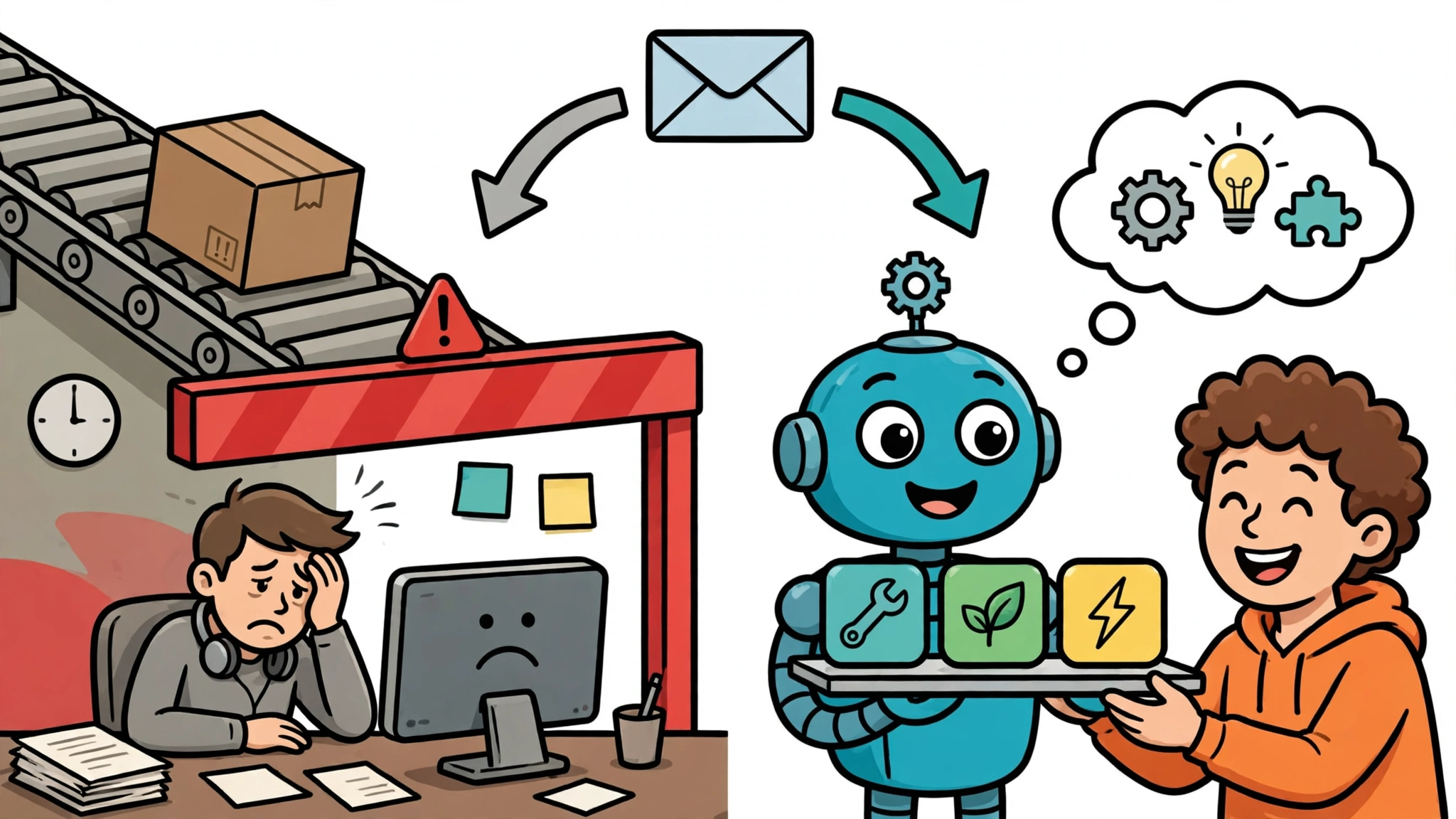
The clearest way to feel the difference is to run one task through both. Take a support request, presented here as an illustrative walkthrough rather than a real incident:
A customer writes: “I ordered the wrong size and the package already shipped. Can I swap it and keep the discount I used?”
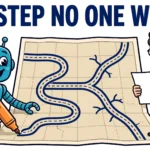
Through a workflow, the message is classified by keyword or a fixed rule. The exchange flow has branches for “wrong size” and “already shipped”, but none for “already shipped and keep the discount”. The flow reaches a condition it cannot satisfy, so it does the thing it was designed to do in this case: it stops, files the case, and escalates to a human. The request stays unresolved, but nothing incorrect has been sent.
Through an agent, the message is read as a whole. The agent checks the order status, reads the discount policy, and works out that a swap is possible but the original discount cannot be re-applied to a replacement order. It can then do one of three things: offer the swap at the new price, ask the customer, or escalate with a summary of what it found. That is the advantage — and the risk. The same freedom that lets it handle the unusual case lets it improvise wrongly: it might apply a discount the policy forbids, or promise a swap the warehouse cannot fulfil. That is why agent frameworks ship guardrails and human-in-the-loop checkpoints — controls that can hold a run for review before an irreversible step.
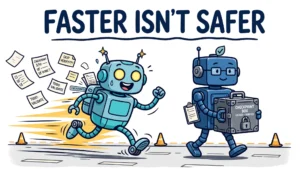
The example also shows why the two can fail differently. A workflow tends to fail by stopping: the failure is visible, but the request stays unresolved. An agent can fail by acting confidently on a wrong conclusion, which can be harder to spot, and potentially expensive. Neither is acceptable without design; they just need different designs.
Where each one fits: choosing between them
Use workflow automation when the inputs are structured, the steps are stable, and a wrong step is expensive. Invoicing, onboarding checklists, data syncing, and approval chains are workflow territory: the path is known, the cost of deviation is high, and determinism is worth more than flexibility.
Use an autonomous agent when the inputs vary, the path cannot be enumerated in advance, or the task needs judgement. Triaging unusual support cases, researching a prospect, or drafting a response that depends on what the agent finds along the way are agent territory: the goal is clear, but the steps depend on discoveries made during the run.
Most real systems are hybrids. Microsoft’s AI Decision Framework recommends deterministic code or non-generative AI for structured, predictable tasks, and mixed architectures in which agents handle intent recognition, ambiguity resolution, or multi-step planning while deterministic code handles validation, routing, and transformation. In practice: a workflow at the top, an agent inside it for the open-ended part, and deterministic steps again for anything that must not vary — refunds issued, records written, money moved.
A short checklist for your own decision:
- Input variability: if every input looks like the last one, use a workflow; if each one is different, consider an agent.
- Cost of error: if a wrong step is expensive or irreversible, keep it in deterministic code.
- Oversight budget: if nobody can review the agent’s work, do not give it actions that matter.
- Audit requirements: if you must prove exactly what happened, a workflow’s fixed path is easier to defend than an agent’s trace.
What changes when you move from automation to agents
Moving from automation to agents changes the economics, not just the capabilities. Cost tends to move from build-time to run-time: a workflow costs effort to build and relatively little per run, while an agent can be quick to start but bills for repeated model and tool calls, retries, and long tasks. The division is a tendency, not a rule: workflows have operating costs of their own, and some call AI models inside their fixed steps. That is the trade Anthropic names directly — latency and cost in exchange for task performance.
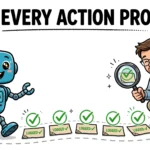
Failure modes change with it. Workflows tend to fail by stopping, which is usually visible. Agents can fail by looping, overspending, or acting on a wrong conclusion, which may not be. Guardrails, spend caps, and step limits are not optional extras for agents; they are the equivalent of the fixed path.
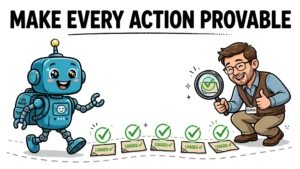
Oversight becomes a design requirement rather than an afterthought. A workflow needs less day-to-day supervision once tested, because its path is fixed — though an input it was never designed for can still stop it or send it down the wrong branch. An agent needs checkpoints by design: human approval before irreversible actions, guardrails that can hold a run for review, and tracing that records every model call and tool result so a bad run can be reconstructed.
Testing changes too. You cannot test every path an agent might take, because the paths are decided at run time. So you test behaviour instead: boundaries, recovery, and failure modes — does it stop when it should, escalate instead of guessing, stay inside its budget. Anthropic’s standing advice applies: find the simplest solution possible, and only increase complexity when needed. If a workflow solves the task, the agent is not an upgrade; it is an added cost and an added risk.
Limits and common mistakes
The most common mistake is treating an agent as a drop-in replacement for a workflow, with no guardrails or checkpoints. The agent may handle cases the workflow could not — and may also handle one wrongly, at run-time cost, with no fixed path to audit.
The mirror-image mistake is automating a judgement call with a workflow, then blaming the tool when it cannot adapt. A workflow that escalates every unusual case is not broken; it is doing exactly what it was built to do. The fix is not a smarter workflow, it is deciding which parts of the task actually need judgement.
A third mistake is assuming autonomy means no human involvement. The oversight burden moves; it does not vanish. Someone still reviews the escalations, maintains the guardrails, reads the traces, and owns the outcomes. An agent without an owner is motion without accountability.
Finally, over-automation. Some tasks are cheaper and safer done by a person, or left unautomated entirely. The rule is the same in both directions: if the steps are known and the cost of error is high, automate deterministically; if the steps are unknown and judgement is the work, give the goal to an agent with guardrails; if neither is clearly true, leave it alone until it is.
The difference between autonomous AI agents and traditional workflow automation is not intelligence versus stupidity. It is who writes the plan: you, in advance, or the model, as it goes. Choose on that basis, and the rest — cost, risk, oversight, testing — follows.