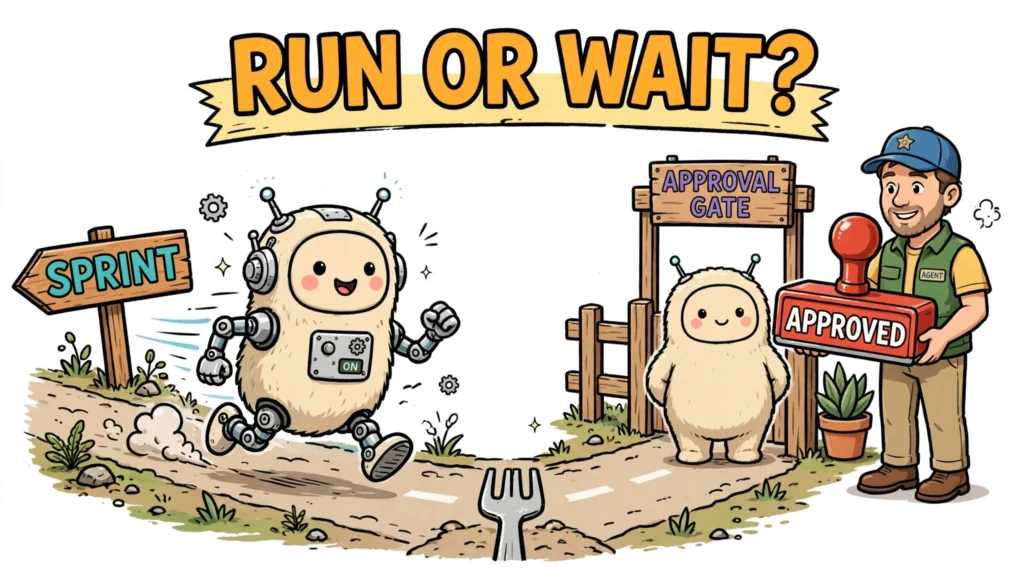



The phrase autonomous guided AI agents covers both sides of one practical choice: should an AI agent run a workflow end to end on its own, or should it pause at defined points so a person can approve, edit or reject what happens next? The two modes use the same underlying machinery. An agent takes a goal, breaks it into steps, calls tools, checks its results and adapts when a step fails. What changes is where the human sits relative to that loop, and that single difference changes speed, risk, accountability and cost in ways that are easy to underestimate until something goes wrong.
This guide defines both modes on the same terms, compares them side by side, places them on a spectrum, works through the same task both ways, and ends with decision rules you can apply. It also clears up a naming problem: guided is not a single universal vendor term, so judge a product by its checkpoints and permissions, not by its label.
What autonomous means in an AI agent
An autonomous AI agent is a system that accepts a goal and then works through the steps needed to reach it without a person driving each step. It perceives its environment by reading a ticket, a customer record, an inbox or a database. It reasons about what needs to happen next. It acts by calling a tool, updating a record, sending a message or searching a knowledge base. Then it checks the result and decides whether the goal is met, whether another step is needed, or whether it should hand over to a person because it has hit an exception it cannot resolve.
Autonomous does not mean unsupervised, unlimited or unaccountable. The agent still operates inside goals, permissions, guardrails and escalation rules set in advance. A support agent may read tickets and draft replies, but not issue refunds above a set amount; a monitoring agent may open tickets, but not change production systems.
What guided means in an AI agent
A guided AI agent works toward the same kind of goal, but it pauses, drafts or proposes at defined checkpoints, and a human approves, edits or rejects before a consequential action executes. The agent still plans and prepares much of the work. The approval sits inside the execution path, so a refusal stops the action rather than merely recording disagreement after the fact.
Guided overlaps heavily with two more common terms. A supervised agent is one where a human approves a plan or batch before the agent executes multiple steps independently. A semi-autonomous agent plans and executes within constraints but stops at checkpoints for review. Some frameworks label a checkpointed mode guided autonomy: the agent plans and executes multi-step workflows with periodic checkpoints, for example gathering sources and drafting a report, then presenting it for review before publication. Other frameworks do not use the word guided at all. The safe reading is operational: a guided agent is one whose consequential actions wait for a human decision at defined points, whatever the vendor calls it.
Guided also needs to be distinguished from three oversight positions. Human in the loop means the agent cannot act on a gated action until a human approves. Human on the loop means the agent acts while a human monitors and can intervene. Human out of the loop means people learn about its behaviour only afterwards, through logs and audits. A guided agent is primarily in-the-loop for its gated actions, and may be on-the-loop or out-of-the-loop for its ungated ones.
Autonomous guided AI agents, side by side
The clearest way to compare the two modes is to hold the goal, the tools and the underlying loop constant and ask what changes. The table below does that for the dimensions that decide most deployments.
| Dimension | Autonomous agent | Guided agent |
|---|---|---|
| Who decides each step | The agent decides and acts inside its defined boundaries. | The agent proposes; a human decides gated steps before they execute. |
| Who acts | The agent acts end to end and reports back at the finish line. | The agent prepares and acts on ungated steps; gated steps wait for approval. |
| When a human intervenes | On exceptions, anomalies, out-of-policy events or high-impact decisions, or after the fact in review. | Before a consequential action, at a defined checkpoint. |
| Speed and scale | Fastest, because no human queue sits in the path of routine work. | Slower at gated steps, because each approval adds latency and staffing. |
| Risk and reversibility | Errors can compound across steps and reach an irreversible action before anyone notices. | Errors are more likely to be caught before they become external or irreversible. |
| Logging and accountability | Accountability rests on policy, bounds and after-action audit. | Accountability rests on the same audit trail plus a named approver for gated actions. |
Two consequences follow. First, an autonomous agent’s mistake at an early step can become a wrong plan at the next step and an irreversible action several steps later, discovered only after the damage is done. A guided agent interrupts that chain, at the price of interrupting the workflow. Second, the choice is rarely about capability: a very capable agent can still be built to ask first.
Autonomy is a spectrum, not a switch
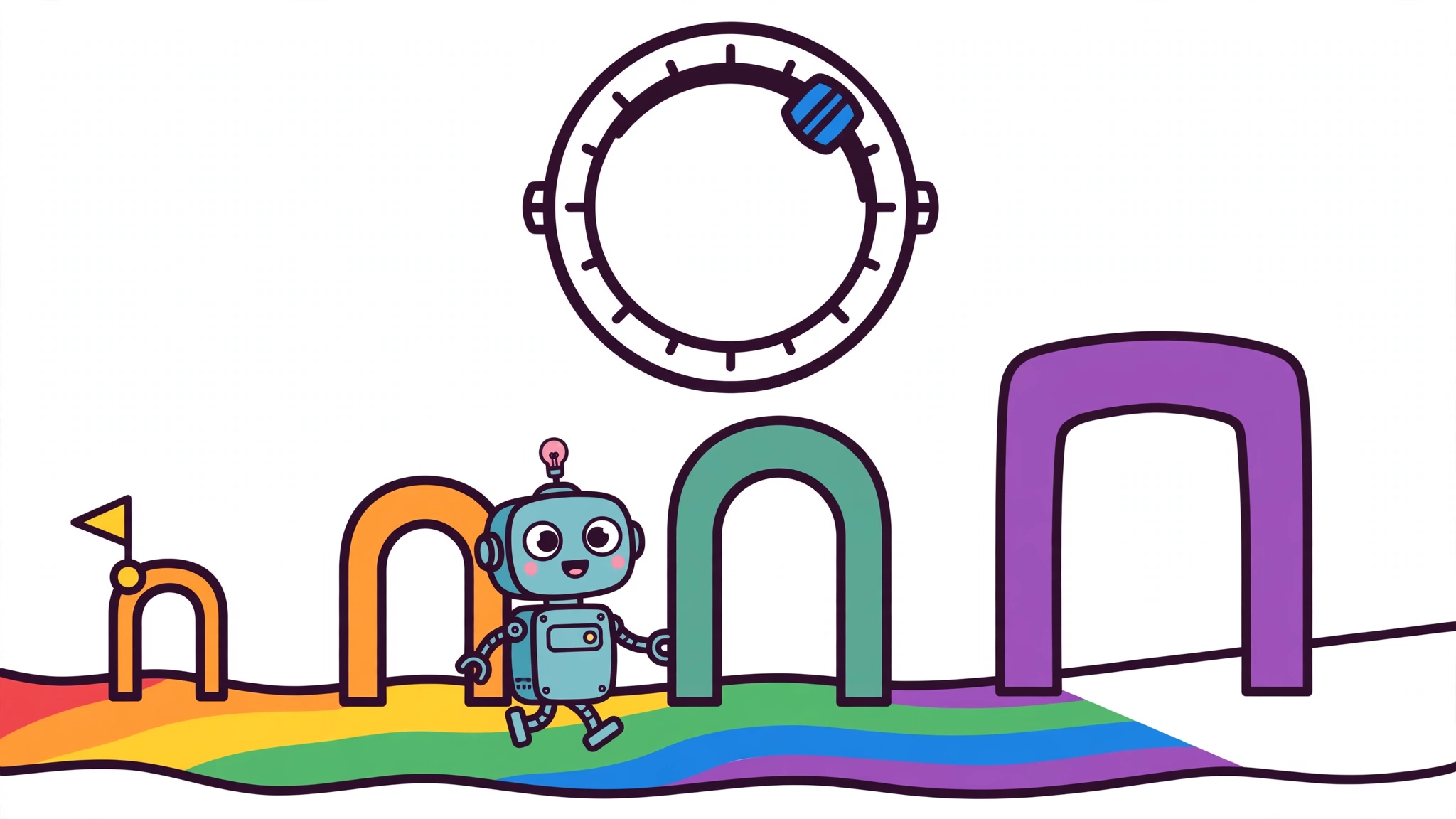
Autonomy is not a binary choice between a human doing everything and a machine doing everything. It runs along a continuum of human involvement, tool scope and oversight, and a system can place different steps at different points on that spectrum.
Two published frameworks make the spectrum concrete. The Cloud Security Alliance framework runs from Level 0, no autonomy, through Level 1, assisted, where a human approves each action, Level 2, supervised, where a human approves a plan or batch, Level 3, conditional, where the agent acts inside defined boundaries and humans handle exceptions, Level 4, high autonomy, where humans monitor and intervene, to Level 5, full autonomy, which the Alliance considers unsuitable for enterprise deployment today.
The Open Data Science framework tells a similar story with different labels. Level 1 is a deterministic task bot. Level 2 is a preparatory agent that always requires review. Level 3 is a narrow operator that handles routine workflows end to end and escalates uncertain cases. Level 4 is a semi-autonomous specialist that operates correctly the vast majority of the time, characterised as around 98 percent, with approvals only for out-of-policy events, anomalies or high-impact decisions. Level 5 is an autonomous problem solver under policy-level supervision and after-action audits rather than step-by-step review, a level its authors do not believe is reachable in the short term.
The frameworks disagree on labels and exact boundaries, and that is itself the lesson. What they agree on is the shape: more autonomy means fewer human decisions per action and a shift from approving each step to approving plans, then to monitoring for exceptions, then to auditing after the fact. Tool permissions are a separately configured boundary, not a consequence of the level itself. Choose the level per action, not per product.
The same task, both ways
Consider a customer asking for a refund. Run autonomously, the agent reads the ticket and order record, checks the refund policy, decides the request qualifies, issues the refund, updates the record and sends the confirmation. Run guided, it does the same reading, checking and preparation, but drafts the refund and waits: a person reviews the amount, reason and customer history, approves, and only then does the money move. The goal, tools and evidence are identical. What changes is the checkpoint, and with it the risk. The autonomous version here is an ungated illustration, not the recommended deployment: the risk guidance later in this article requires approval before a financial action such as a refund executes, so a deployment following that guidance would keep the refund gated even if other steps run autonomously.
Now consider a research task, such as preparing a weekly summary from internal reports. Run guided, the agent gathers sources, verifies claims and drafts the summary, then presents it for human review before it is shared. Run autonomously, it gathers, verifies, drafts and publishes on a schedule, leaving an audit trail for later review. Here the trade-off can look different under an explicit hypothetical: suppose the summary’s consequences have been assessed as low, its contents easily corrected, and its uncertainty low. Then an autonomous schedule may be defensible, while a guided version adds a weekly approval queue. That recommendation is conditional on that assessment, not a general claim about internal summaries.
A sales example shows the mixed reality: an agent may autonomously qualify leads and draft outreach, while every outbound message to a named customer waits for a human. That is a workflow with autonomous and guided steps, chosen action by action.
How to choose between autonomous and guided
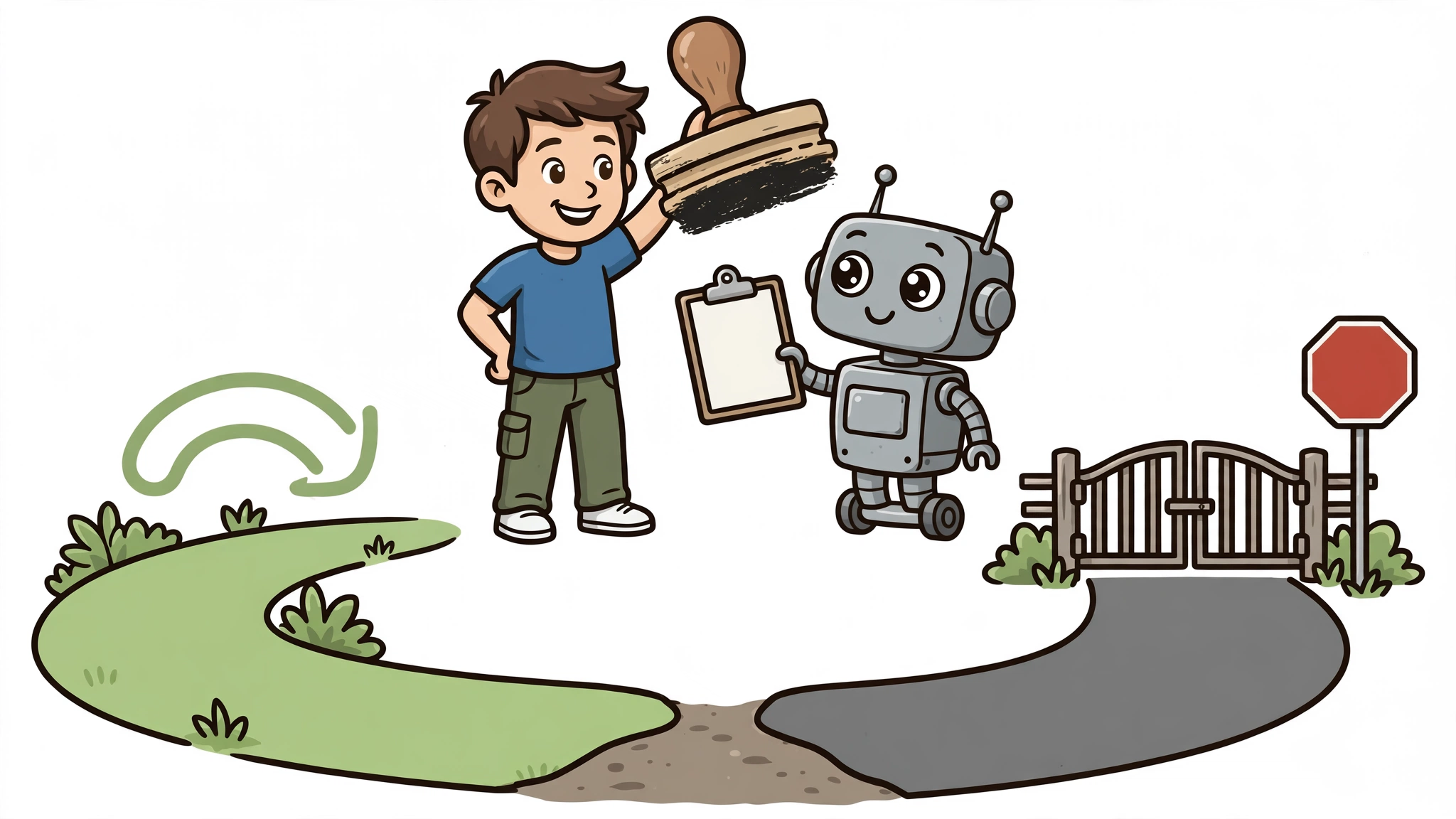
Start with the action, not the agent. Ask four questions about each consequential step. Is it reversible, or does it move money, change a person’s rights, delete data, leave the organisation under its name, or get filed with a regulator? What is the blast radius if it is wrong? How confident is the agent, and how well does it recognise uncertainty? And what does a human actually add at that checkpoint: real judgement, or a rubber stamp?
That last question deserves attention, because approval only works when approvers are still paying attention. Research reported by NeuralTrust, citing Anthropic, found that users approve 93 percent of Claude Code permission prompts, a pattern described as approval fatigue. A control approved nearly every time no longer separates safe actions from risky ones. If a guided workflow asks a person to approve dozens of low-risk actions a day, expect the same fatigue. Guided works when approvals are rare, informative and backed by hard technical limits, not when approval is the only control.
The practical rule that follows is graduated autonomy. Automate the routine, gate the consequential, log the middle ground. Let read-only and easily reversible actions run without a prompt. Require approval before external or financial effects, and a named approver or second reviewer for destructive or privilege-changing actions. Block some actions outright in policy, such as disabling logging, so no approval path exists for them. Then start guided, measure where checkpoints actually catch problems, and loosen only where the evidence says it is safe.
Hard limits matter as much as human checkpoints. Scoped credentials, allowlists, spend limits, rate limits and volume caps enforce boundaries the model cannot talk its way around. OWASP names excessive autonomy, meaning no independent approval of high-impact actions, as one of three root causes of excessive agency. Removing a tool the agent does not need is often a better control than adding an approval prompt for a tool it should never have held.
Common mistakes and limits
The first mistake is treating autonomous as unsupervised. An autonomous agent without defined boundaries, scoped credentials and an audit trail is not a bold deployment; it is an ungoverned one. The second mistake is treating guided as manual. A guided agent still plans, drafts, prepares and executes ungated steps. The human is a checkpoint on consequential actions, not the operator of every step.
The third mistake is trusting the label. Vendors use autonomous, guided, supervised, semi-autonomous and assisted loosely, and the same word can describe different checkpoint arrangements in different products. Before you adopt a product, ask which actions wait for approval, which actions run on monitoring alone, which actions are blocked outright, and what credentials the agent actually holds. The answers to those questions are the product’s real autonomy level, whatever its marketing page says.
The fourth mistake is setting one autonomy level for a whole system and never revisiting it. Workflows and tools change, and a credential that once reached only a test system can quietly reach production. Gartner, as reported by NeuralTrust, forecasts that over 40 percent of agentic AI projects will be cancelled by the end of 2027, partly on insufficient risk controls. That forecast is a warning, not a verdict, but it points in the same direction as everything else in this guide: match the autonomy level to the action, keep the human where judgement actually helps, and enforce the rest in the infrastructure itself.
Autonomous and guided AI agents are not rival technologies. They are two settings on the same loop, separated by where a human is allowed to step in. Choose the setting action by action, start guided where the cost of error is high, and let the checkpoints, not the label, tell you which mode you are really running.