


Introduction to Google Antigravity
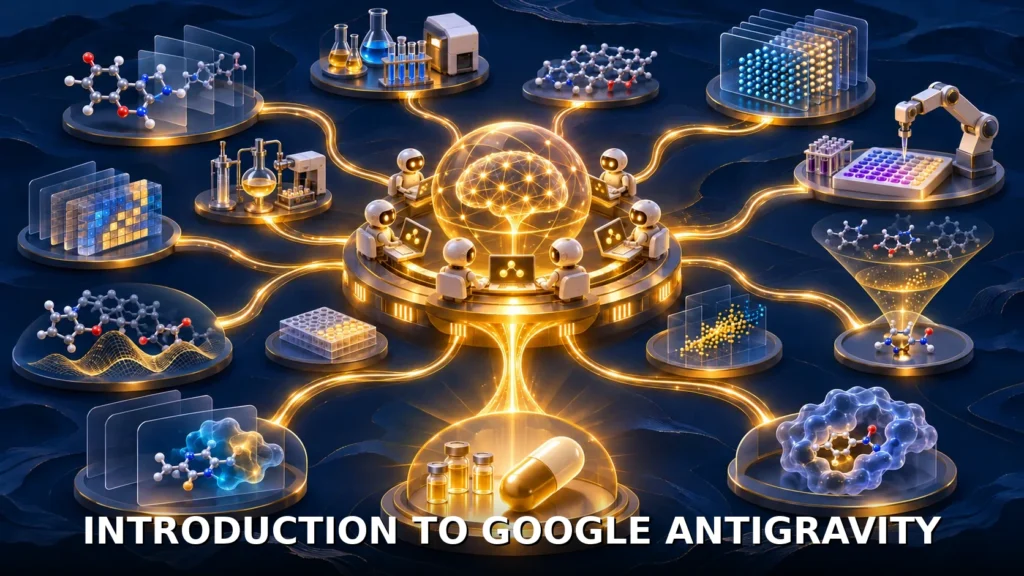
Google Antigravity’s new Cheminformatics Skills connect an AI agent’s workflow planning with chemistry tools, literature retrieval and molecular modeling. In a November 3, 2026 technical walkthrough, Google DeepMind describes an agent that searches thousands of compounds, analyzes molecular changes and proposes new macrocycles with potential synthesis routes in about an hour. Google says the demonstrated workflow previously would have taken multiple days and significant computational expertise.
The practical question is what that acceleration delivers. The demonstration produces curated data, analyses, predictive models and proposed molecules. It does not establish that those proposals become effective medicines. Its immediate value is in helping chemists assemble and examine the evidence behind a design hypothesis, then decide what deserves experimental testing.
Google presents Antigravity as a collaborative science workbench for both computational and experimental chemists. The language model coordinates the work, navigates databases and contributes scientific reasoning; deterministic chemistry tools perform molecular calculations. That division of labor is central to understanding the system. The agent organizes a scientific workflow while specialized software executes chemistry operations within it.
The distinction matters because molecular information is unforgiving. As Google’s account explains, a compound may appear as an IUPAC name in a paper, a Markush structure in a patent or a structure-data file, known as an SDF, in a catalog. Changing one atom or bond describes a different compound. Bringing these representations together therefore requires more than collecting text that looks relevant.
The evidence for the claimed speedup is Google’s own walkthrough. It supports a concrete account of how the workbench can operate, but supplies no independent replication or controlled timing comparison. The strongest supported interpretation is that Google has demonstrated a faster route through a particular computational discovery workflow, with experimental validation still ahead.
Overview of Cheminformatics Skills

The Cheminformatics Skills encode domain practices into the agent’s workflow. Google says they are grounded in RDKit, the open source cheminformatics toolkit, alongside connectors to curated resources from ChEMBL and PubChem. The workbench also has access to local tooling. Together, these components connect the agent’s instructions and reasoning to software and data used for molecular analysis.
The first demonstrated task is literature retrieval and preparation. Asked to investigate lung cancer drugs and their analogues, the agent extracts molecules from documents, associates them with reported data and prepares them for analysis. Google reports that it retrieves thousands of compounds within minutes, removes irrelevant molecules such as buffers and solvents, and documents the sources in a report.
That association between a structure and its reported data is essential to the subsequent analysis. A collection of molecular structures alone cannot support the demonstrated potency comparisons; the compounds need to remain connected to the measurements and metadata being examined. The source report and interactive viewer give the scientist ways to inspect that connection rather than relying solely on the agent’s narrative.
The viewer displays curated compounds, associated data and customizable scatter plots. Scientists can browse the retrieved set, select individual molecules and inspect their metadata. In Google’s example, plotting cellular potency against the number of rotatable bonds, with compounds colored by macrocycle status, exposes a relationship between molecular rigidity and potency in that dataset.
The skills extend beyond retrieval and visualization. The walkthrough includes matched molecular pair analysis, molecular machine learning, reaction manipulation and validation, electron-pushing diagrams, and searches for similar reactions in public databases. Results can be exported in formats suitable for other chemistry software. These are stages of the demonstrated workbench, although the supplied account does not specify the export formats or provide a reproducible configuration for the entire workflow.
The design also gives the scientist opportunities to intervene. A researcher can inspect the compound collection, choose relationships to plot and assess model outputs before asking the agent to continue. The useful shift is from manually coordinating each operation toward reviewing and directing a connected analysis. How much oversight that saves in another project remains an open question.
Impact on Drug Discovery Workflows

Google’s case study centers on rigidification, a medicinal chemistry strategy for limiting a molecule’s freedom to change shape. Rotatable bonds let a molecule adopt different three-dimensional conformations. Binding to a target can require it to settle into a particular shape, with an associated entropic penalty. Adding a bond in the right place can constrain that motion and favor the shape needed for binding.
The walkthrough uses crizotinib and lorlatinib to make the strategy concrete. Google describes crizotinib as a first-generation small-molecule tyrosine kinase inhibitor used for certain forms of non-small cell lung carcinoma, with five major rotatable bonds. Lorlatinib, a third-generation inhibitor, resembles crizotinib but has been cyclized, reducing the effective number of rotatable bonds to zero and contributing to higher potency among other effects.
The agent searches for these drugs and their analogues, then examines whether the broader compound set supports the rigidification rationale. The initial plots show that macrocycles such as lorlatinib tend to have fewer rotatable bonds and higher potency. This visual relationship motivates a more focused comparison, rather than serving as a complete explanation on its own.
Matched molecular pair analysis compares molecules that differ by a small, discrete change. In this demonstration, the analysis examines pairs differing in whether they are cyclized. Google reports that cyclization reduces rotatable bonds while generally increasing potency. Comparing such pairs is useful for investigating the effect of a specific structural change, although the supplied account does not report numerical effect sizes or uncertainty estimates.
The agent also builds potency models using different feature sets and model architectures, validating them on held-out data. Google describes comparisons across four experimental readouts using a scaffold split to assess performance on structurally different compounds. Its skills guidance also favors chronological splits, when dates are available, so that models trained on older compounds predict newer ones.
These validation choices address a consequential question: whether a model’s predictions remain useful beyond the compounds on which it learned. The account explains the intended evaluation approach, but does not supply numerical model scores. Readers therefore cannot use this walkthrough to rank the architectures or quantify the accuracy of the resulting potency predictions.
The workflow ends with proposed macrocycles, medicinal chemistry rationales and potential synthesis routes consistent with documented procedures. The agent predicts their potency using its previously trained models. It can also prepare compounds for further analysis with AlphaFold or physics-based approaches such as molecular dynamics simulation; the account does not establish that those additional analyses were completed for the proposals.
For drug discovery teams, the demonstrated benefit is the connection among these stages. Retrieved evidence feeds comparative analysis, which informs modeling and design proposals. Google’s approximately one-hour account concerns that computational sequence. It is not a measured reduction in the time needed to synthesize a compound, validate it experimentally or develop a medicine.
Role of AI in Scientific Reasoning
The language model’s contribution goes beyond executing a fixed list of chemistry commands. According to Google, it handles workflow orchestration, database navigation and scientific reasoning. In the demonstration, the agent independently suggests matched molecular pair analysis before the researchers request it, anticipating that the dataset contains informative pairs.
That suggestion illustrates a specific form of assistance: proposing an analytical next step suited to the available evidence. The subsequent design stage extends the same pattern. The agent combines its chemistry knowledge with the pair analysis and potency models, explains why it recommends particular molecular changes, and suggests synthesis plans. Those explanations make its proposals available for scientific review.
Deterministic chemistry tools have a separate role. They execute molecular calculations, while the language model coordinates their use and interprets the workflow. This architecture provides a clearer account of where calculations occur than a description in which an AI simply “understands chemistry.” It also leaves several distinct questions for a reviewer: whether the structures and data are correct, whether the analysis is appropriate, and whether the interpretation follows from the results.
The interactive viewer and statistical outputs support that review. Scientists can examine the underlying compounds, plot relationships and evaluate model performance before iterating with the agent. Electron-pushing diagrams similarly expose the mechanism the agent proposes for a reaction. These outputs help communicate a rationale; they do not independently prove that a proposed synthesis will work.
Google explicitly identifies limits to predictive precision: sparse data, noise between laboratories’ assays and narrow dynamic ranges. Those constraints affect what the models can infer from the available measurements. A confidently presented prediction cannot eliminate uncertainty already present in the evidence used to train and evaluate it.
The report’s discussion of brain penetration illustrates the need to preserve this distinction. Google says the retrieved macrocycles are largely predicted to be brain-penetrant, a relevant property because the lung cancer under discussion frequently metastasizes to the brain. The description is a prediction about those compounds, not experimental confirmation of their behavior.
The same standard applies to the final designs. Google states that every proposed molecule must be synthesized and validated experimentally. Scientific reasoning in this workbench helps generate and prioritize testable hypotheses. Its quality ultimately depends on whether the evidence, calculations and interpretation justify the next experiment, rather than on how persuasive the agent’s explanation sounds.
Future of Research with Antigravity
Google says the Cheminformatics Skills are available through the Science plugin in the Antigravity app. Its announcement also describes enterprise access through “Use Business Account” with Google Cloud credentials. These access details establish how Google presents the offering, while the walkthrough provides the substantive example of what a scientist might do with it.
The broader implication is a change in how computational research tasks can be coordinated. In the demonstrated workflow, literature retrieval, compound curation, visualization, comparative analysis, model building and molecular proposals sit within a collaborative workbench. For scientists evaluating this approach, the relevant question is whether that continuity helps them reach a better-supported experimental decision with less preparation work.
Several questions remain unanswered by the supplied account. It does not quantify curation error rates, report the potency models’ numerical performance or show experimental outcomes for the newly designed compounds. Nor does it establish how the reported timing changes with another target, dataset or degree of scientist intervention. These omissions limit generalization from the example without negating the specific workflow Google describes.
A useful assessment would therefore distinguish several outcomes: the speed of preparing an analyzable dataset, the reliability of the associated molecular information, the quality of model validation and the experimental performance of proposed designs. The walkthrough offers evidence about the workflow and its claimed timing, while leaving the later experimental outcomes unresolved.
Antigravity’s demonstrated contribution is to bring more of the preparation and analysis behind a molecular design hypothesis into one agent-assisted process. Google’s own qualification sets the boundary for that contribution: computational designs remain testable hypotheses. Faster research decisions become scientifically meaningful when the structures, measurements, models and proposed experiments can withstand scrutiny. Experimental synthesis and validation remain the decisive next steps for the molecules this workbench proposes.