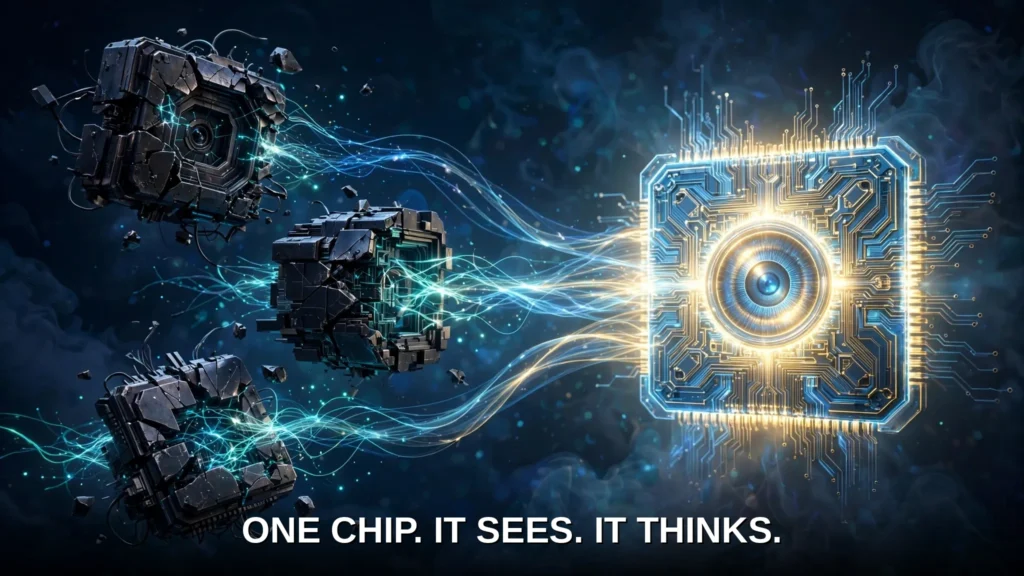



Bharat Semi AI sensors are the reason a nearly five-year-old, pre-revenue Indian chip startup has just raised $24 million. The New Delhi-based company is building programmable image sensors that combine capture, processing, and AI on a single chip, and it says the approach can cut system costs by at least 70% compared with the conventional setup. The all-equity seed round, reported on 15 November 2026, will fund engineering expansion and product development as the company targets initial commercial production in 2027.
The funding is a bet on a specific idea: that the sensor itself should do the thinking. In the conventional setup Bharat Semi compares itself against, a camera that needs to understand what it sees sends visual data to separate processors elsewhere in the system. Bharat Semi wants to collapse that chain onto one chip, so machines can act on what they see without shipping images around first.
The $24M seed round at a glance
The round is $24 million, all equity, led by Info Edge Group, South Park Commons, and Indus Bridge Ventures, with participation from Valour Capital, Micromax, Gaingels, and individual investors. No valuation was disclosed.
Bharat Semi plans to use the funding to expand its engineering team, complete product development, and bring its sensors to market. The company is still pre-revenue, and its sensors remain under development — but it says it has already secured design wins with two customers: U.S. defense technology company General Atomics and India’s Kaynes Semicon. A design win means a customer has selected the technology for a development program; it is an early commercial signal, not revenue.
The round was reported by TechCrunch on 15 November 2026, based on an interview with co-founder Vrinda Kapoor.
What Bharat Semi’s AI sensors actually do
Bharat Semi is developing programmable image sensors that combine image capture, processing, and AI capabilities on a single chip. The point, in Kapoor’s words, is to move “from sensors to sense-making solutions”: the sensor does not just record a scene, it interprets it.
The company’s own framing is that physical AI runs on machine vision, but today’s sensors were built for people. A conventional sensor captures everything and sends it all to a processor elsewhere, even though most of what it captures never matters to the task. Bharat Semi’s pitch is intelligence in the right place: everyday machines that see what is around them and decide on the device, so no images ever leave it.
The first-generation sensors are already in prototyping. The second-generation sensors, which will incorporate more advanced AI capabilities, are expected to reach the prototype stage by mid-2027, with the company planning to get them into customers’ hands by the end of 2027.
How Bharat Semi AI sensors differ from the conventional setup
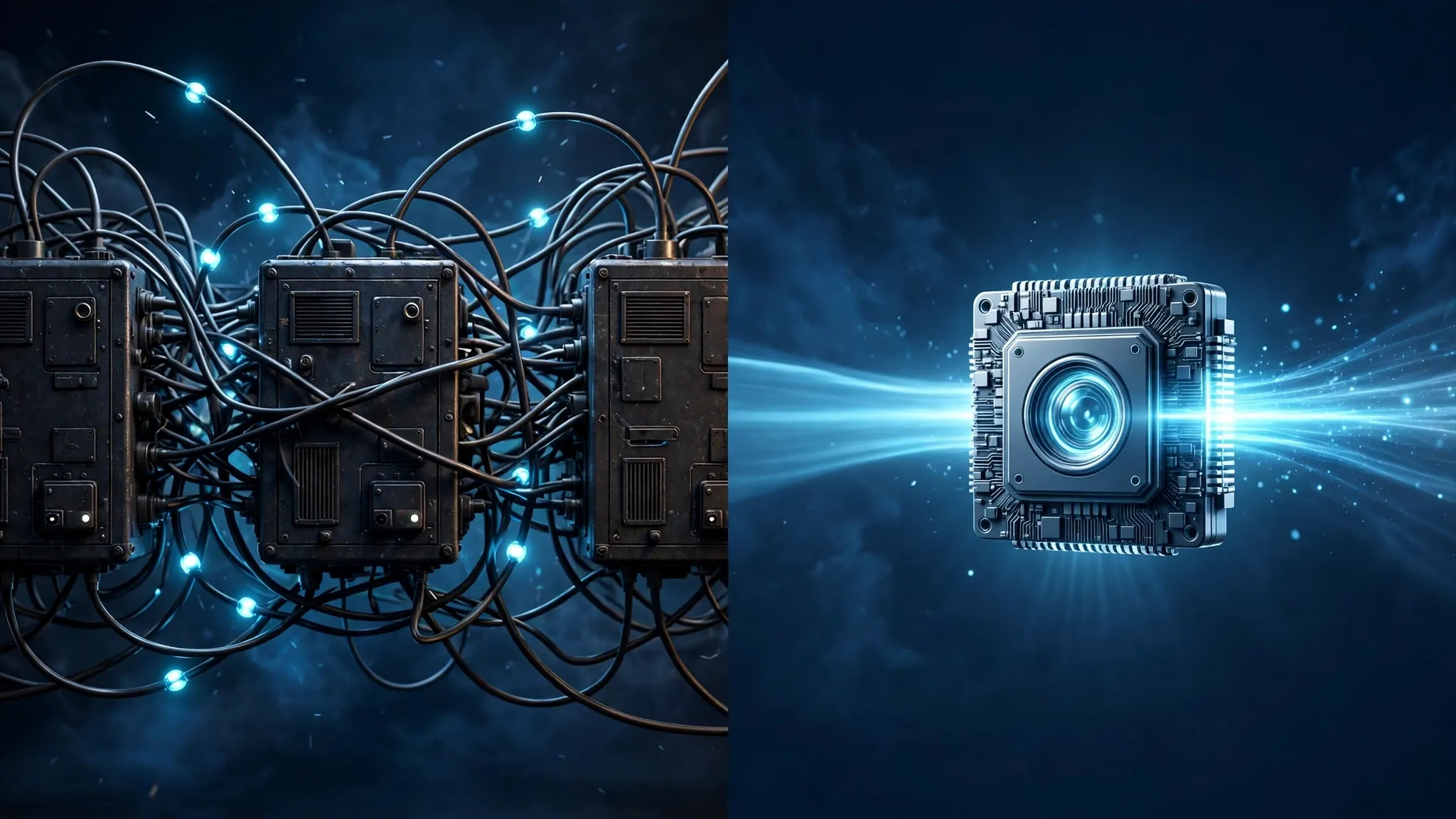
The conventional setup Bharat Semi compares itself against has three parts: an image sensor, an image signal processor, and a system-on-chip. Visual data travels between them. Bharat Semi collapses all three onto a single chip, so the processing and the AI inference happen where the image is captured.
Kapoor says the move could cut system costs by at least 70% compared with conventional setups. That figure is the company’s claim, not an independently verified result, and it is worth treating as such until the sensors ship and customers confirm it. What is clear from the design is where the saving would come from: fewer components, less data movement, and no need for expensive computing hardware elsewhere in the system.
What the company claims, in short, is a simpler system: one chip doing the work of three separate components.
Where the sensors would be used
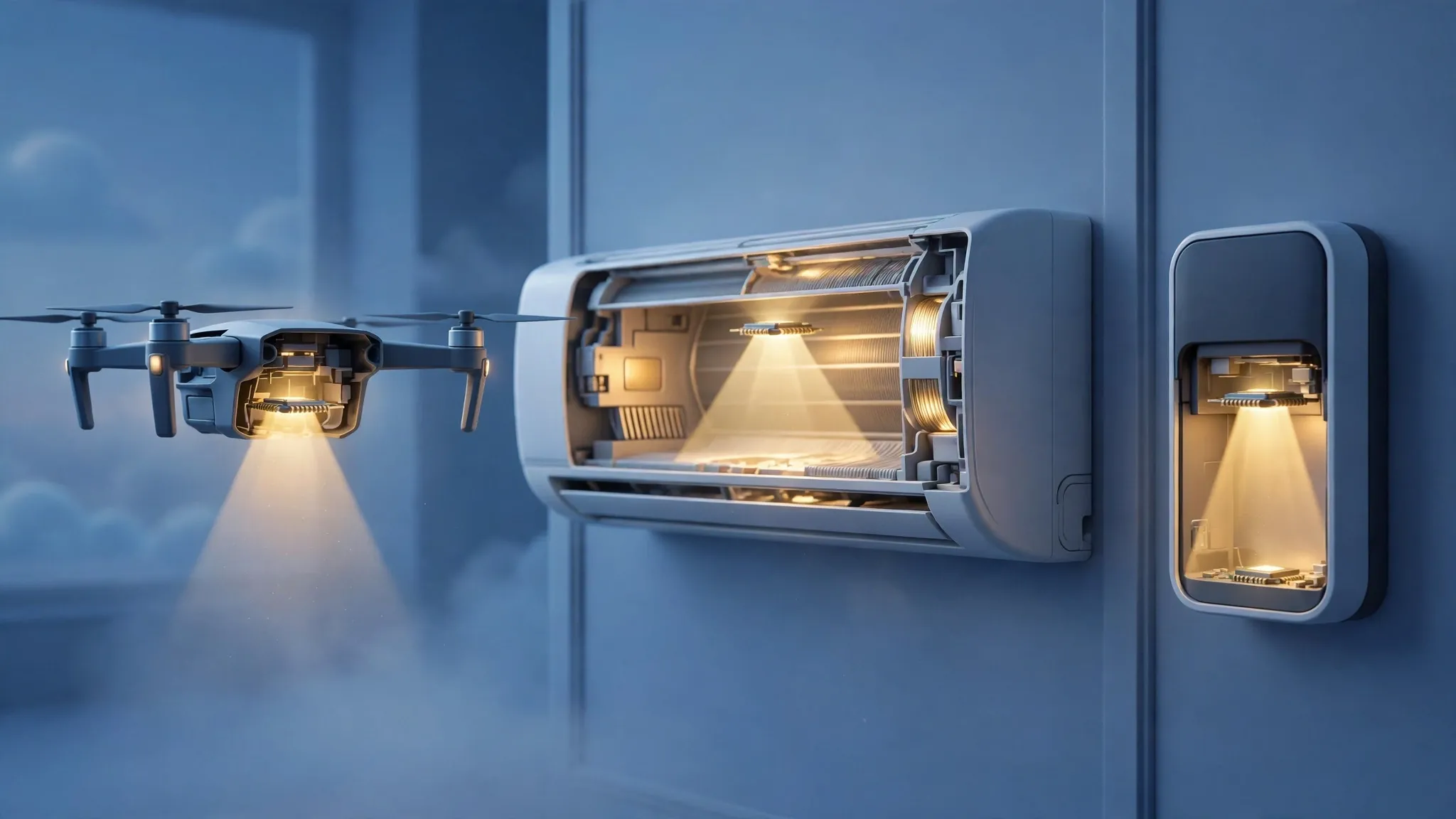
Bharat Semi is targeting smart homes, industrial automation, surveillance, and aerospace. The examples Kapoor gave are deliberately everyday ones: air conditioners that could detect when a room is empty and adjust automatically, and drones that could process visual information on board, even without more expensive computing hardware elsewhere in the system.
The company’s own site extends the list: a video doorbell that could recognise a delivery, a ceiling fan that could tell when someone has fallen asleep and ease its speed down, and a drone that could spot power lines ahead and adjust its flight path on its own.
The common thread is places where sending video elsewhere for processing is costly, slow, or impractical — and where keeping images on the device is itself a benefit.
Product roadmap: from prototypes to production
The timeline is short and checkable. First-generation sensors are in prototyping now. Initial commercial production is targeted for 2027. Second-generation sensors, with more advanced AI capabilities, are expected to reach the prototype stage by mid-2027 and into customers’ hands by the end of 2027.
The design wins with General Atomics and Kaynes Semicon are the first footholds, but they should be read for what they are: the sensors are still under development, and a design win is a selection for a development program, which does not establish revenue. The test of this roadmap is whether those wins convert into paying customers if the company meets its targeted 2027 production start.
The company behind the chips
Bharat Semi was founded in late 2021 in New Delhi by Vrinda Kapoor and Vinayak Dalmia. Kapoor is a South Park Commons fellow who earlier worked in healthcare technology; Dalmia, the managing director, previously worked at McKinsey and in private equity. The chief technology officer, Boyd Fowler, previously held the same role at image-sensor maker OmniVision.
The company has about 75 employees across India and the U.S., including 10 to 12 in Santa Clara. It plans to increase its U.S. headcount to around 20 by mid-2027, and it has also begun hiring engineers in Europe. Its offices are in New Delhi, Bengaluru, and San Francisco.
Bharat Semi plans to remain fabless, outsourcing chip manufacturing while focusing on semiconductor design and software. That matters because the company has a second, separate project: in 2024 it announced plans for a semiconductor fabrication project in India involving a technology partnership with the U.S. Space Force. That initiative remains in development, and the new funding will not be used to finance it.
“It’s a story of can we build a global technology company out of India,” Kapoor told TechCrunch — a line that frames the funding as a bet on Indian semiconductor design, not just on one product.
What to watch next
Three things will decide whether this becomes a real product business. First, whether the claimed design wins convert into paying customers if production starts on the targeted 2027 schedule. Second, whether the second-generation sensors hit their mid-2027 prototype milestone with the more advanced AI capabilities the company promises. Third, whether the 70% cost claim holds up once customers can measure it themselves.
The wider context is India’s push to build a domestic semiconductor industry. The country has committed billions of dollars to the effort, hoping to become an alternative manufacturing hub as U.S. companies look to diversify supply chains beyond China. It has yet to establish itself as a major chip manufacturing hub. Bharat Semi’s model is to design the sensors in India, outsource manufacturing, and focus on design and software while seeking customers in the United States and elsewhere. Whether that model works depends on milestones the company has dated only loosely: the exact production and first-shipment dates remain unspecified.