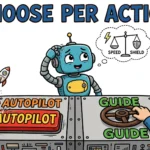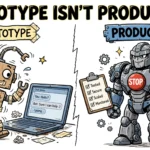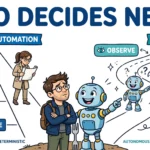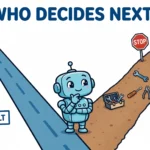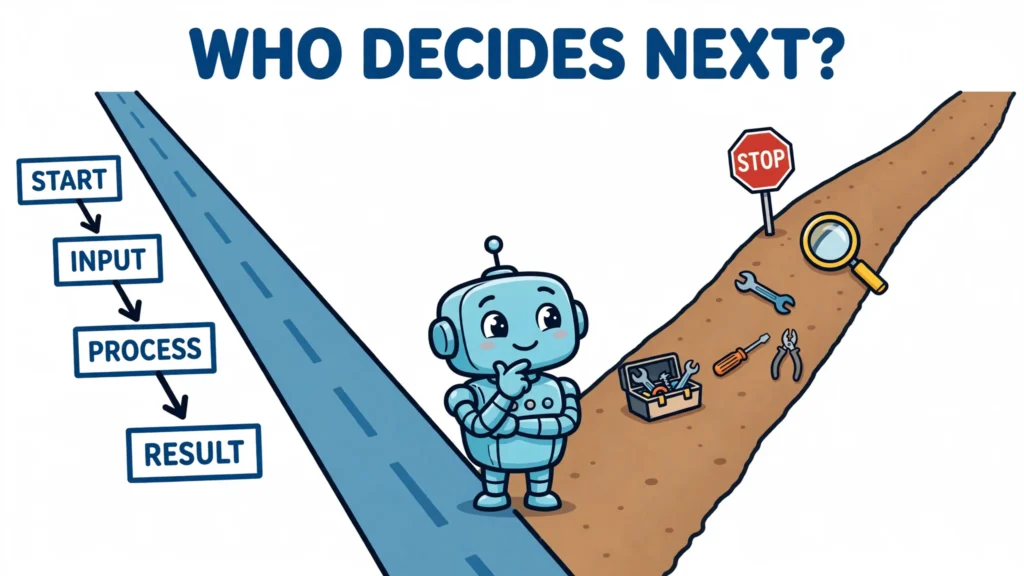


The question behind ai agents vs software is not which one is smarter. It is who decides what happens next. In conventional software, control flow is written in advance: branches, loops, and rules in code decide the permitted steps. In an AI agent, a model selects the next action within software-defined constraints — the tools, permissions, and stopping conditions that programmers set — revising its plan as tool results arrive. Both are software. The difference is where the decision about the next step is made, and that difference changes how you build, test, and trust a system.
This article makes that distinction carefully, because the common version of it is misleading. Conventional software is often described as fully deterministic, memoryless, and predictably failing, while agents are described as adaptive, remembering, and unpredictably failing. None of those contrasts holds as a categorical claim, as the Codex review of the brief for this article rightly insisted. This guide therefore frames the comparison as explicitly programmed control flow versus model-directed selection of actions within software-defined constraints, traces one task through both approaches, and ends with a decision framework for choosing between them.
What traditional software actually does
Conventional, explicitly programmed software follows control flow written in advance. A human writes branches, loops, and rules in code, and those rules decide the permitted steps a program may take. Data, configuration, and external state can still change what happens on a given run: the same payroll calculation reads different records, the same payment API receives different requests, and the same data-sync script encounters different files.
That control flow is typically replayable and testable step by step for a given input and state, which is why conventional software is so auditable. It does not follow that all conventional software is deterministic in every case. Randomness, concurrency, external inputs, and adaptive algorithms can make outcomes vary. The Communications of the ACM overview of deterministic database systems states that every major database system available today is nondeterministic, with operating-system thread scheduling, deadlock, or server failure able to change the order in which transactions take effect. Race conditions in concurrent programs likewise make the final outcome depend on the unpredictable timing of thread execution. A payment API, a payroll calculation, and a data-sync script are good examples — each lives in a world of state and timing the code alone does not determine.
What an AI agent actually is
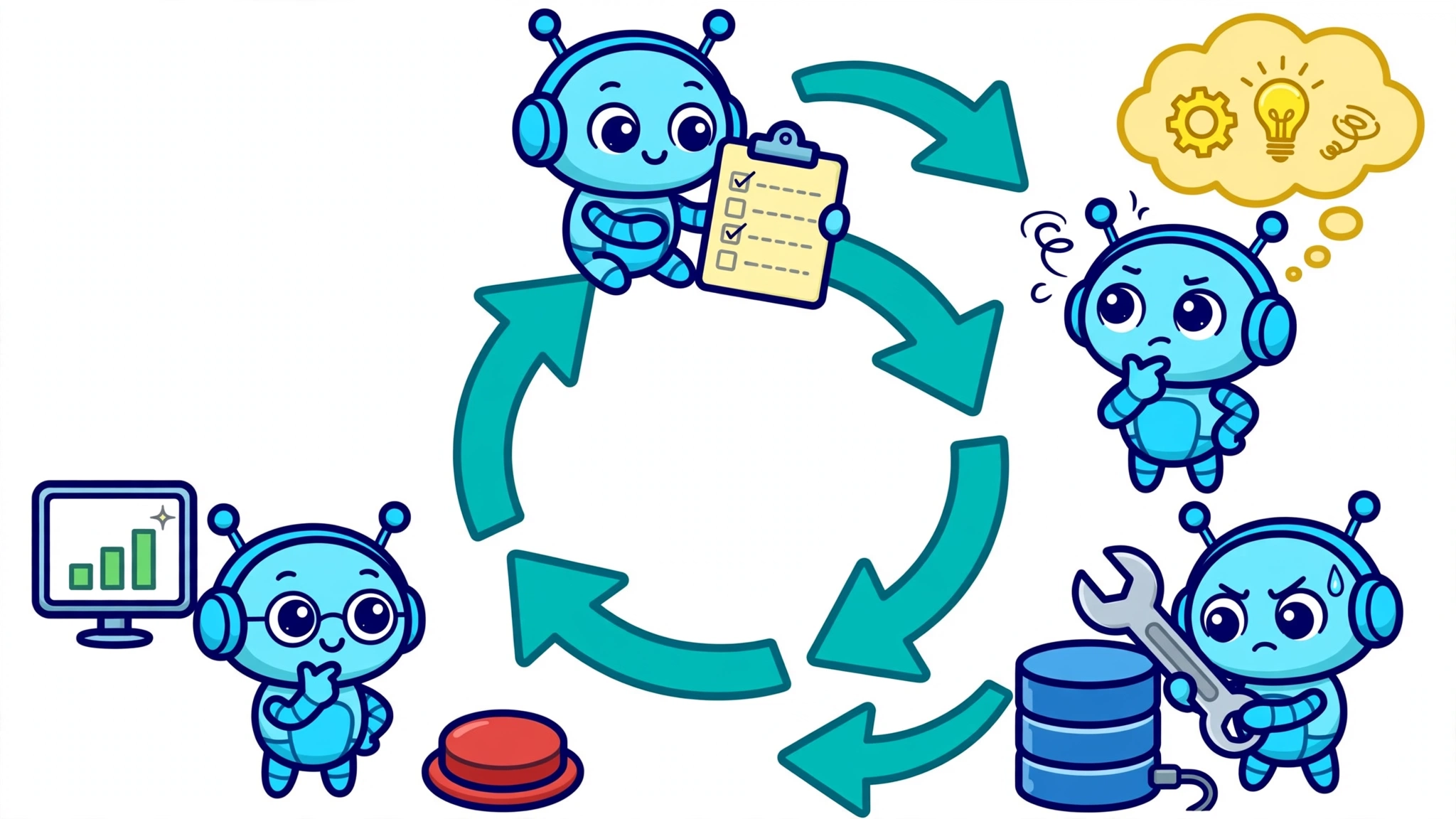
An AI agent is a goal-directed loop, not a smarter script. It perceives a task, reasons about it, acts through tools, observes the result, and selects the next step itself, repeating until it is done or stopped. One pattern illustrating that interleaving of reasoning and action is ReAct, from Yao and colleagues in 2022, in which reasoning traces and task-specific actions alternate, so reasoning traces help the model induce, track, and update action plans and handle exceptions, while actions let it interface with external sources to gather information. The model selects the next step from the state of the task, rather than following a fixed flowchart — but it does so within software-defined constraints. The tools, permissions, and stopping conditions are programmed, and the model selects actions within them.
Anthropic draws an important architectural distinction inside this picture. In its guide to building effective agents, it categorises both workflows and agents as agentic systems, but distinguishes them: workflows are systems where language models and tools are orchestrated through predefined code paths, while agents are systems where language models dynamically direct their own processes and tool usage, maintaining control over how they accomplish tasks. The OpenAI Agents SDK shows model/tool orchestration in code form: its Runner calls the model, ends on final output, runs tool calls and appends their results before calling the model again, switches agent on a handoff, and raises an error if a configured maximum number of turns is exceeded. The loop is scaffolding written in code; the model-directed choice happens inside it. Anthropic’s post notes its tooling landscape has changed since December 2024 and points to its Managed Agents documentation; treat its patterns, not its tooling list, as durable.
AI agents vs software: the core differences
The central comparison is best held as five dimensions, each stated as a tendency with its qualification attached. First, who selects the next step: control flow written in advance versus the model selecting within programmed tool and control boundaries at run time. Second, predictability versus adaptability: explicitly programmed flow is typically replayable for a given input and state, while an agent may take different paths toward the same goal — and neither property is absolute, since conventional software can vary with state, inputs, and randomness, and agents operate within programmed constraints.
Third, state and memory: conventional software uses variables and persistent storage, while an agent uses working memory, context, and retrieved knowledge selected at run time. The difference is how state is selected and used, not a claim that only agents have memory. Fourth, tool use: calls fixed in code versus the model choosing, within its programmed tool set and permissions, which tool to call and when. Fifth, failure modes: wrong branches, crashes, and silent failures occur in conventional software as well as in agents, while agents add failure modes such as wrong plans, tool misuse, hallucinated tool arguments, and looping. Predictability of failure is a matter of degree, not a categorical split. The workflow/agent distinction frames who directs the process; the workflow-specific contrast belongs in the companion article on agents versus workflow automation.
How decision-making differs in practice
Trace one task through both approaches: handling a refund request. The fixed program branches on rules written in advance. If the order exists, if the purchase is within the refund window, and if the payment method supports a refund, issue it; otherwise, route to a queue or return a fixed message. Every branch was enumerated by a programmer; an unanticipated input falls through to a default, an error, or a human queue. Behaviour can be inspected branch by branch, which is why it is easy to audit.
The agent handles the same request differently. It reads the request, decides what it needs to know, calls a lookup tool, reads the result, and decides the next step — perhaps checking policy, perhaps asking the customer a question, perhaps issuing the refund. If a tool returns contradictory data, it must decide which result to trust or whether to ask. Where the fixed program branches on rules, the agent selects actions within its constraints by reasoning about the situation. Each approach struggles where the other is strong: fixed programs struggle with variation that cannot be enumerated in advance, such as a refund request phrased in a way no rule anticipated, while agents struggle with repeatability and auditability, since the same request may take different paths on different runs and the reasoning behind a choice is harder to inspect than a branch in code.
How each handles the unexpected
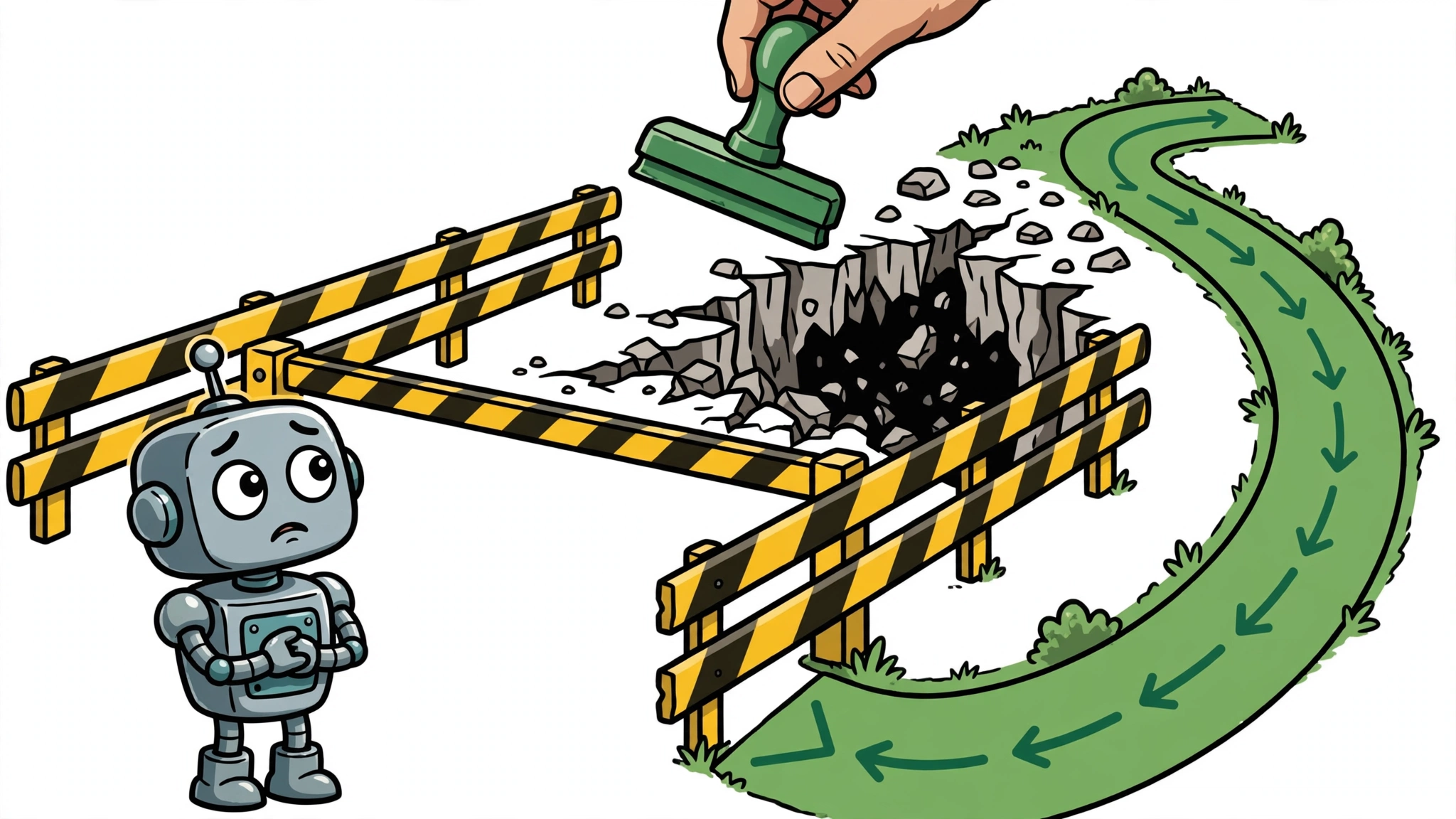
Novel inputs, errors, and edge cases are where the two approaches separate most in production. Conventional software may fail loudly, silently, or unpredictably on inputs outside its rules, depending on validation, error handling, and state. A missing validation check can let a bad value through quietly; a race condition can corrupt shared state only under load; a database ordering effect can change which transaction wins. Predictability is not guaranteed by the mere fact that the code was written in advance. What conventional software offers is inspectable control flow: its explicit branches and error handling can be inspected and tested step by step, while state, concurrency, and environment can still produce unforeseen failures.
Agents can adapt to novel phrasing within their constraints, but they can fail in additional ways: hallucinated tool arguments, wrong plans, and loops. Guardrails and stopping conditions are how agents bound the unexpected: a maximum number of iterations, as in the OpenAI Agents SDK’s turn limit, approval gates before destructive actions, and fallbacks to fixed logic when a step fails. Without those constraints, adaptability increases the risk of uncontrolled execution or compounding errors, and the agent’s ability to keep going is a liability rather than a strength.
When to use each approach
The decision turns on how well the task can be specified in advance. Fixed software wins where the task is stable, well-defined, and auditable: the steps can be enumerated, the inputs are bounded, and a human or regulator may need to inspect exactly why a decision was taken. Payment processing, payroll calculation, and data synchronisation are the natural territory of explicitly programmed control flow, and most real systems keep those parts fixed even when they add an agent elsewhere.
Agents earn their place where inputs vary, judgement is needed, and the path cannot be enumerated in advance: triaging varied customer messages, gathering information from several sources, or handling a task whose steps depend on what is found along the way. Anthropic’s advice is that agentic systems often trade latency and cost for better task performance, and that workflows offer predictability and consistency for well-defined tasks while agents suit cases needing flexibility and model-driven decision-making at scale. The cost, latency, and reliability trade-off should be stated as workload-dependent: model calls typically add cost and variable latency for an equivalent task, while explicitly programmed logic typically runs with lower marginal cost and more predictable timing. Neither is free or instant, and no general per-run figure was found that could honestly be quoted for all tasks; any figure used in a real decision must specify the task, implementation, model, infrastructure, and measurement conditions. Most real systems pair the two, using the agent where variation demands it and fixed code where predictability matters.
What changes when you build with agents
Building with agents changes testing, observability, and reliability work. Testing adds evaluations over representative tasks alongside unit and integration tests for tools, orchestration, and safeguards; evaluations complement, and do not replace, deterministic tests, because the deterministic parts of the system — tool argument validation, state transitions, guardrail behaviour — remain testable exactly. Observability becomes essential, through available events, tool calls, state transitions, outputs, and any exposed reasoning summaries, not just logs, without assuming access to internal model reasoning.
Reliability work moves to guardrails, retries, human approval, and fallbacks to fixed logic. The NIST definition quoted in this article’s research makes the stakes clear: in its January 2026 request for information, NIST’s Center for AI Standards and Innovation described AI agent systems as capable of planning and taking autonomous actions that impact real-world systems or environments, consisting of at least one generative AI model and scaffolding software that equips the model with tools to take a range of discretionary actions, and deployable with little to no human oversight. A system that can change external state needs the controls that match that reach: scoped tool permissions, approval before irreversible actions, and a fixed-logic fallback when the agent cannot proceed safely. Those controls are programmed: the contrast is within software, not outside it.
Common mistakes when comparing the two
The most common mistake is treating an agent as a smarter script. The difference is who selects the next action within programmed constraints, not how clever the code is — and agents are themselves software, built from a model plus scaffolding. A second is expecting strict determinism from an agent, or open-ended adaptability from fixed logic, forgetting that conventional software varies with state and inputs and agents are bounded by their tools and stopping conditions.
A third mistake is ignoring cost and failure modes when choosing. An agent that works beautifully in a demo may be unaffordable or unreliable at volume, with compounding errors across turns, while a fixed program that looks rigid may be exactly what an auditable, high-volume task needs. Judge the choice on the task’s variability, its audit requirements, and its tolerance for varied paths and variable latency, not on novelty. In summary: conventional software executes control flow someone wrote in advance; an agent selects and revises its next actions within software-defined constraints. Choose the first where the path can be written down, the second where it cannot, and in most real systems, use both — each where it earns its place.