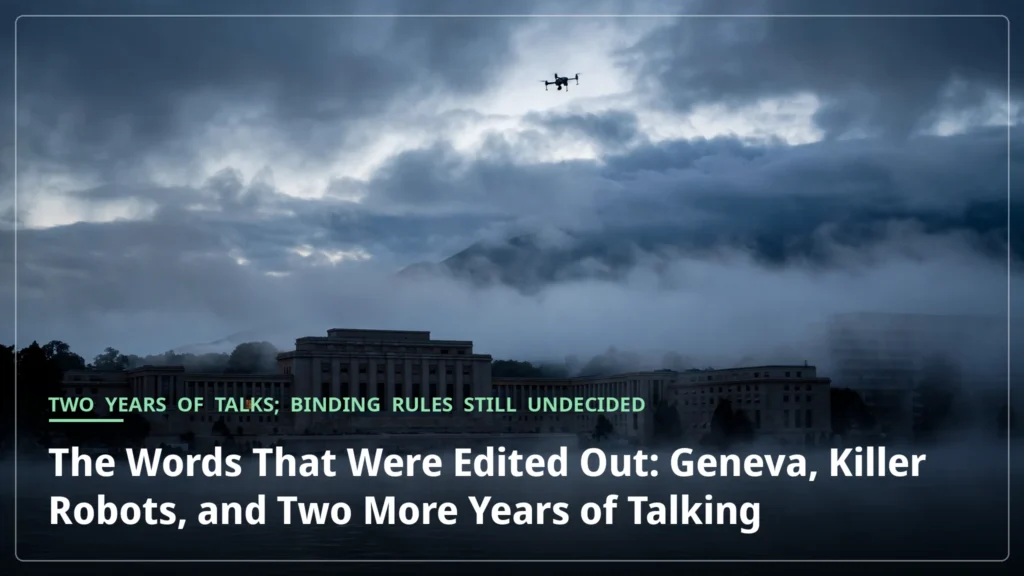



In the small hours of Saturday morning, after a week of negotiations in Geneva, diplomats emerged with an agreement about what they would agree to talk about. They would spend two years elaborating an international instrument on lethal autonomous weapons systems, the weapons often called “killer robots.” They did not agree on legally binding rules, on specific regulations, or on how any future rules would be enforced. They agreed to start discussing options, leaving open whether any future rules would bind anyone.
The negotiation in Geneva was, in large part, a negotiation about the words that would govern the negotiation. By the end of the week, three words that had mattered at the start — “lethal,” “meaningful” and “accountability” — had been removed from the text or downgraded inside it. The process survived. Whether the softer language can harden into binding rules over the next two years is now the question the whole exercise has to answer.
The 128 countries party to the Convention on Certain Conventional Weapons agreed to launch the elaboration of an international instrument on lethal autonomous weapons systems, to be conducted over the next two years. The parties would work on the instrument, and then decide whether it should be a treaty and how far its provisions should be binding. NPR put the compromise more bluntly: countries would have two years to suggest regulations that could be legally binding, but could also be optional.
The ask, and the answer
Before the negotiations began, the International Committee of the Red Cross had said it was urgent for legally binding rules to be drafted within a year. That call, as reported by The Verge citing NPR, was backed by the United Nations secretary-general and by Pope Leo.
Seven countries had come with a sharper proposal. Austria, Belgium, Brazil, Ireland, Mexico, New Zealand and Panama had proposed launching negotiations on a rulebook that could prevent or limit the ability of machines to kill without human control or accountability. That effort fell short, the Associated Press reported. Brazil’s ambassador, Frederico Meyer, put the gap in a single line: “Technology is moving faster than diplomacy.”
Humanitarian organisations argued for binding rules because autonomous weapons were being used in conflicts in Ukraine, Gaza and Sudan. NPR reported that civilians there are being killed by semi-autonomous drones, and that, this year in Sudan, 80% of civilian deaths were caused by drones, according to the UN. Humans remain, albeit very remotely, in control for now, NPR reported. The reporting distinguishes semi-autonomous drones from the fully autonomous systems the talks were meant to govern.
Three words, edited out

On day one, Russia delayed proceedings by objecting to the meeting’s agenda, according to The Verge citing NPR. Reuters added that Russian objections to the rules of procedure forced the cancellation of some formal meetings, and that negotiators spent hours wrangling over a handful of words overnight.
Then came the edits, as reported by The Verge citing NPR. The United States objected to the term “lethal autonomous weapons systems,” and its preferred term, “autonomous weapons systems,” was adopted. Israel objected to including “meaningful human control” and “accountability” in the proposed text. After “meaningful” was removed, “human control” was adopted as a concept to be studied. Discussion of accountability was removed completely.
Each edit changes what the text can require. “Human control” as a concept to be studied is not a stated requirement. With accountability removed, the question of who answers when a machine selects a target was not settled, or even kept on the table in the form proposed. None of this, on the reporting available, establishes why any state objected. The objections are reported; the motives behind them are not, and this article does not guess at them.
The United States had also proposed a five-year window to discuss nonbinding, optional guidelines. That was a proposal, not the outcome. The outcome was two years, and a mandate whose binding force remains undecided.
Why one objection can carry so far
Part of the answer is procedural. Decisions under the Convention on Certain Conventional Weapons are made by consensus, the Associated Press reported, which means any single country can thwart an agreement, and any deal was likely to be based on a low common denominator. A mandate to “elaborate” an instrument, rather than to negotiate a treaty, keeps every option open, including ending with guidelines that do not bind. Whether the instrument will be a treaty, and how far it will bind, remains to be decided.
The other reading
It would be wrong to present the outcome as failure alone, because the officials who negotiated it did not present it that way. Izumi Nakamitsu, the UN high representative for disarmament affairs, called the outcome a “significant achievement” while acknowledging a “glass half full or half empty” scenario. The Swiss chair hailed it as a significant achievement after more than ten years of talks, Reuters reported. On that reading, a softened mandate keeps the states with the technology inside the process, and language compromises are the price of consensus.
States may also genuinely disagree over what counts as a lethal autonomous weapon, what human control requires, and how accountability applies when a system selects and attacks a target without human intervention once activated. Settling the terms could be a necessary step before enforceable rules, rather than a way of avoiding them. Neither reading is settled by the evidence.
What the campaigners heard

The campaigners heard something else. Stop Killer Robots, a coalition of more than 300 organisations, said states had adopted a watered-down mandate that fails to chart a clear path toward a legally binding instrument, and that over 95 states had expressed support for a treaty. Reuters reported that around 100 countries had backed legally binding rules within a short timeframe, while the United States, Russia and Israel opposed it. The ICRC said it regretted the move and renewed its appeal for a binding treaty. Max Tegmark, of MIT and the Future of Life Institute, said states had agreed it was sufficient to just talk about the issue, for the 14th year.
Georgia Hinds, a legal adviser to the International Committee of the Red Cross, said: “You cannot hold a machine accountable for a violation of the law.” The quotation sits beside a week in which accountability was removed from the proposed text.
Killer robots: two years to find out
Over two years, states are to elaborate an instrument. Whether that process will produce binding rules, and in what form, remains undecided.
The unanswered questions are the story to watch. What does the agreed mandate actually say, word by word, about elaboration and negotiation? What would count as human control, in a definition that could be enforced? How would accountability be assigned, now that the word itself did not survive the text? And what level of autonomy and human supervision do the systems in current conflicts actually have, as a matter of verifiable evidence?
Geneva did not settle the rules for machines that can select and attack targets. It settled the words in which the next argument will be conducted. The words that were removed — lethal, meaningful, accountability — are the measure to watch. In 2028, the question is whether the instrument states elaborated can bind anyone, and whether the language softened in Geneva hardened into something a commander, a state, or a machine’s operator can actually be held to.