


The label on the box
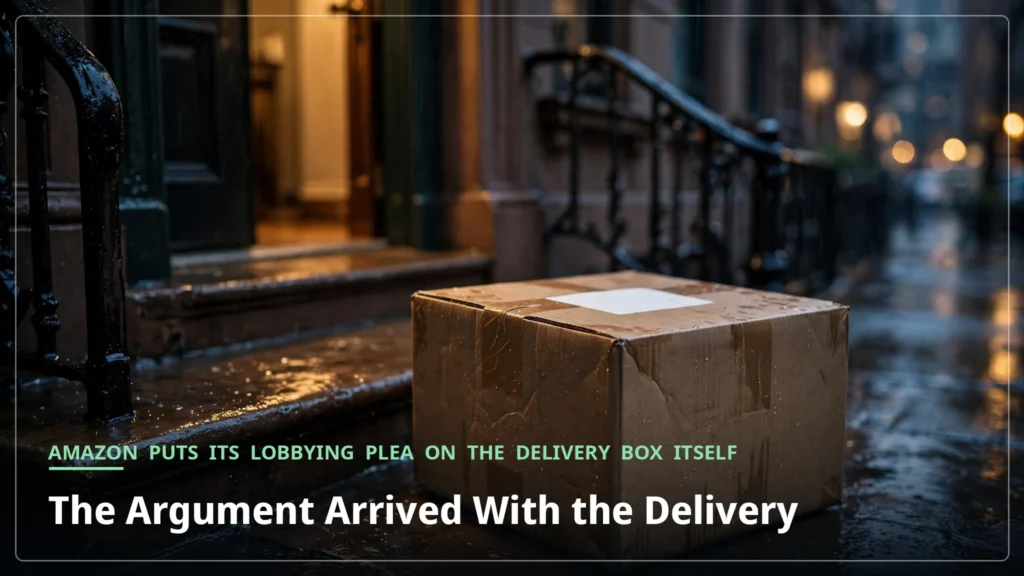
The argument arrived with the delivery. On a shipment in New York City, Amazon shipping labels say that the New York City Council could add up to $5 to any Amazon order, and invite the person who opens the box to scan a QR code and tell their council member there should be no price increases for New Yorkers. The label urges readers to act now to protect low prices.
Earlier in the same week, the company began showing notifications in its mobile app and on its website reading: “Attention NYC Council could add up to $5 per order.” The shipping-label message is almost identical. What has changed is where the wording sits. A notice in an app reaches a shopper while they are shopping. A label reaches a recipient at home, holding the thing the dispute is about. Amazon is inviting the recipients of its deliveries to press their council members against the Delivery Protection Act by putting that invitation on the packages themselves — a move that may turn deliveries made under the disputed third-party arrangements into a lobbying channel for the dispute about those arrangements. Whether it will work is a question the reporting so far does not answer.
What the bill would do, as described
The Delivery Protection Act, known as Intro 518, is sponsored by New York City Council Member Tiffany L. Cabán. According to the account in The Verge, the bill would effectively ban the third-party delivery arrangements Amazon currently uses for many packages, including small companies and independent contractors. Last-mile delivery firms operating warehouses would need to be licensed by the city and directly employ their workers.
The City of New York describes the proposal in similar terms. A city release from August 2026 says the bill would create a licensing system for certain last-mile warehouses and distribution facilities, establish new safety, training and labour standards, and hold the company operating a facility responsible for employing the workers performing core services, such as delivery.
The city’s case is about the subcontracting model. Mayor Zohran Mamdani announced his support in August 2026. The release also notes at least 18 large last-mile facilities have opened across New York City since 2017, including 11 since 2020, and cites a 2025 report from the Office of the Comptroller finding that 78% of nearby areas experienced an increase in injury-causing crashes after last-mile facilities opened.
Amazon’s case, in Amazon’s words
Amazon’s position is that the bill, if passed, would disrupt the network it uses now. The company claims it would likely mean slower and more expensive delivery for millions of customers in New York City, and it has threatened to move its warehouses outside the city. A statement on Amazon’s website, as reported, says the company works with third-party contractors for last-mile delivery and would no longer be able to work with them if the bill passes: “If this legislation passes, we’d no longer be able to work with them, and we’d be forced to consider moving our operations outside of the city.”
The $5 figure sits at the centre of that case, and it needs to be handled with care. It is Amazon’s claim, stated conditionally — the Council “could” add up to $5 per order — not a fee written into the bill in any source read for this article. No cost breakdown for the figure, and no council cost analysis answering it, appears in the reporting gathered here. Until one does, the honest form of the claim is the conditional one: Amazon says compliance could cost this much, and the other side disputes it.
Amazon also puts the dispute in terms of the small businesses in its network. An Amazon spokesperson, as reported, said the bill would threaten the livelihoods of more than 40 small delivery businesses the company works with in New York City and the more than 5,000 New Yorkers they employ. That is Amazon’s stated position; the numbers are the company’s, reported through its spokesperson. A label on its own shipment is open advocacy, but the question is whether the case printed on the box proves what it suggests.
The answer from City Hall

The answer from the city’s leadership has been blunt, and aimed at the messenger as much as the message. Labour unions, Council Speaker Julie Menin and Mayor Mamdani countered, in The Verge’s account, that Amazon was attempting to threaten New Yorkers and intimidate the City Council and was acting out of “greed,” pointing to Amazon’s market capitalisation of nearly $3 trillion. No specific union is named in that account. Menin, as reported, called the $5 warning deceptive, and said: “It defies logic that Amazon, a $3 trillion corporation, would raise New Yorkers’ cost of living if it’s forced to adhere to basic regulations and worker protections.”
Mamdani’s response was sharper still. Writing on X, as reported, he said: “Amazon is a multi-trillion dollar company. If Jeff Bezos adds $5 to your order, it’s not because of City Council’s efforts to protect workers’ rights and keep our streets safe. It’s greed.” He urged passage of the bill. The force of that reply depends on a claim the reporting does not settle either: that a large company could absorb the cost of new employment and licensing requirements without passing it on. The size of a company is not, by itself, proof of what it will charge. The supporters’ case, put fairly, is that the requirements address who employs the driver — and a conditional price claim does not settle the cost.
A bill that may already be changing
There is a further reason to keep the story conditional. Transport Topics, citing people with knowledge of the matter, reports that lawmakers are considering replacing the direct-hire mandate with a menu of options: direct employment, use of carriers such as UPS or the United States Postal Service, or contracting with fully independent operators, with city licensing and oversight continuing. A vote could come within a few weeks if an agreement is reached. That is reported discussion, not a confirmed amendment. The Verge article gives no vote, enactment or effective date, and describes the bill conditionally, as “if passed.” The label cannot tell the recipient which version is under discussion.
What Amazon shipping labels do not say
What remains unknown is considerable. How widely are the labels being used, and on which shipments? How many recipients scan the QR code, contact a council member, or do anything at all in response? Does that outreach affect how the Council handles the bill? The reporting gathered here answers none of those questions. Nor does it establish, from the bill text itself, every requirement beyond the summary of licensing and direct employment, or the basis on which Amazon reached $5 per order.
Those gaps matter because the mechanism at the centre of this story depends on them. The label works, if it works, by addressing the recipient in two roles at once: as a customer receiving a delivery, and as a constituent able to contact a council member. That dual address is an interpretation drawn from the label’s own wording — not a measured fact about how recipients read it. A package can carry an invitation without carrying a conversion.
For now, the label campaign’s effect remains unmeasured, and the bill’s final form and timetable remain open. The argument arrived with the delivery. Whether the delivery of the argument changes anything is still, properly, a question.