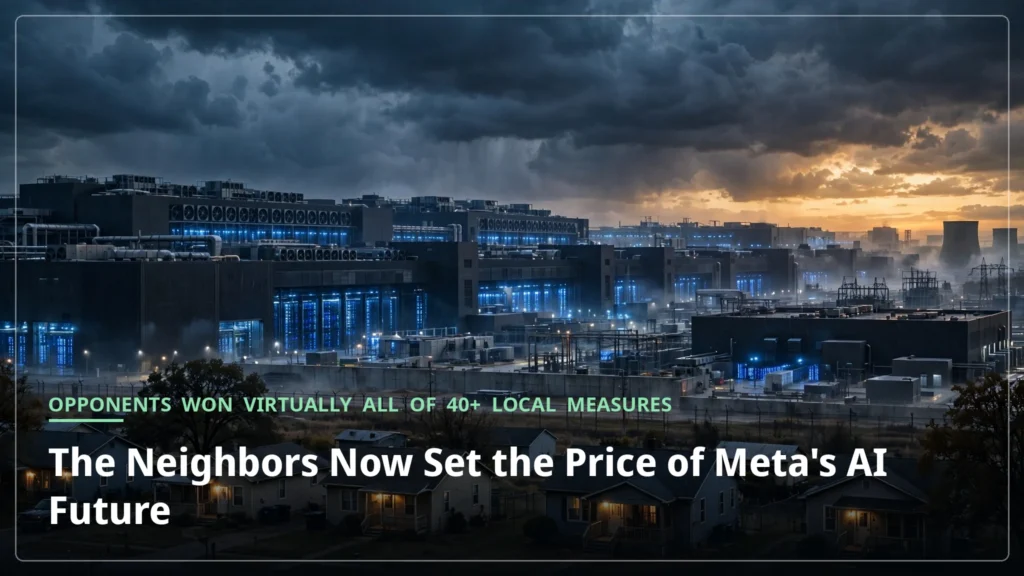



Meta’s president stood on a stage this week and put the tech industry’s new political problem in plain words: the Meta data center backlash has made its future harder to build.
Dina Powell McCormick, speaking at the Wall Street Journal Tech conference, said the Democratic wins in the midterm elections are going to make it a lot harder for companies to build data centers. The industry, she added, has “not done as good a job as we needed to explain the benefits of these investments.”
It was a striking admission from a company that has spent two decades building data centers, now operates them in 23 states, and has five more planned as projects of one gigawatt or more, including one in Texas. Meta has pinned its hopes on its AI investments. Its consumer AI agent, Muse, has more than 10 million users today, and Meta aims to scale it into a business that serves billions. The concrete is already poured. The question now is whether anyone will let the company pour more of it.
More than forty votes, one win

The numbers behind Powell McCormick’s warning are brutal. Voters in localities across ten states decided more than 40 ballot measures on data centers on Tuesday. Opponents of the facilities won virtually all of them. The only place data centers prevailed, according to Route Fifty’s tally, was Harwood, North Dakota — where voters rejected a charter amendment that would have required an independent review and public hearing before large industrial projects could be adopted.
Ohio was the center of the fight. In Trenton, a ballot measure capping data center capacity at 25 megawatts passed with nearly 80 percent of the vote. Eighteen other Ohio municipalities posted similar results. Voters in at least 29 jurisdictions passed bans or restrictions, according to a Washington Post count, and a tracker counted 37 restrictive measures passed with six more leading the morning after.
The backlash also reached the governor’s office. In Texas, Democrat Gina Hinojosa unseated incumbent Governor Greg Abbott after running on a moratorium on new data centers pending stronger utility and community protections. In Georgia, Keisha Lance Bottoms won on a pledge to pause new data center construction statewide. In Ohio, voters elected Amy Acton, who supports a conditional moratorium on new projects, and sent Sherrod Brown back to the U.S. Senate.
And this was not a protest that arrived on election night. More than 125 local moratoriums on data centers had already been adopted by September. A tracking poll cited by New Street Research found public opposition to data centers rising from 42 percent in August 2025 to 75 percent in August 2026. NBC’s exit polls found 56 percent of voters called AI and data centers a crucial or major factor in their vote; of those, 64 percent voted Democratic.
The visible manifestation of the Meta data center backlash
What makes this backlash different from every other argument about AI is that it has an address. Powell McCormick put it precisely: “The visible sort of manifestation of AI is a data center, and it’s something that people can say, ‘I don’t want this in my community.'”
A chatbot is abstract. A gigawatt campus is a construction site, a power line, a water bill. Residents’ concerns, as Route Fifty reported, center on what data centers do to their water and power bills, and on the lack of transparency in how deals are signed between local governments and the companies seeking to build. The lack of transparency is a reported concern; the evidence does not establish it as the explanation for the anger.
Powell McCormick herself linked the two, saying there is “an underlying bigger issue, which is how people feel about AI in general.” Whether diffuse unease about AI is what turns into a local vote, a cap, a ban — or whether power, water and land use matter more — is the question the evidence leaves unresolved. What is certain is that the data center is where the argument now happens, in concrete and copper, in a field outside town.
The template: benefits for consent
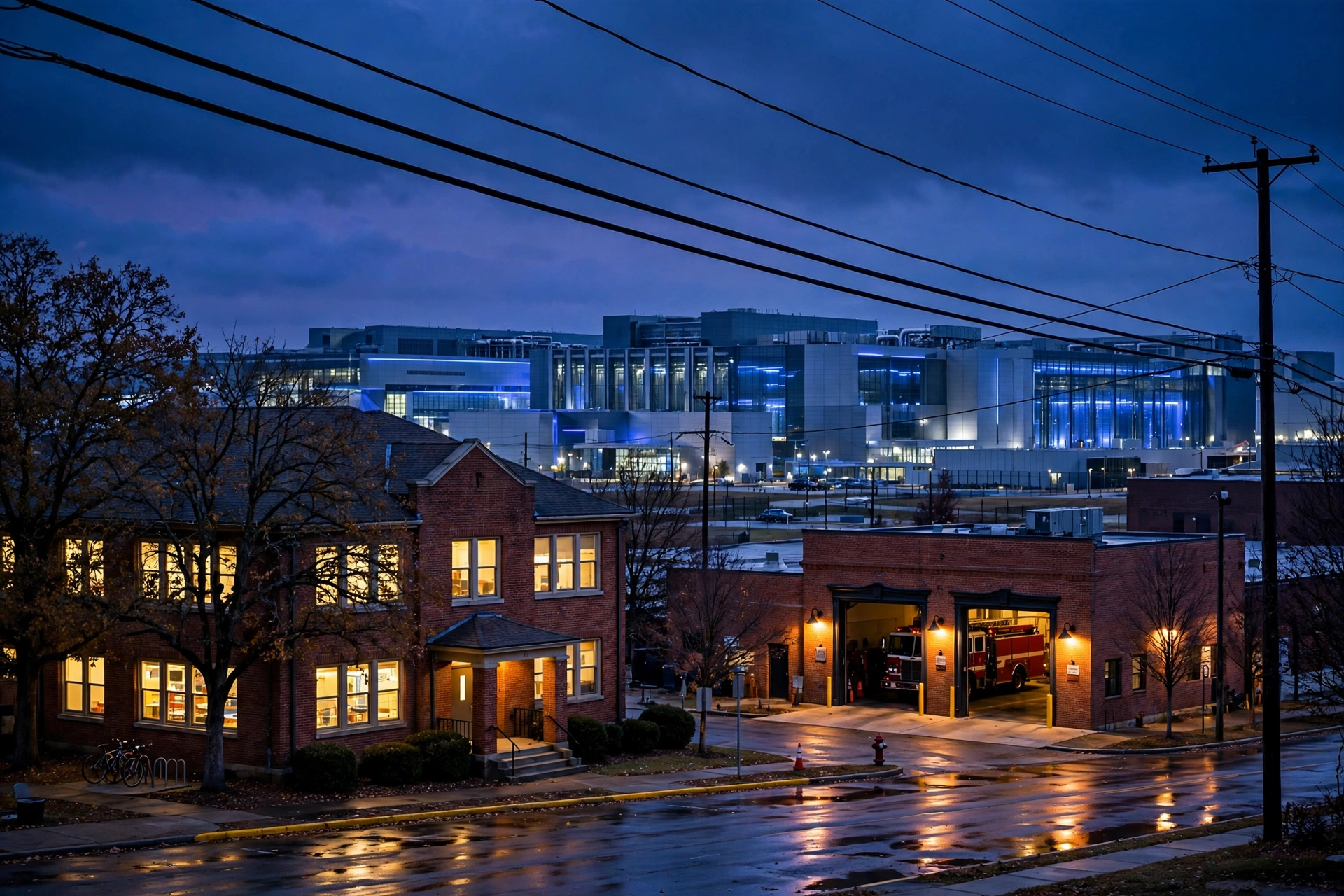
So what does Meta do about it? Powell McCormick described the approach the company now uses to close data center deals in local communities, and it reads less like a permitting strategy than a price list. Successful projects see Meta paying for its own electricity, directing any tax surpluses from the data centers toward teachers and first responders, keeping the labor force local, and getting bipartisan support for the project.
“I think it’s going to be harder,” she said. “It has been hard, I should say, but I also think that it’s becoming clear what models work, and the states want those models that work.” Going forward, she expects projects to come under more review, weighed against whether the constituents actually want them.
This is the pattern in Meta’s own account: consent is now the question every project has to answer, and the company describes its answer as a bargain — power paid for, surpluses for schools and emergency services, local jobs — offered in exchange for permission to build. The scale of the projects exposed to approval uncertainty is large. Meta’s El Paso campus alone is growing to one gigawatt, with investment now above $10 billion and more than 300 jobs promised once completed. Ohio is the target of up to $40 billion in planned AI-infrastructure investment by 2030 — a statewide figure, with no company attribution in the evidence.
The hedge
Meta, notably, is not acting like a company that believes its investments are stranded. Powell McCormick said the company believes its data center investments will not be for nothing even if the AI bet falls short, because the compute itself will be valuable. “We’re getting calls every day to lease that compute [we’ve built], and so one way or another, we’re seeing a path to monetization.”
That is a hedge worth noting, because the exposure is real. A New Street Research analysis found that local opposition blocked or delayed nearly $200 billion worth of U.S. data center projects in the first half of 2026 alone, against AI capital spending running at $690–725 billion for the year. The industry is building at a pace its neighbors have now voted, repeatedly, to slow.
And the votes are not finished. Ohio is pursuing a state-level effort to put a constitutional amendment banning new data center construction on the ballot next year.
What remains unanswered
None of this settles the question Powell McCormick’s warning raises. Her company has a template for winning consent — pay your own power, fund the teachers and the first responders, hire locally, win both parties. What no one has shown is whether the template actually wins approvals at scale. The ballot returns record rejections; they do not show whether Meta’s benefits template was offered in those places, or how it fared where it was. It is also possible the local bargains work: Meta itself says states want models that work, and if the benefits package wins approvals, the buildout may continue at pace — the approval-rate question is what decides it.
That is the uneasy shape of the story. The company building the future now has to negotiate for it, community by community, with a benefits package in one hand and a leasing business in the other. The future, it turns out, is not only a question of how much compute you can build. It is a question of how many neighbors will let you build it — and whether the bargain on offer is enough.