


A year ago, the chief executive of rival humanoid maker Figure AI looked at Agility Robotics and made a prediction in public: “You’ll be bankrupt in <12 months.”
On Thursday, Agility answered the only way a listed company can. It began trading on the Nasdaq under the ticker AGLT, the first pure-play humanoid robotics company on the American stock market.
The taunt is the fun part. The filing is the story. Agility arrives on the public market with an unglamorous record: real robots doing repetitive work in real warehouses, $174,000 of revenue in the first six months of 2026, and a $362 million loss in the same period. The question the listing poses is whether investors will pay for deployments instead of demonstrations.
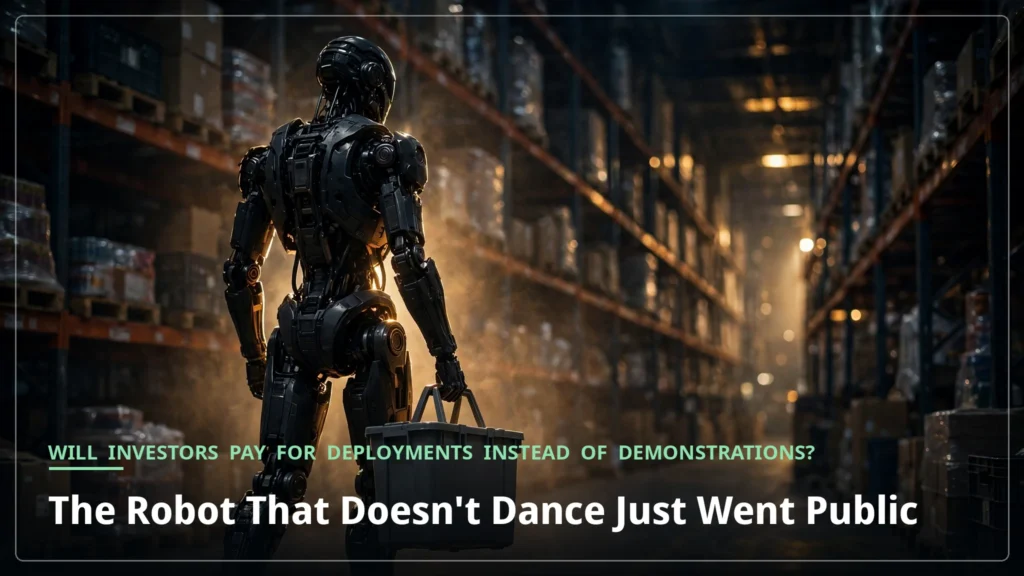
Agility Robotics: the robot that doesn’t dance
Agility is the least spectacular company in humanoid robotics, and its chief executive, Peggy Johnson, sounds almost proud of it. “You don’t see a lot of dancing robots or backflipping robots from Agility,” she told TechCrunch ahead of the debut. “We stuck to our strategy, which [are] these manual, very repetitive jobs, that it’s hard to find humans to do.”
In those deployments, Digit’s documented work is moving heavy totes. Nine customers run Digits in industrial settings, including Schaeffler, GXO, Toyota Motor Manufacturing Canada, and Mercado Libre. At a GXO logistics facility in Flowery Branch, Georgia, Digit has moved more than 100,000 totes, at about 98 percent on-task accuracy.
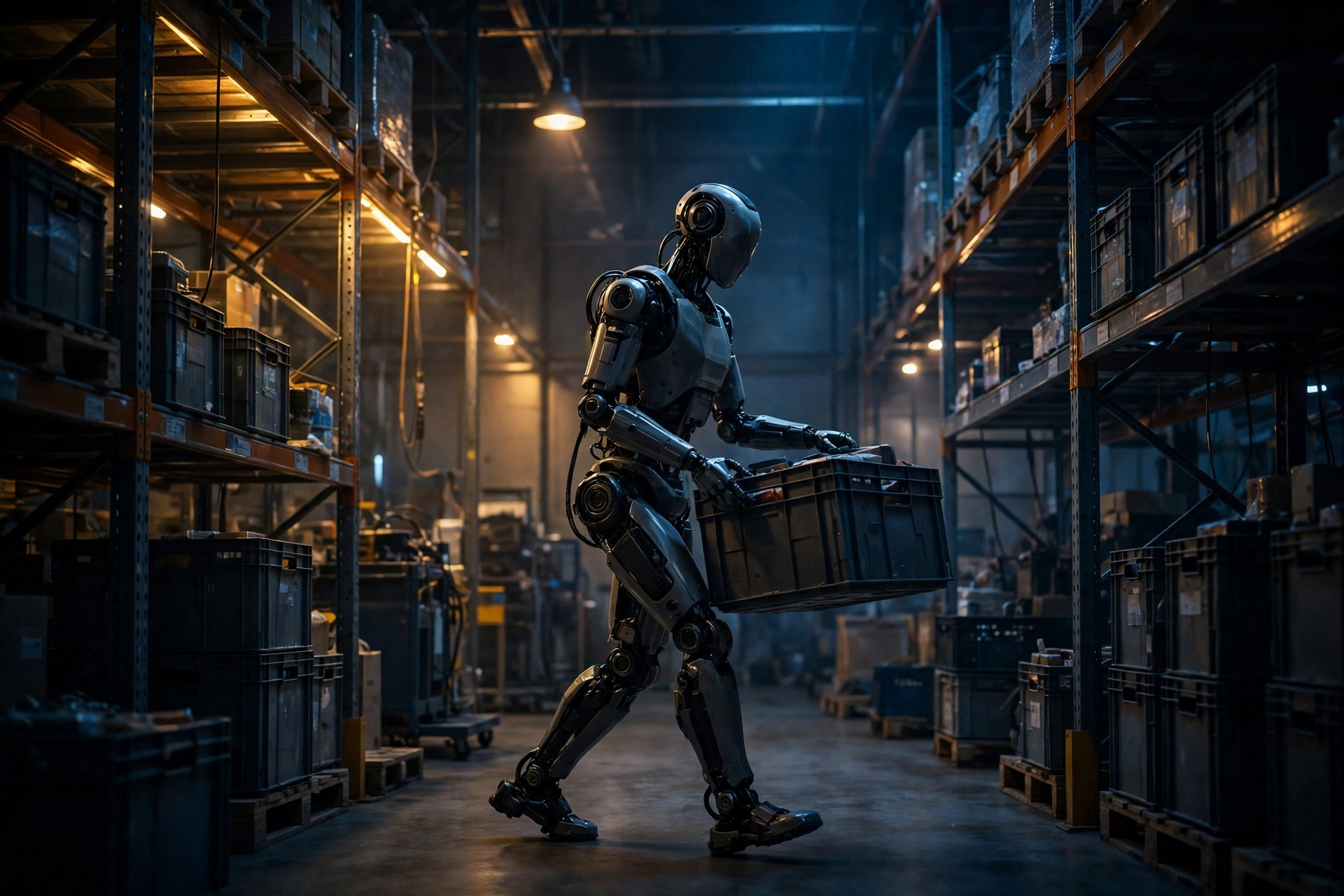
That deployment is the real credential. The GXO partnership began as a pilot in late 2023 and converted in June 2024 into a multi-year Robots-as-a-Service agreement — described as the industry’s first commercial humanoid deployment in live operations and the first humanoid RaaS agreement. On October 26, GXO and Agility expanded the partnership to two more sites, in Statesville, North Carolina, and Lebanon, Tennessee, with operations starting in early 2027.
Agility says its robots have now logged more than 65,000 hours of real operational data from real customers in real facilities. Johnson’s argument is that this is the scarce input in the field: “There’s no internet of physical data of robot movements, and that’s why you see so many people trying to simulate the data using a variety of things, and we use all of those techniques as well.”
The numbers behind the bell
The unglamorous record comes with unglamorous numbers. Agility earned $174,000 in the first six months of 2026, mostly from related parties, and lost $362 million in the same period. In 2025, the company reported $1.8 million in revenue against an operating loss of about $138 million.
Set against that, the listing values Agility at a $2.5 billion pre-money equity valuation — roughly 1,400 times its 2025 revenue. The transaction, a reverse merger with the special purpose acquisition company Churchill Capital Corp XI, is expected to deliver about $465 million in gross proceeds: roughly $164 million from the SPAC’s trust account, a $201 million private investment led by Foxconn at $10 a share, and $100 million in equity already received.
That $465 million is less than the $620 million-plus projected when the deal was announced in June. Approximately 61.5 percent of the shell company’s Class A shares were redeemed, with those holders choosing their cash back instead of a stake in the combined company. Johnson said the capital raised would meet the company’s current needs, but she would not project that it would be enough for Agility to become self-sustaining.
The robot nobody has seen

Much of the listing’s case rests on a robot that has not yet been shown in public. Digit 5, unveiled in September 2026, is the new generation of the machine — designed, the company says, to operate safely around humans rather than in an isolated work cell. Agility reports more than $300 million in planned contracts for it, but the prototypes have not been demonstrated; the company says they will appear at CES 2027, with general availability targeted for the end of that year.
The orders come with conditions. To close the deals, Digit 5 will have to hit undisclosed targets on throughput, uptime, and the accuracy of its placements. The framing of the backlog itself is unsettled: TechCrunch reports the $300 million spans 30 customers, while coverage of the SEC filings describes a backlog of 1,000 Digit 5 units for a single undisclosed customer. The supplied evidence does not resolve the customers’ identities or whether any of them are investors.
Winning the next customer is expensive, too. A prospective customer must spend $500,000 for an on-site proof of concept before a deployment is fully scaled up; four had signed up by May 2026.
What a robot has to earn
The pitch, as Johnson tells it, is arithmetic. A Digit can save a company $100,000 a year under the robot-as-a-service model, and more if the customer buys the robot outright. The filings put numbers on that model: about $8,500 a month to rent a Digit, plus a $25,000 deployment fee, or about $200,000 to buy one, plus roughly $36,000 a year for software. The company’s own projections in the filings imagine deployment volume growing from roughly 800 units in 2027 to 25,000 by 2035. The counterargument is that revenue alone poorly describes a hardware company preparing to scale: the company has said its production facility could produce 10,000 Digit robots a year.
Whether that arithmetic works depends on Digit 5’s capabilities — how accurately it works, and how long it can run without pausing to recharge or for maintenance. The new model carries a 10-to-1 run-to-charge ratio: 90 minutes of operation followed by a 9-minute charge. Johnson gave the example of a single person lifting a 50-pound object. “Digit can do that over and over,” she said. “You don’t want to give a human that job. You want to give that to the robot.”
GXO’s own chief executive has said humanoids have not paid for themselves yet. That is the honest version of the story Agility is now telling in public: the deployments are real, the savings are still a pitch, and the gap between the two is what the next few years have to close.
The question on the ticker
Agility’s cofounder and chief technology officer, Johnathan Hurst, has a grand version of the plan. “Let’s start with the bins and the totes, and then let’s do the picking and the kitting,” he said. “And then let’s like start working on cardboard, which is really hard, and loading and unloading tractor trailers and things like that. Okay, now we’re at 100 million robots, you know? A trillion-dollar company.”
Start with the bins and the totes. That is, in the end, what Agility is asking the stock market to buy: not a backflip, not a demo, but a machine that does the same heavy, repetitive job over and over in a warehouse in Georgia — and a promise, still unproven, that the next machine will do it well enough, cheaply enough, and safely enough around people to be worth $2.5 billion.
The taunt is settled. What remains open is whether the $465 million is enough, whether the unit economics work, and whether the conditional Digit 5 contracts convert.